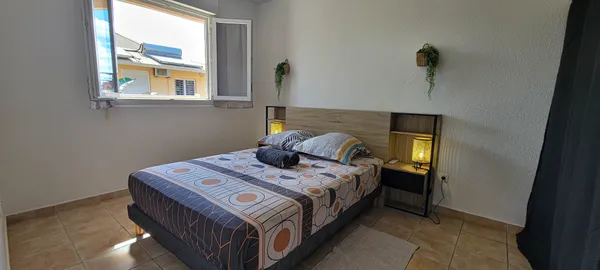

You are running a training session in Cayenne, a worksite in Kourou or an audit assignment in Saint-Laurent-du-Maroni, and you need to house one or more contractors for several days, sometimes several weeks. In French Guiana, this very practical need quickly runs into two realities: a limited hotel offering that is often fully booked during peak periods, and administrative constraints (invoice in the company’s name, VAT, expense claims, payment by bank transfer) that standard peer-to-peer holiday rentals cannot always handle.
Serviced accommodation (the French “para-hôtelier” model) offers a response tailored to this professional context: the comfort of an entire home (kitchen, workspace, washing machine) combined with a clean administrative framework for the company. This guide reviews the real needs of trainers and contractors travelling in French Guiana, the documents you should insist on for compliant accounting, and how to organise a medium- or long-term stay without unpleasant surprises.
Why house your contractors in serviced accommodation rather than a hotel
A hotel remains an option for a night or two, but as soon as the assignment stretches out, its limits show. A trainer staying ten days in Cayenne, an engineer deployed for three weeks on a worksite in Kourou or a consultant on a long assignment appreciates coming home to a real living space rather than a room.
Serviced accommodation means a furnished property let with hotel-style services (linen, cleaning, welcome) but within a setup designed for longer stays. In practical terms, that changes a great deal day to day:
- A fully equipped kitchen: the contractor can cook their own meals, which sharply reduces the catering line on the expense claim and suits dietary requirements.
- A workspace: a table, a good connection, and the quiet needed to prepare a session or work through files in the evening.
- Household linen and cleaning: sheets, towels and upkeep included or scheduled, with nothing for the contractor to arrange.
- A washing machine: essential beyond a week, especially in French Guiana’s equatorial climate.
- An entire home: genuine privacy and rest, which matters when the assignment is intense.
For the company, there is a financial benefit too: over time, the nightly cost of an entire home in serviced accommodation is generally more contained than a hotel of equivalent standing, particularly when several people need housing or each contractor needs their own room.
Climate and distances, two French Guiana realities to factor in
French Guiana is not a destination like any other. Distances are long: allow roughly 1 hour by road between Cayenne and Kourou, and often more than 2 hours 30 between Cayenne and Saint-Laurent-du-Maroni depending on traffic on the RN1. Housing the contractor as close as possible to the assignment site avoids tiring and costly daily commutes. The equatorial climate, hot and humid all year round, also makes air conditioning and a well-maintained property non-negotiable for a comfortable business stay.

The serviced-accommodation difference: clean accounting for the company
This is the point that makes all the difference for an HR department, an executive assistant or a company director. Booking with a private host through a consumer platform often leaves the company with incomplete supporting documents: no invoice in the company’s name, no VAT, just a receipt that is hard to put through the books.
A structured serviced-accommodation provider, by contrast, supplies the documents a finance department expects.
The invoice in the company’s name
The invoice is issued in the name and at the address of your company, with its SIREN/SIRET number, rather than in the contractor’s name. That is what allows the expense to be attached to the company and justified in the event of an audit. It itemises the nights, the period, the property concerned and any additional services.
VAT, under the framework applicable in French Guiana
Serviced-accommodation activity falls under a services regime (welcome, linen, cleaning, among others). In French Guiana, VAT has an important particularity: it is not applicable in the same way as in mainland France, the territory falling under a specific regime. In practice, this affects the wording that appears on the invoice. The principle to remember: ask for a clear invoice stating the VAT regime applied, and pass it to your accountant, who will rule on deductibility according to your situation. Never treat a recoverable amount as a given without validation from your chartered accountant.
Payment by bank transfer
For a company, a bank transfer is often preferable to the contractor’s personal card, which then has to be reimbursed. A professional host accepts transfers, possibly on receipt of invoice or with a deposit, which simplifies the internal approval chain and the contractor’s cash flow.
The compliant expense claim
When the company does not pay directly, the contractor fronts the cost and puts it through as an expense claim. The supporting document still has to be acceptable. A serviced-accommodation invoice in the company’s name, dated, itemised and stating the VAT regime is solid evidence, far more so than a screenshot of a booking.
Choosing the right area in French Guiana according to the assignment location
The right property starts with the right location. Here are the key points by major activity hub.
Cayenne and its urban area
Cayenne concentrates the administration, company head offices, training organisations and a large share of service-sector assignments. The city-centre districts (around the place des Palmistes), Montabo (close to the coast and several institutions) and the Zéphir area are sought after for their proximity to workplaces. Rémire-Montjoly, the neighbouring commune, offers a quiet residential setting and more spacious properties, a few minutes from Cayenne. Matoury, near Félix-Éboué airport, is practical for a contractor making repeated flights.
Kourou
Kourou largely lives to the rhythm of the Guiana Space Centre and its subcontractors. Technical, industrial and training assignments are frequent there. Staying on site avoids the daily round trip from Cayenne and puts the contractor closer to the operational sites. Demand can be strong around launch campaigns and industrial activity peaks: it is better to book early.
Saint-Laurent-du-Maroni
French Guiana’s second city, on the Maroni river at the border with Suriname, Saint-Laurent hosts assignments linked to healthcare, social services, administration and training. The offering there is more limited than in Cayenne, which makes a reliable accommodation solution that can be booked in advance all the more valuable for a stay of several days or weeks.
Organising a medium- or long-term stay
Long stays are precisely where serviced accommodation makes the most sense. For a stay of two weeks to several months (a training programme spread over time, a support assignment, a replacement posting, a worksite), several elements are negotiable.
- Sliding-scale rates: beyond a certain number of nights, a monthly rate or a long-stay package is generally possible. As a guide, the nightly cost drops appreciably once you move from a few days to several weeks, but the range depends on the property, the commune and the season.
- Cleaning frequency: on a long stay, a weekly or fortnightly clean is often scheduled rather than a daily one, which optimises the budget.
- Date flexibility: assignments shift. A professional host can generally accommodate an extension or a change of dates, subject to availability.
- Housing several contractors: depending on the case, each person is housed in a separate studio, or several people share a property with separate bedrooms, according to the company’s preference and budget.
Peak periods to anticipate
Availability varies with the season. Periods of strong economic activity, Space Centre campaigns, major events and the dry season (broadly from July to December, with strong local variation) tighten the market. Conversely, the rainy season can offer more choice. In every case, the earlier the booking, the better the choice and the rate. The seasonal guidance above is indicative and varies from year to year.