
You need to house an employee for three weeks in Cayenne, Kourou or Saint-Laurent-du-Maroni, and the question lands on your desk: hotel or aparthotel? On the first line of the quote, the hotel often looks “normal” and the furnished accommodation “off to the side.” But as soon as you add up the 21 nights, the meals eaten out for lack of a kitchen, the laundry bill and the time spent handling paperwork, the ranking almost always flips. This article lays out the real math, line by line, for a three-week business trip in French Guiana, from the perspective of a para-hotel operator who issues invoices, applies VAT and gets paid by bank transfer.
The goal isn’t to sell you a night at any price, but to give you a decision framework you can present to your finance department or your client. The figures below are indicative and serve to structure your own estimate: actual rates depend on the season, the town and the length of stay.
Why three weeks changes everything
Below three or four nights, the hotel keeps real advantages: 24/7 reception, daily housekeeping included, breakfast, no logistics. The extra cost per night dissolves into the brevity of the stay.
From two weeks on, the logic reverses. Over 21 nights, every euro of daily difference is multiplied by twenty-one. And above all, two line items explode at the hotel:
- Meals. Without a kitchen, your employee has lunch and dinner out seven days a week. In French Guiana, where dining options close early in the evening in several towns, this often means ordering in or going to a restaurant every night.
- Laundry. Three weeks of clothes means several laundry cycles billed by the kilo at the hotel, or a washing machine freely available in furnished accommodation.
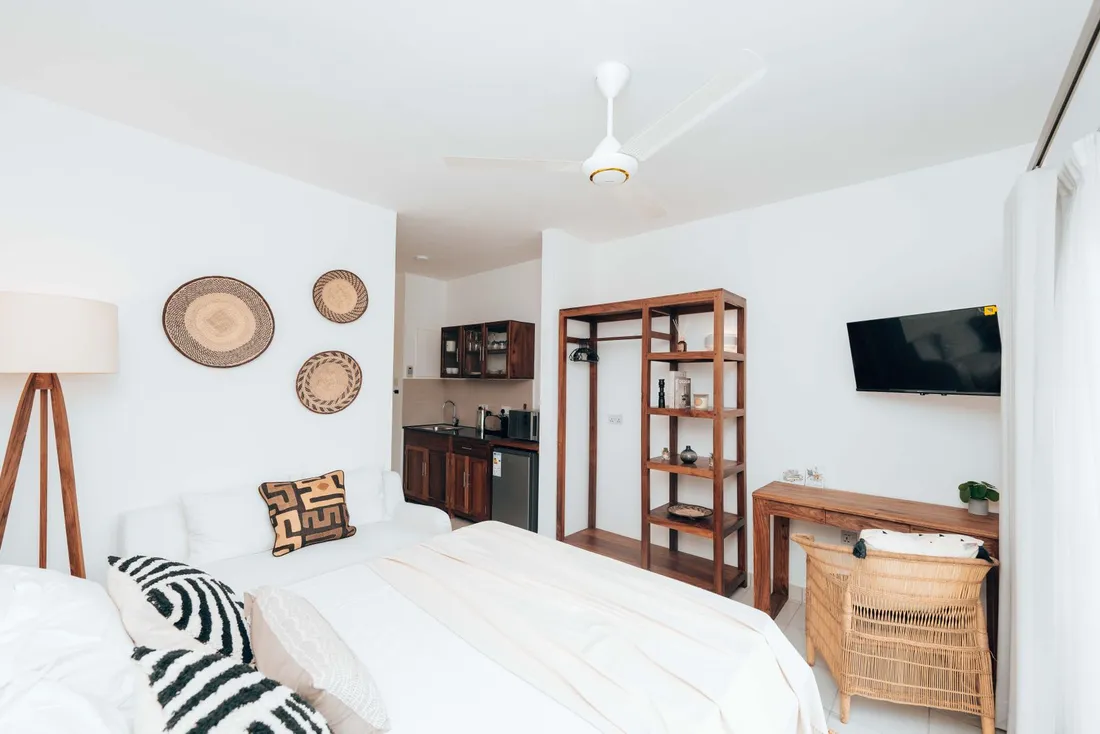
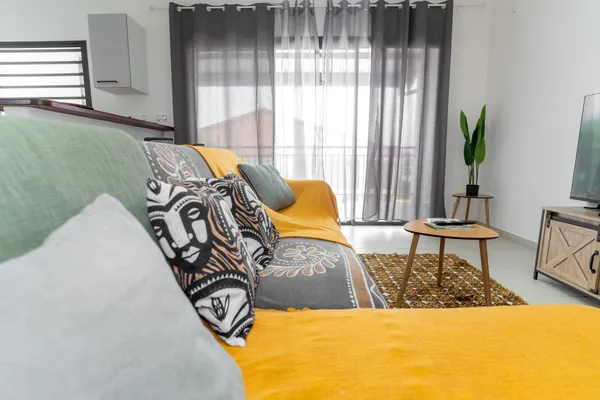
The aparthotel (or the furnished para-hotel unit) gives the traveler back an equipped kitchen, a real workspace and a washing machine. These aren’t comfort “extras”: they’re expense items you stop paying for.
The line-by-line math
Take a typical assignment: one employee, 21 nights, arriving on a Monday, leaving three weeks later. Here are the items to compare. The ranges are indicative and should be adjusted to your actual quotes.
The bare accommodation
At the hotel, a mid-range “corporate” rate in French Guiana can sometimes be negotiated, but it is still billed per night, often without a strong discount beyond a week. In furnished para-hotel accommodation, the nightly rate falls mechanically with the length of stay: a three-week stay almost always unlocks a long-stay or monthly rate well below the price of a single night.
On this item alone, the aparthotel is often already ahead for a long stay.
Meals
This is the decisive item. Estimate what two restaurant meals a day represent over 21 days, then compare it to a weekly grocery basket for someone who cooks in the evening and on weekends. The gap easily runs into hundreds of euros over three weeks.
Accommodation with a kitchen doesn’t eliminate restaurant meals — your employee will want some — but it turns a daily obligation into an occasional choice.
Laundry
- At the hotel: billing by the kilo or per item, which piles up over three weeks.
- In furnished accommodation: washing machine included, marginal cost close to zero.
Incidental costs
Parking, bottled water, coffee, snacks: so many small lines that, at the hotel, go through the minibar or the shop at marked-up prices. In equipped accommodation, they fold into the groceries.
The summary table
| Item | Hotel (3 wks) | Furnished aparthotel |
|---|---|---|
| Accommodation | Nightly rate, small discount | Sliding long-stay rate |
| Meals | 2 meals/day out | Equipped kitchen, groceries |
| Laundry | Billed by the kilo | Washing machine included |
| Workspace | Room / lobby | Separate desk + living room |
| Drinks/snacks | Marked-up minibar | Groceries |
Over a three-week stay, the furnished total regularly comes out below the hotel total once meals and laundry are included — this is precisely the “real math” that the accommodation line alone hides.
What the accountant looks at: invoice, VAT and transfer
A business trip is not judged only by the advertised price. It is also judged by its accounting compliance. This is where a structured para-hotel operator makes the difference compared with a private rental found on a platform.
A real invoice in the company’s name
To book it as an expense and on an expense report, you need a proper invoice: company name, address, SIREN/SIRET number, breakdown of services, dates of stay. A para-hotel operator issues this document natively. Conversely, a private rental often only provides a platform receipt that is hard to justify to an accounting department.
Recoverable VAT
This is the most important technical point. Para-hotel accommodation — that is, a furnished unit combined with hotel-type services (reception, provision of linen, housekeeping, breakfast or associated services) — is subject to VAT, unlike a bare rental or a “simple” furnished rental between private individuals.
In practice, this means a VAT-registered company can, under ordinary conditions, recover the VAT on the para-hotel accommodation service. Over three weeks, this is no detail: it can represent a significant share of the cost, a line you generally cannot recover on a rental from a non-registered private individual.
Recovery rules depend on your tax situation and the exact nature of the services. Always have this validated by your accountant. But the key point is knowing that para-hotel opens this possibility, where a private individual’s furnished rental does not.
Payment by bank transfer
An accounting department much prefers to settle by bank transfer to a professional account, with a reconciled invoice, rather than by the employee’s personal card to be advanced then reimbursed. A para-hotel operator accepts company transfers and aligns the schedule with your usual payment terms.
The expense report, without friction
For the employee on assignment, the difference is very concrete. Here is the checklist so that the stay doesn’t become an administrative headache upon return:
- Invoice in the company’s name, received by email
- Breakdown of the stay dates and the nature of the service
- Mention of VAT if applicable
- Proof of payment (reconciled transfer or receipt)
- Operator’s contact details in case the accounting department has questions
With a furnished para-hotel unit, these items are provided from the outset. The employee advances nothing if it is settled by company transfer, and the accounting department has a complete file. It is a real time saving, hard to quantify but very real, often absent from informal rentals.
Comfort and productivity on a long assignment
Three weeks away from home is long. Comfort isn’t a luxury: it’s a factor of productivity and retention. A poorly housed employee comes home sooner, works less well, or turns down the next assignment.
What furnished accommodation brings on a long stay:
- A workspace separate from the sleeping area, with a real table and a connection — precious when part of the work is done remotely.
- The ability to cook, and therefore to eat better and control one’s rhythm, especially in French Guiana where dining hours are more constrained than in mainland France.
- Space: a living room, storage, enough to live three weeks without feeling shut in a bedroom.
- The quiet of a residential neighborhood rather than the traffic of a hotel lobby.