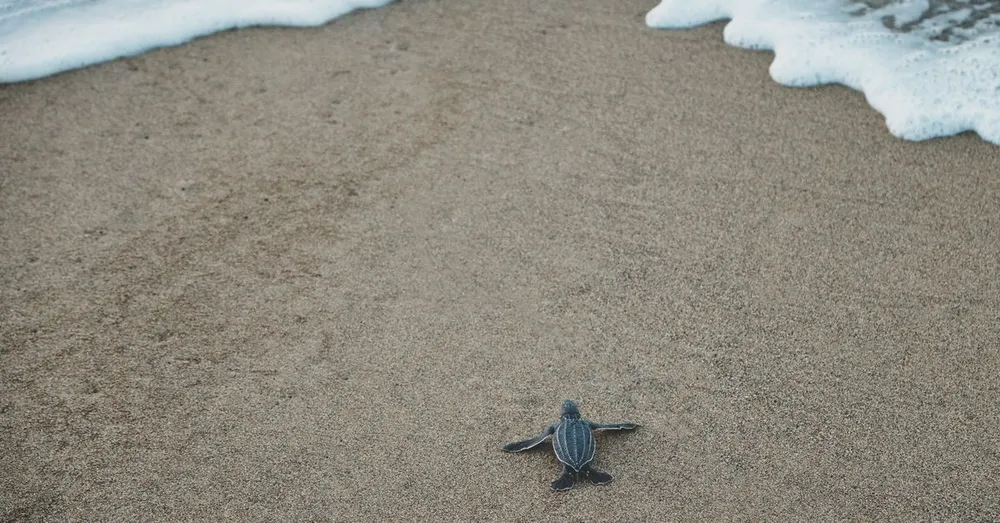
At the far western edge of French Guiana, where the Maroni River meets the Atlantic across from Suriname, lies a town unlike any other in the territory: Awala-Yalimapo. The youngest municipality in French Guiana (created in 1989, after separating from Mana), it is also the only one with official recognition as an Amerindian territory. Here, Kali’na culture is alive, the sea deposits ocean giants on the sand every year, and the rhythm of life bears no resemblance to the bustle of Cayenne. For anyone visiting French Guiana, it offers one of the most unfamiliar and authentic experiences imaginable.
Awala-Yalimapo, land of the Kali’na people
A unique Amerindian town
Awala-Yalimapo brings together two villages, Awala and Yalimapo, populated mainly by the Kali’na (or Galibi), one of the six Amerindian peoples of French Guiana. It is the only French municipality whose population is overwhelmingly indigenous, and its town council has long been led by elected officials from the community. This singularity is felt everywhere: in the language spoken day to day (Kali’na is one of the Amerindian languages officially recognised in French Guiana), in the organisation of the village around family carbets, and in a relationship with the river and the sea passed down from generation to generation.
Visiting Awala-Yalimapo is not about ticking a tourist box: it is about being welcomed into someone’s home. Respect for the place, the people and the customs is essential here. You ask before photographing, you park where indicated, and you adopt the gentle pace of the place.
Craftsmanship, basketry and inherited skills
Kali’na material culture is revealed through remarkable craftsmanship. Basketry made from arouman (a woven plant fibre) gives rise to baskets, cassava strainers (the famous “matapi”) and decorative objects with codified geometric patterns. You will also find pottery, hammocks and colourful beadwork. Buying directly from the artisan supports the local economy and lets you leave with a truly one-of-a-kind piece.
A few points of reference to soak up the culture:
- The carbet and village life: observe the traditional architecture, open to the outside, adapted to the equatorial climate.
- The cuisine: cassava flatbread (cassave), cachiri (a fermented manioc-based drink, sometimes served during festivals), river fish.
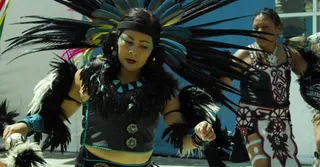
- Traditional festivals, such as the Épékodono funeral ritual or seasonal celebrations, which are not to be visited as a spectator but to be respected.
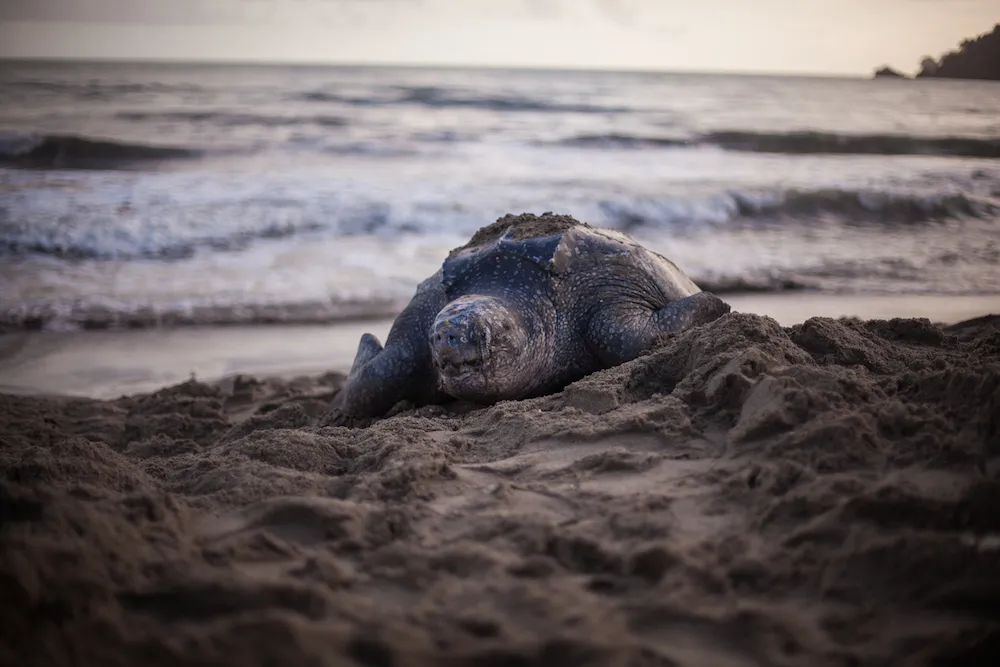
Leatherback turtles, giants of Les Hattes beach
A nesting site of global importance
Les Hattes beach (Yalimapo) is one of the most important nesting sites in the world for the leatherback turtle (Dermochelys coriacea), the largest marine reptile on the planet: up to 2 metres long and over 500 kg. Each female comes ashore at night, digs her nest and lays around a hundred eggs before returning to the ocean. The sight, in the darkness, of a turtle weighing several hundred kilos ploughing through the sand is one of the most moving that nature offers in French Guiana.
You may also encounter the green turtle and the olive ridley turtle, depending on the season. The entire coastline is protected within the Amana Nature Reserve, which watches over these endangered species.
When and how to observe the turtles
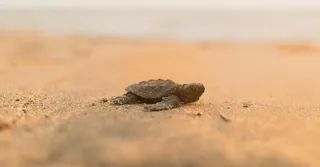
The nesting season generally runs from April to July, with a peak usually between May and June for leatherbacks. The hatchings mostly occur from July to September, when dozens of baby turtles head out to the ocean at dusk.
A few golden rules for responsible observation:
- No white light: torches and flashes disorient the turtles. Use only a red-light lamp, or follow the guides’ instructions.
- Keep your distance and stay behind the animal, never in front of its head.
- Silence and patience: a nesting can take more than an hour.
- Choose a guided outing led by the reserve or a local association, which guarantees that the protocol is respected and enriches the experience.
Observation is free on the public beach, but a guided outing (usually expect a few dozen euros) is strongly recommended to understand what you are seeing and to avoid harming the animals.
Planning your visit to Awala-Yalimapo
How to get there
Awala-Yalimapo sits at the far western end of the coastline, near the mouth of the Maroni. A car is essential in French Guiana, and even more so here. A few realistic distances and travel times:
- From Saint-Laurent-du-Maroni: about 50 km, or 1 hour of driving via Mana.
- From Cayenne: about 250 km, allow 3.5 to 4 hours of driving (a chance to discover Saint-Laurent and its Transportation Camp along the way).
- From Félix-Éboué airport (Matoury): plan for a full day if you go straight through.
The main road (RN1) is paved and in good condition as far as Mana, then a secondary road leads to the villages.
The best time to combine culture and turtles
The dry season, from mid-July to mid-November, offers the most comfortable conditions for getting around and enjoying the coast. For the turtles, the ideal window combines the end of the rainy season and the start of the dry season: June to August often lets you observe both late nestings and the first hatchings. This is also why many travellers plan their western trip around this window.
Essential practical tips
- Yellow fever vaccination is mandatory to enter French Guiana.
- Mosquito protection is indispensable, especially at dusk on the beach.
- Currency: the euro (French Guiana is a French overseas department).
- Time difference: -5h in winter, -6h in summer compared to Paris.
- Dialling code: +594.
- Respect for the territory: ask before photographing people, and find out about freely accessible areas.
What to do nearby?
Awala-Yalimapo pairs ideally with western French Guiana. On site or nearby, you can:
- Explore Saint-Laurent-du-Maroni and the penal colony (Transportation Camp).
- Travel up the Maroni River by pirogue to meet the Bushinengue and Amerindian villages.
- Discover the rice paddies of Mana and the savannah landscapes.
- On a longer stay, push on towards the Guiana Space Centre in Kourou (free tour, Ariane 6 and Vega launches) or the Salvation Islands.
To plan your whole itinerary, our complete guide to French Guiana details must-sees, seasons and logistics.
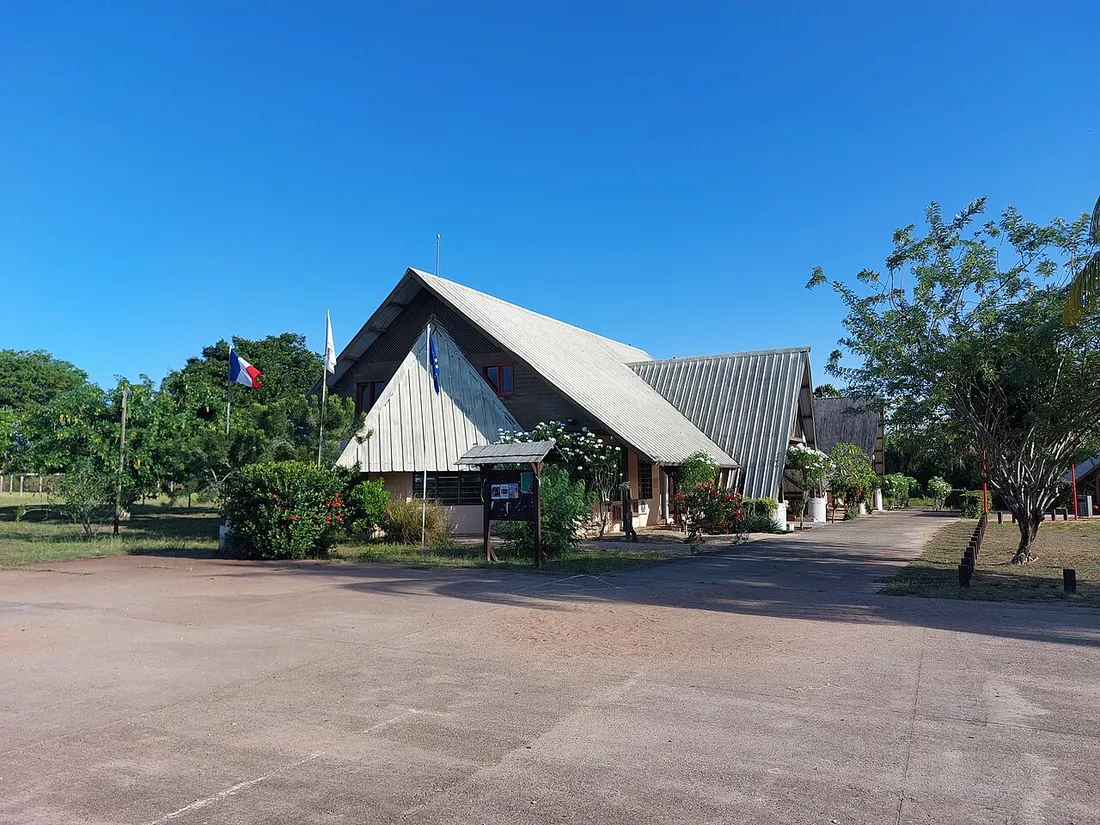
Where to stay to explore the West
Awala-Yalimapo can be experienced in a few hours to a day, but the West deserves several days. Many travellers choose to set down their bags in Saint-Laurent-du-Maroni or in the eastern towns (Cayenne, Rémire-Montjoly, Matoury) depending on their route, then explore from there.
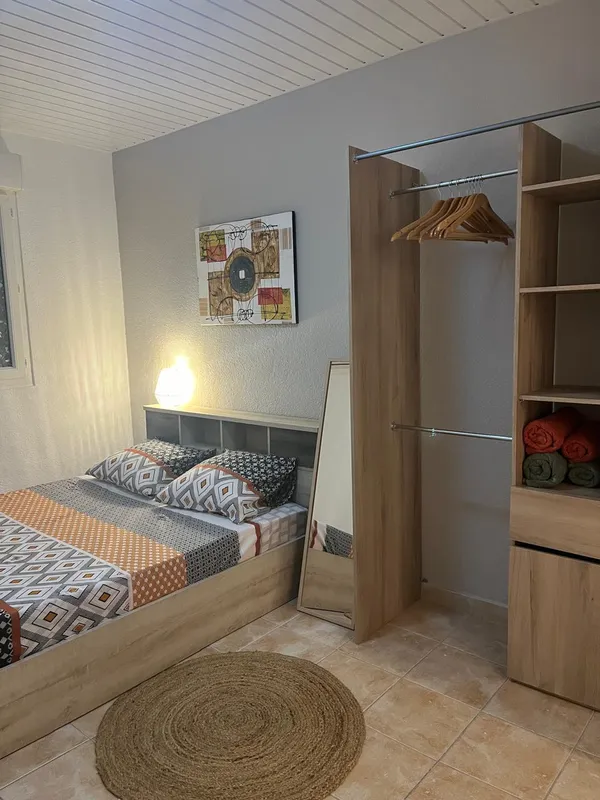
At Hostel Toucan, we offer accommodation through seasonal rentals in French Guiana designed for explorers: direct booking with no platform fees, free cancellation up to 7 days before arrival, and WhatsApp assistance 7 days a week to advise you on your routes, the tide schedules for the turtles or the best local pirogue operator. Whether you come to watch the leatherbacks in June or follow it up with an Ariane launch, we help you build a seamless stay.
Do you own a property in French Guiana and want to make the most of it with respectful travellers? Discover our concierge service dedicated to owners.
Awala-Yalimapo is not a destination you pass through: it is an encounter, with a people, a language, and ocean giants that return each year to the same sand. As long as you come with respect and curiosity, it is one of the most beautiful chapters French Guiana can offer you.
FAQ
What is the best time to see leatherback turtles in Awala-Yalimapo?
The leatherback turtle nesting season runs mainly from April to July, with a peak in May-June. The hatchings take place mostly from July to September. The June-August window often lets you observe both late nestings and the first hatchings, while also enjoying the start of the dry season.
How do I get to Awala-Yalimapo from Cayenne?
Allow about 250 km and 3.5 to 4 hours of driving from Cayenne, passing through Saint-Laurent-du-Maroni and then Mana. From Saint-Laurent, only about fifty kilometres remain, or roughly 1 hour. A car is essential in French Guiana to reach this town in the West.
Can you visit the Kali’na village freely?
Yes, but Awala-Yalimapo is an inhabited Amerindian territory, not a tourist site. You come with respect: ask before photographing people, park in the indicated spots and respect the traditional festivals. Buying craftwork directly from the basket makers supports the local community.
Is turtle observation regulated?
Yes. The coastline is protected by the Amana Nature Reserve. It is forbidden to shine white light or a flash on the turtles, to position yourself in front of their head, or to touch them. A guided outing led by the reserve or a local association is strongly recommended in order to respect the protocol.