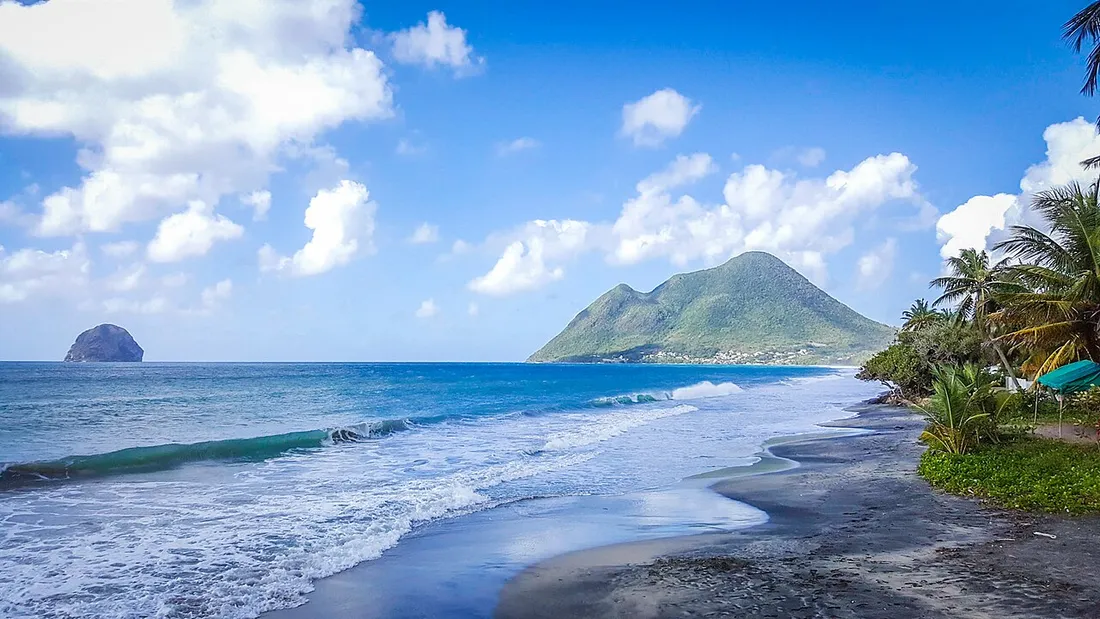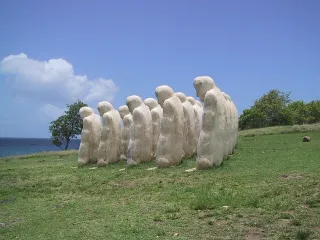
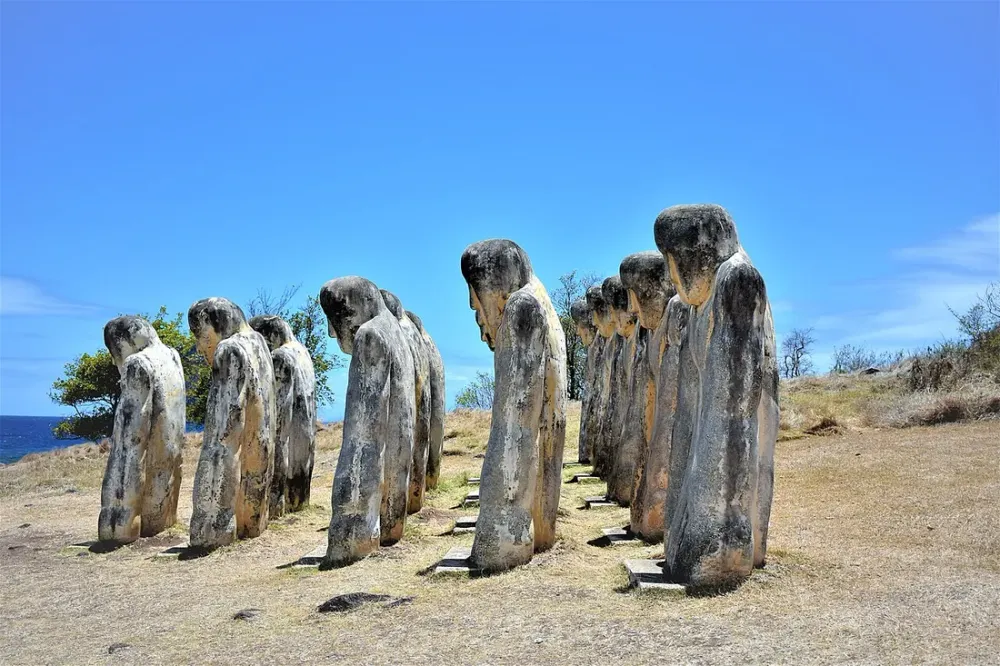
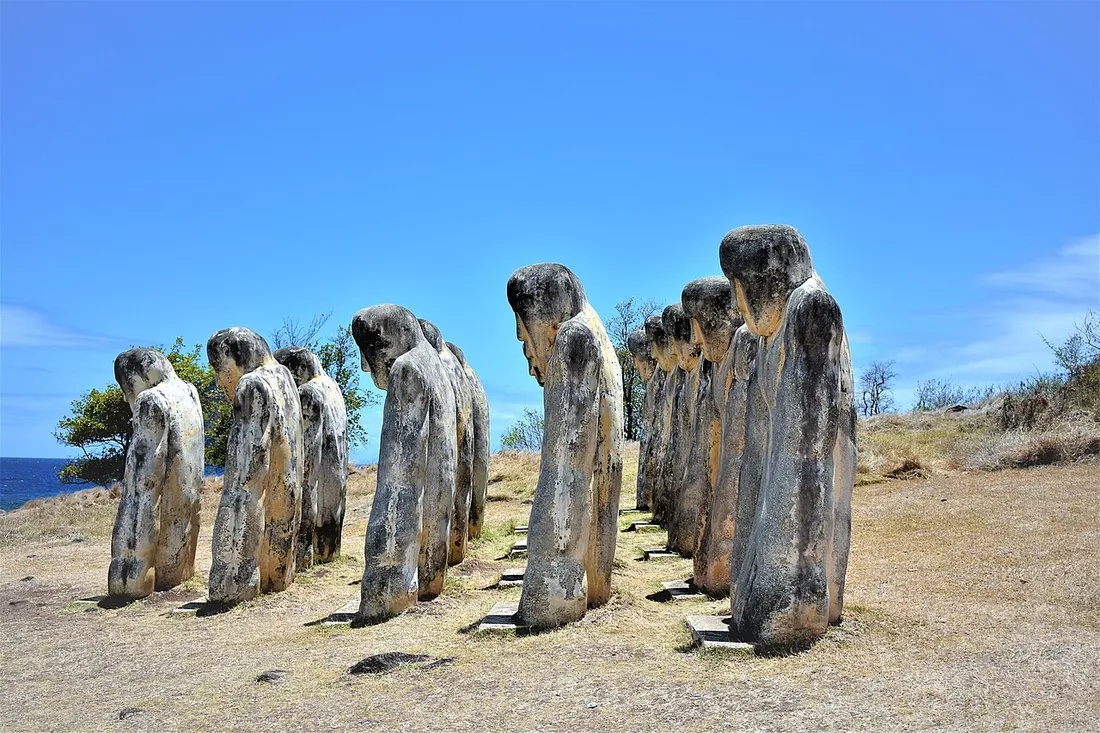
There are places you visit, and others you feel. The Cap 110 Memorial, set on the close-cropped grass of Anse Caffard at the western tip of Le Diamant, belongs to the second kind. Fifteen white concrete figures, heads bowed, lined up facing the ocean, in the rustle of the trade winds and with the Diamond Rock sitting on the horizon: the first time you come upon this scene, you lower your voice and linger far longer than planned. After years of bringing my guests here, I remain convinced it’s the finest distillation of southern Martinique. Here is my field guide to experiencing the site, its coastal trail and the long Diamant beach right next door.
The Cap 110 Memorial: fifteen statues turned toward the open sea
The Cap 110 Memorial is a work by Martinican artist Laurent Valère, unveiled in 1998 for the 150th anniversary of the abolition of slavery. Fifteen monumental busts, around two and a half metres tall, are arranged in a triangle and oriented toward the 110-degree heading — toward the Gulf of Guinea from which the slave ships set out, hence the name of the ensemble.
The history the statues carry
The memorial honours the victims of a shipwreck that occurred on the night of 8 to 9 April 1830, below the cliffs of Anse Caffard. A vessel loaded with captives smashed against them at a time when the slave trade was already officially banned: it was therefore a clandestine ship, and many of the people chained on board perished. The grave faces and the gaze strained toward the horizon convey mourning and waiting. You quickly understand why the place commands silence: it is not a backdrop, it is an open-air memorial stone.
My practical tips for the visit
- Access and price: the site is outdoors, open and free, accessible year-round, with no set hours or ticket office. Free parking is just below, along the D37.
- Duration: allow 30 to 45 minutes, more if you read the information panels.
- Best time: aim for late afternoon, around 4–5:30 pm, when the golden light enhances the white concrete and the sun sets behind the Rock. Early in the morning or on a weekday, you’ll have the site almost to yourself, away from the cruise-ship coaches.
- Respect for the site: this is a memorial, not a selfie backdrop. Decent dress and behaviour are expected, and you do not climb on the statues.
From the small viewpoint nearby, a panel tells the area’s other legend: in the early 19th century, the British had fortified the Diamond Rock and registered it as a fictional warship, “HMS Diamond Rock.” This 175-metre volcanic spire, about 2 km off the coast, is today a reserve where no landing is permitted.
The Anse Caffard coastal trail
Many visitors leave right after the statues. That’s a shame: Anse Caffard continues with a pleasant coastal trail that follows the rocky shore and offers, to my mind, the finest views of the Diamond Rock.
What the walk is like
- Distance: a short loop of 1.5 to 2.5 km from the memorial car park.
- Duration: 45 minutes to 1h15 at a leisurely pace, photo stops included.
- Profile: flat to rolling, on earth and volcanic rock; a few sections near the edge call for attention.
- Level: easy, family-friendly. This is not the climb up the neighbouring Morne Larcher, which is far more demanding.
The path crosses a dry forest typical of the south — candle cacti, lignum vitae, seaside grapes — and opens onto rocky outcrops swept by the spray. The contrast between the blue of the open sea, the black of the rock and the white of the statues set back remains one of my favourite images of Martinique.
What to bring
- Closed shoes or good walking sandals: the volcanic rock is sharp and slippery in places.
- Water (at least 75 cl per person): there is no water point along the way.
- Hat, sunglasses and sunscreen: shade is rare on this coastline exposed to the trade winds.
Avoid the trail just after heavy rain, when the red earth turns muddy, and never get too close to the edge in a strong swell: the sea quickly reclaims its rights.
Diamant beach, a stone’s throw from the memorial
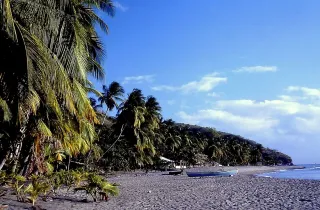
A few minutes’ drive to the east, Diamant beach begins. With its more than 3 km of pale sand facing the Rock, it’s one of the longest beaches on the island, vast and windy, ideal for walking at the water’s edge, watching the surfers and closing the day at sunset.
Swimming, wind and safety
- Swimming: possible but cautious. The beach is exposed to the trade winds and a rip current can set in depending on the swell; stay close to shore and give up in rough seas. For a calm family swim, head instead to Pointe Marin in Sainte-Anne or the Anses-d’Arlet.
- Sargassum: facing the Caribbean side, the beach is generally spared, unlike the Atlantic beaches on the east of the island.
- Services: a few food trucks and lolos line the road, with simple Creole cuisine at €12–25 a dish and €5 to €8 for a fresh juice or a ti-punch.
The sequence for a perfect half-day
To link it all without driving back and forth, start around 4 pm with the Cap 110 Memorial, continue onto the coastal trail loop, then drop down to Diamant beach around 5:30 pm for sunset, before dinner at a lolo in the village.