

The Guadeloupe-France time difference is one of the first questions travellers ask me when they book a place with us. And it’s a fair one: between calls to family back in mainland France, the odd day of remote work and the fatigue of an 8-hour flight, mishandling those 5 or 6 hours of difference can spoil your first three days of holiday. Good news: the direction of the shift works in your favour on the way out. After several years welcoming travellers in Sainte-Anne, Le Gosier and Deshaies, here’s everything you need to know to arrive fresh and enjoy yourself from the very first sunset.
What time is it in Guadeloupe compared to mainland France?
Guadeloupe runs on Atlantic time: UTC-4, all year round. Unlike mainland France, the archipelago never changes its clocks. The direct consequence is that the time difference varies with the season in France:
- From late October to late March (winter time in mainland France): Guadeloupe is 5 hours behind Paris. When it’s noon in Paris, it’s 7 a.m. in Pointe-à-Pitre.
- From late March to late October (summer time in mainland France): the gap widens to 6 hours. Noon in Paris = 6 a.m. in Guadeloupe.
A simple rule of thumb I always give our travellers: during the dry season (December to April, the best time to come), remember “Paris - 5h”. For a July-August stay, remember “Paris - 6h”.
Why doesn’t Guadeloupe change its clocks?
In the tropics, the length of the day barely varies over the year. Here, the sun rises between 5:30 and 6:15 a.m. and sets between 5:30 and 6:45 p.m., summer and winter alike. Daylight saving time would bring no energy benefit. It’s actually something that surprises many people: in Guadeloupe, night falls early and fast, around 6 p.m. in December. Plan your hikes up La Soufrière or to the Carbet Falls for the morning, never the late afternoon.

Guadeloupe-France time: the concrete impact on your stay
Calling family and managing remote work
This is the real day-to-day issue. With 5 to 6 hours behind the mainland, here are the windows that work:
- To call France: between 7 a.m. and 2 p.m. local time (that’s 12-7 p.m. or 1-8 p.m. in Paris). After 3 p.m. in Guadeloupe, your loved ones in the mainland are sitting down to dinner or heading to bed.
- To be called without being woken up: ask your family not to call before 1 p.m. Paris time, otherwise the phone will ring at 7 a.m. during your lie-in.
- For remote workers: a meeting set for 2 p.m. Paris time falls at 8 or 9 a.m. local time. It’s actually very comfortable: you work in the cool of the morning and have Caravelle beach in Sainte-Anne all to yourself from 1 p.m. Many of our long-stay travellers organise their entire trip this way.
A practical note: the Guadeloupe dialling code is +590, but almost all mainland phone plans include calls and data in the French overseas departments at no extra cost (Guadeloupe is a French department — just check your contract before you leave).
Flight times, your best ally
The direction of travel changes everything. Flights from Paris to Pointe-à-Pitre (Pôle Caraïbes airport) generally take off between 10 a.m. and 2 p.m. from the mainland and last about 8h30. Thanks to the time difference, you land between 1 and 4 p.m. local time: you still have a full afternoon to pick up your rental car (budget €30 to €45/day in the dry season), reach your accommodation and dive into the sea before sunset.
On the way back, it’s the opposite: take-off around 5-7 p.m. local time, an overnight flight shortened by the time difference, landing in Paris between 7 and 9 a.m. It’s that return that tires you out the most — more on this below.
On the budget side, expect €450 to €700 return when booking 3 to 4 months ahead outside school holidays, and easily €900 to €1,200 in the thick of February or over the holiday season.
Guadeloupe jet lag: our field-tested tips for adjusting
On the way out: the “easy” time shift
Travelling west is physiologically simpler: your day lengthens instead of shortening. In practice, you’ll feel sleepy around 8-9 p.m. local time the first few evenings (that’s 1-2 a.m. for your body clock) and you’ll wake up around 4:30-5:30 a.m. Rather than fighting it, make the most of this rhythm:
- Day 1: don’t nap on arrival. A swim, a light dinner around 7 p.m. (a bokit or some accras, not a heavy colombo), bed by 9 p.m.
- Days 2-3: enjoy those dawn wake-ups. This is THE magical moment in Guadeloupe: sunrise over Pointe des Châteaux, deserted beaches, mild temperatures. The locals live by early hours — do as they do.
- Get morning light and avoid screens after 8 p.m.: your body clock will reset within 2 to 3 days at most for a 5-6h westward shift.
Making the most of the shifted rhythm to sightsee smartly
This natural early wake-up is a strategic advantage I recommend exploiting to the full during your first week:
- La Soufrière (1,467 m): set off from the Bains Jaunes car park at 7 a.m. and you’ll climb before the clouds cap the volcano from 10 a.m.
- Cousteau Reserve at Malendure (Bouillante): the 8 a.m. snorkelling trips out to the Pigeon Islets offer the best visibility and the fewest people (around €25-35 for the boat trip, €50-60 for an intro dive).
- Pointe-à-Pitre or Le Moule market: the atmosphere peaks between 6:30 and 9 a.m.
- Crossing to Les Saintes: the first ferries leave Trois-Rivières around 8 a.m. (roughly €25-28 return) — arrive on Terre-de-Haut before the day-trippers.
To build a complete itinerary between Grande-Terre and Basse-Terre, see our Guadeloupe guide, which breaks down both wings of the butterfly day by day.
On the way back: the real jet lag to anticipate
The eastward return is harsher: you “lose” 5 to 6 hours and the overnight flight lasts barely 7h30, often without any real sleep. My resident’s tips, validated by dozens of round trips:
- For the last 2-3 days on the island, shift gradually: go to bed at 10-11 p.m. instead of 9 p.m., get up at 7 a.m. instead of 5:30.
- On the plane, eat early, then on with the eye mask and earplugs as soon as the lights go out. Even 3-4 hours of sleep make all the difference.
- On arrival in Paris in the morning, hold out until evening without a nap (or 20 minutes maximum). Daylight, walking, coffee before 2 p.m. only.
- If you can, don’t go straight back to work the same day: landing on a Saturday morning and starting back on the Monday is the ideal scenario.
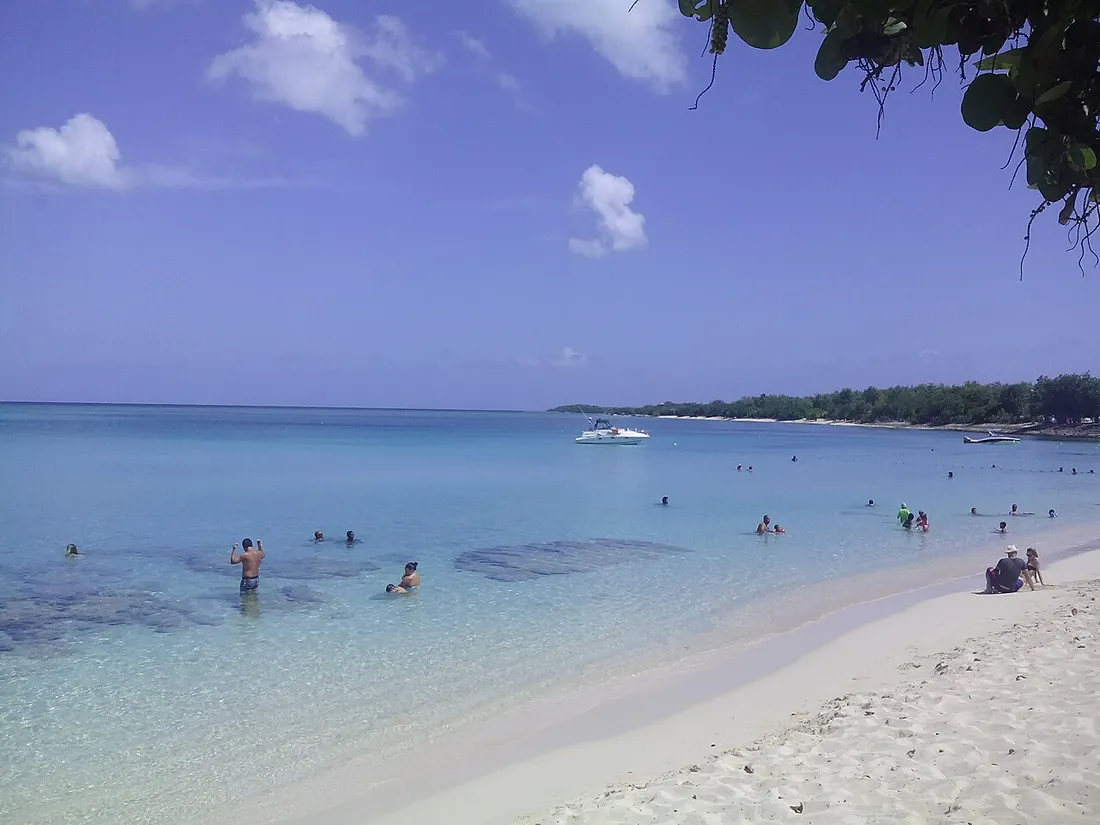
Choosing the right accommodation to cushion the time shift
A detail people don’t think about: your lodging plays a real role in adjusting. A well-blacked-out bedroom (those 5:30 a.m. sunrises pierce thin curtains), quiet air conditioning and a terrace for dawn breakfasts make the difference during the first three days.
At Hostel Toucan, we select and manage holiday rentals in Sainte-Anne, Saint-François, Le Gosier and Deshaies designed for exactly this — and because we live here, our WhatsApp support 7 days a week answers in local time, not 6 hours out of sync like a service based in mainland France. By booking directly on our Guadeloupe rentals page, you avoid platform fees (often 12 to 15% of the stay) and benefit from free cancellation up to 7 days before arrival. Own a property in the archipelago? Our concierge service handles your travellers at any hour — precisely because the requests often come in out of sync.
FAQ
What is the time difference between Guadeloupe and France?
Guadeloupe is 5 hours behind the mainland in winter (from late October to late March) and 6 hours behind in summer (from late March to late October). The archipelago stays on UTC-4 all year: it’s mainland France that changes its clocks, not Guadeloupe.
Is jet lag hard to handle in Guadeloupe?
On the way out, no: travelling west lengthens your day and the body adjusts within 2 to 3 days. You’ll go to bed early and wake at dawn, which is perfect for hiking and diving. The return to the mainland is more demanding: allow a buffer day before going back to work.
What time should you call France from Guadeloupe?
The ideal window is between 7 a.m. and 2 p.m. local time, i.e. 12-7 p.m. (winter) or 1-8 p.m. (summer) in the mainland. Avoid calling after 4 p.m. Guadeloupe time: it’s already 9 or 10 p.m. in Paris.
Is there a time difference between Guadeloupe and the other islands?
Not for the archipelago’s dependencies: Les Saintes, Marie-Galante, La Désirade and Petite-Terre are all on UTC-4, as are Martinique and Saint-Martin. You can island-hop without touching your watch.