French Guiana explained: capital, currency, Brazilian border and cost of living
Published on August 11, 2026 · by Ismael Samuel
Seen from Macapá or Belém, French Guiana feels both next door and entirely foreign: a European territory sitting on the northern border of Brazil’s Amapá state, where you pay in euros, people speak French, and you cross in over a bridge on the Oyapock river. Every year, thousands of travellers head there for tourism, business, family visits or work — and they all ask the same questions. Here are the answers, in the order they usually come up.
Is Cayenne really the capital?
Yes. Cayenne is the administrative capital of French Guiana: its largest city, the seat of its institutions, and the gateway to the territory through Félix-Éboué international airport, located in the neighbouring commune of Matoury.
One common misconception is worth clearing up: French Guiana is not a country. It has no capital in the sense of a sovereign state, and no government of its own. It is a French department and region, and therefore part of the European Union located in South America.
Two other cities structure the territory:
Kourou, about 1 hour’s drive (60 km) from Cayenne, home to the Guiana Space Centre, from which Ariane 6 and Vega rockets lift off.
Saint-Laurent-du-Maroni, about 2h45 away (250 km), on the border with Suriname.
The euro (€). This follows directly from French Guiana’s status: a French department and an outermost region of the European Union, and therefore part of the eurozone.
That has several practical consequences:
The Brazilian real is not accepted in shops, not even in Saint-Georges-de-l’Oyapock on the border. Bring euros or a card.
International bank cards work in most businesses in Cayenne, Kourou and Rémire-Montjoly, but cash remains essential as soon as you leave urban areas: small shops, markets, village crafts and some tour operators. See paying in French Guiana outside Cayenne.
ATMs are concentrated along the coast and in the main communes. Withdraw before heading inland.
Check your bank’s foreign exchange and withdrawal fees, which can add up quickly on a short trip.
How far does your money go?
Exchange rates change constantly, so check the rate on the day you travel — that is the only reliable figure. What is stable is the purchasing power ratio, and that is what matters when planning a budget.
French Guiana applies French prices, further raised by economic isolation: virtually all manufactured goods and a large share of food arrive by ship from Europe, with freight and a local import duty (octroi de mer) built into the shelf price. In practice, a given sum buys noticeably less here than in neighbouring Brazil or Suriname, particularly on imported food, restaurants and accommodation.
A few habits that make a real difference:
Local produce and markets offer the best value: the Cayenne market at weekends, local fruit and vegetables, fresh fish.
Accommodation with a fitted kitchen transforms the budget of a multi-day stay by removing two restaurant meals a day.
Fuel and car rental are a major line item, since a car is essential here.
Amapá. The border follows the Oyapock river (Oiapoque in Portuguese) for roughly 700 kilometres, making it France’s longest land border — and a border with Brazil.
At the other end of the territory, Suriname borders French Guiana along the Maroni river. But on the Brazilian side, Amapá is the only bordering state.
Which town is closest to Brazil?
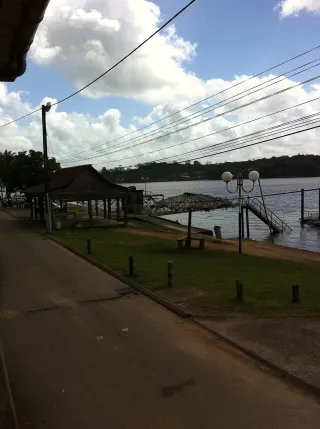
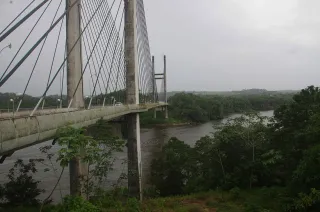
Saint-Georges-de-l’Oyapock, on the French bank of the river, directly opposite the Brazilian town of Oiapoque. The two are linked by the binational bridge over the Oyapock, open to traffic, and by local pirogues that cross the river.
Practical points:
Saint-Georges is connected to Cayenne by the RN2, a paved road of roughly 190 km, meaning 3 to 4 hours depending on road conditions and weather.
Crossing the border involves customs and immigration checks on both sides, with opening hours worth verifying before you set off.
Taking a vehicle across requires specific paperwork (documents, insurance) — check before you go, or you will be turned back.
This is the one point where guesswork is a bad idea, because French Guiana is not part of the Schengen area: entry rules differ from those of mainland France. A document valid for Schengen does not automatically apply to French Guiana, and vice versa.
Two checks are essential before any trip:
The entry conditions applying to your nationality for French overseas departments, to be confirmed with the relevant French consulate. These rules evolve — do not rely on a forum post or on an experience from several years ago.
Yellow fever vaccination, required to enter French Guiana. The injection must be given at least 10 days before travel, at an approved centre, and the certificate must be available for inspection. See yellow fever vaccination and health formalities.
Also bring a valid passport and, if you plan to drive, the required vehicle documentation.
Is French Guiana safe?
The question comes up constantly, and it deserves a measured answer rather than a slogan. French Guiana is a French department with the same public services, healthcare system and police forces as mainland France, and the vast majority of stays pass without incident.
That does not remove the need for common-sense precautions, the same ones that apply in any large South American city:
Avoid displaying valuables and phones in the street, particularly at night.
Ask locally which neighbourhoods to avoid after dark — and darkness falls early, around 6.30pm all year round.
Never leave belongings visible in a vehicle.
On inland roads and near the borders, check travel conditions before setting out.
In practice, the most concrete risks for a visitor are health- and nature-related: mosquitoes, sun exposure and river swimming. Our guides to safety in French Guiana and mosquito protection cover both in detail.
Where to stay
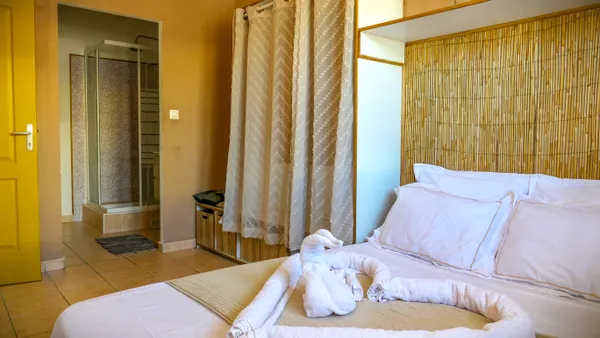
Two realities to factor in. First, hotel capacity is limited and concentrated in Cayenne and Kourou; it fills up during the dry season (July to late November), during carnival, and around rocket launch campaigns. Second, accommodation with a fitted kitchen substantially reduces the cost of a stay.
At Hostel Toucan, we offer accommodation in Cayenne, Rémire-Montjoly, Matoury and Kourou: fitted kitchen, serviced air conditioning, wifi, direct booking with no platform fees, free cancellation up to 7 days before arrival and WhatsApp support 7 days a week. We also arrange a live video tour before booking for longer stays. Browse our accommodation in French Guiana, or get in touch via our contact page.
In summary
Cayenne is the administrative capital of French Guiana, which is a French department and an outermost region of the European Union — not a country. The currency is the euro, the Brazilian real is not legal tender, and prices are French prices raised by freight and local import duty. The bordering Brazilian state is Amapá, the border follows the Oyapock river, and the closest town to Brazil is Saint-Georges-de-l’Oyapock, opposite Oiapoque, linked by a binational bridge and by the RN2 to Cayenne (190 km, 3 to 4 hours). Before travelling: confirm entry conditions with the French consulate, since French Guiana is outside the Schengen area, and get vaccinated against yellow fever at least 10 days ahead.
FAQ
Is Cayenne the capital of French Guiana?
Cayenne is its administrative capital: the largest city, the seat of its institutions and the gateway to the territory via Félix-Éboué airport in Matoury. But French Guiana is not a country: it is a French department and region, and therefore an EU territory in South America. The two other structuring cities are Kourou, home to the Guiana Space Centre, and Saint-Laurent-du-Maroni, on the Suriname border.
What currency does French Guiana use?
The euro. As a French department and an outermost region of the European Union, French Guiana is part of the eurozone. The Brazilian real is not accepted, not even in Saint-Georges-de-l’Oyapock on the border. International cards work in most businesses in the main communes, but cash remains essential in small shops, at markets and inland.
Which Brazilian state borders French Guiana?
Amapá. The border follows the Oyapock river for roughly 700 kilometres, making it France’s longest land border. At the other end of the territory French Guiana also borders Suriname, along the Maroni river, but on the Brazilian side Amapá is the only bordering state.
Which town in French Guiana is closest to Brazil?
Saint-Georges-de-l’Oyapock, on the French bank of the river, directly opposite the Brazilian town of Oiapoque. The two banks are linked by a binational bridge and by local pirogues. Saint-Georges connects to Cayenne via the RN2, a paved road of roughly 190 km, meaning 3 to 4 hours of driving. Crossing involves immigration and customs checks on both sides, with specific paperwork required for vehicles.
Do I need a visa for French Guiana?
French Guiana is not part of the Schengen area: entry conditions differ from those of mainland France, and a document valid for Schengen does not automatically apply here. Check the rules for your nationality with the relevant French consulate before travelling, as they change. Bring a valid passport and a yellow fever vaccination certificate, required for entry, with the injection given at least 10 days beforehand.
Is it dangerous to travel to French Guiana?
French Guiana is a French department with the same public services, healthcare system and police forces as mainland France, and the vast majority of stays pass without incident. Usual big-city precautions still apply: do not display valuables, ask locally which areas to avoid after dark — which falls around 6.30pm all year round — and leave nothing visible in a vehicle. The most concrete risks for a visitor remain health-related: mosquitoes, sun and river swimming.
Nous utilisons des cookies de mesure d'audience et de publicité pour améliorer votre expérience
et nos campagnes. Vous pouvez accepter ou refuser. Voir notre
politique de confidentialité.