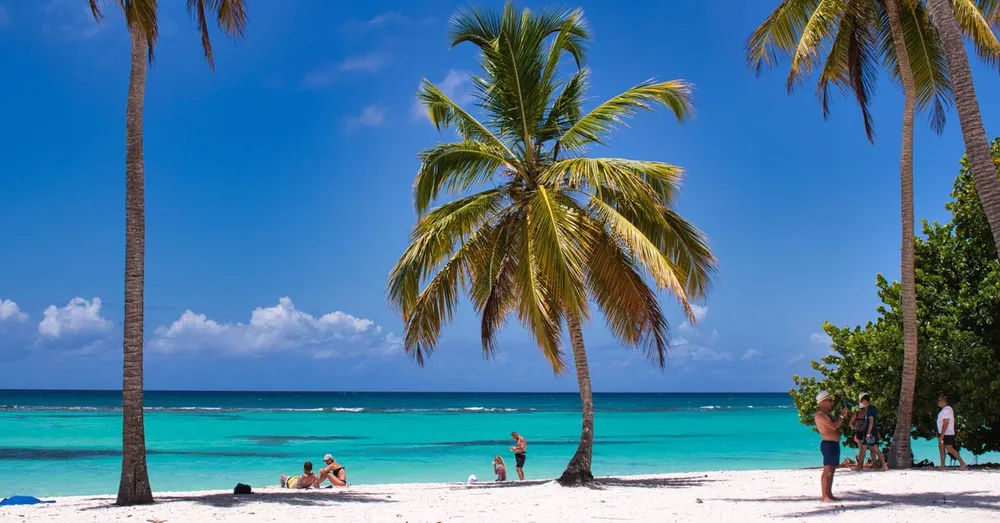
Planning a trip to Guadeloupe with kids always raises the same questions: are the beaches really safe for a three-year-old? Can you take a stroller on the trails? What driving distances are reasonable with little ones in the back seat? And how much does it all really cost? At Hostel Toucan, our host families live in the archipelago year-round and regularly welcome families into their homes. We’ve put together a selection of activities genuinely tested with young children, paired with a complete logistics guide: beaches, health, choosing your base and budget. Here are 15 concrete ideas, sorted by mood, with our ratings for stroller access, duration and price.
Why Guadeloupe is ideal with children
Guadeloupe is a French overseas department (DROM), which makes everything simpler: people speak French (and Creole), you pay in euros, health and medical standards are French, and you’ll find pharmacies, diapers and baby food everywhere. The archipelago is shaped like a butterfly, with two very different wings joined by a bridge: Grande-Terre, limestone and seaside, with its turquoise lagoons, and Basse-Terre, volcanic and tropical, dominated by La Soufrière (1,467 m).
A few practical basics that save a huge amount of time:
- No heavy paperwork: an ID card is enough for French citizens, the usual health record, and no mandatory vaccines.
- Direct flight from Paris: about 8h30 nonstop to Pôle Caraïbes airport (Pointe-à-Pitre). Take the daytime flight on the way out to land in mid-afternoon, eat early and put everyone to bed early.
- Manageable time difference: -5h (winter) to -6h (summer) compared to Paris. An often-overlooked advantage: children wake up early, perfectly in sync with the cool morning hours, ideal for sightseeing. The jet lag fades within 48 hours.
- French healthcare system: the Carte Vitale is accepted, on-call doctors, pharmacies in all main towns.
- Reasonable distances: 35-40 minutes between the airport and Sainte-Anne, about 1h15 between Le Gosier and Deshaies, rarely more than 1h30 for a day trip from a good base.
The best time with children remains the dry season, from December to April: less rain, calmer seas, fewer mosquitoes, temperatures of 28-30°C. July and August work too, with short tropical showers and lodging prices 20 to 30% gentler.
Current-free lagoons: stress-free swimming for toddlers
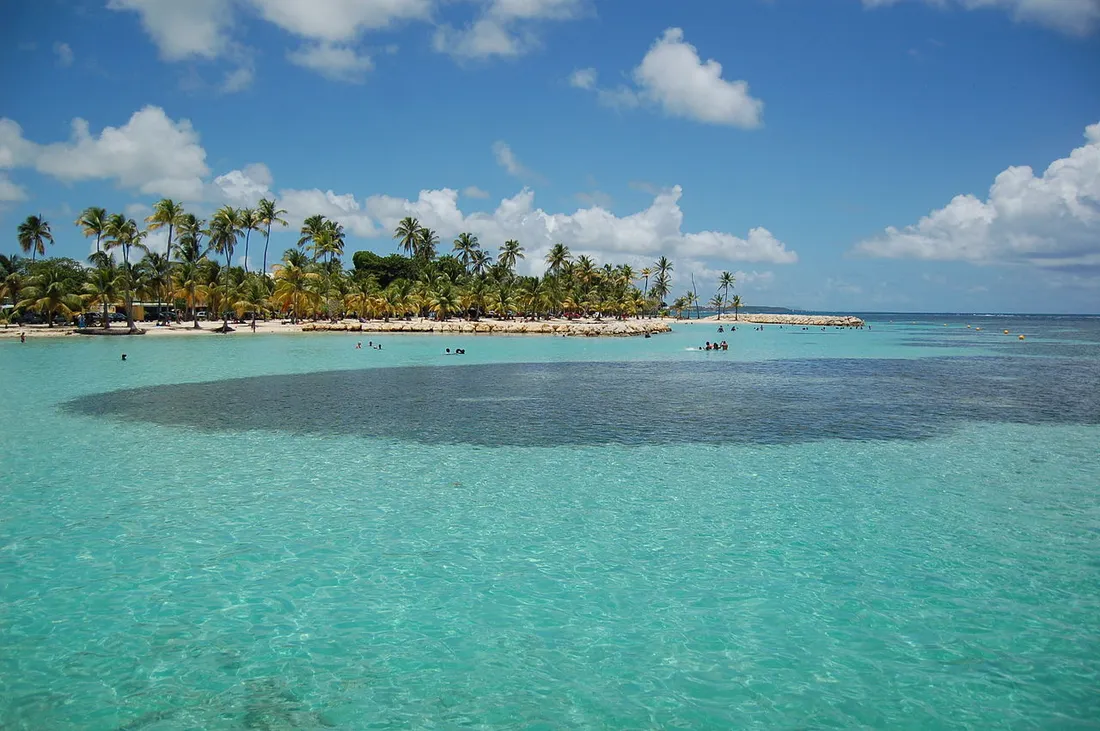
For young children, the number-one criterion is calm, shallow water with no current. The coral reef along the southern coast of Grande-Terre creates natural pools where the water reaches mid-thigh for tens of metres. Here are our sure bets.
1. Plage de la Caravelle (Sainte-Anne)
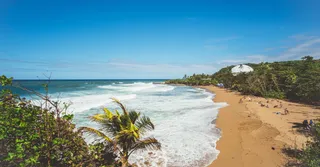
Our absolute favourite for under-6s. A lagoon protected by a coral reef, turquoise water at 28°C, a very gentle slope, white sand, the shade of coconut palms. Free parking, showers, food trucks. Stroller access: easy (packed sand near the entrance). Ideal from 18 months; arrive before 9:30 a.m. to park and enjoy the shade of the sea-grape trees.
2. Plage du Bourg de Sainte-Anne
Right in the centre, so handy for alternating between swimming and lunch. An even more enclosed and very shallow lagoon, perfect for a baby’s first swim. Snack bar and toilets nearby. Stroller access: excellent (a landscaped promenade runs along the beach).
3. Anse à la Gourde (Saint-François)
Wilder, but a generous lagoon. Bring water shoes for the coral. Stroller access: moderate (100 m path).
4. Plage de Bois Jolan (Sainte-Anne)
A vast stretch of shallow water lined with coconut palms, perfect for sandcastles. Little shade in the afternoon: come early. Stroller access: moderate.
5. Anse du Souffleur (Port-Louis)
Huge, shallow and often less crowded on weekdays: a lovely alternative for getting away from the crowd without giving up the safety of the lagoon.
On the Basse-Terre side, for children who already swim, Grande Anse in Deshaies offers a magnificent golden-sand beach, but watch out for the breakers on some days: stay within the supervised area. On the other hand, avoid Pointe des Châteaux for swimming: stunning for a short panoramic walk, but the ocean there is powerful and dangerous for little ones. Take the same care on the breaker-prone beaches of the Atlantic coast.
Local golden rule: never let children sit under a manchineel (a toxic tree marked with a red stripe on the trunk), and swim in the morning, when the wind is light.
Farms, animals and rainy-day outings
Children love animals, and the archipelago has no shortage of petting farms and visits that rescue a rainy day.
6. Petting farms of Basse-Terre
Several farms let you meet goats, hens, rabbits and Creole pigs. Count on 6 to 9 € per child, a 1h30 visit at a relaxed pace. Stabilised paths, stroller possible.
7. The Botanical Garden of Deshaies
A must-see: waterfalls, koi ponds, an aviary of lorikeets that land on children’s arms (a cup of nectar is enough to delight them). Family ticket around 45-50 € (2 adults + 2 children). Wide, paved walkways: excellent stroller access. Allow 2 hours. Panoramic restaurant on site.
8. Aquarium of Guadeloupe (Le Gosier)
Small but well thought out, and sheltered if the rain comes. Sharks, turtles, a recreated mangrove. About 11-16 € depending on age, a 1h to 1h30 visit. 100% stroller-accessible. Perfect on a rainy day.
9. Butterfly farms and plantations
Several estates combine a cocoa plantation, a banana grove and butterfly watching. Ideal for filling a Basse-Terre morning between two swims.
Mini-hikes suited to little legs
No need to tackle La Soufrière with a toddler. Basse-Terre is full of short, spectacular walks.
10. Cascade aux Écrevisses
The family hike par excellence: 5 to 10 minutes’ walk on a flat path from the Route de la Traversée, to a waterfall and a shallow swimming pool. Stroller access: possible on the main section. Very popular: come early.
11. First and second Carbet Falls
The first, high fall is the most accessible of the Carbet Falls: about 20 minutes’ walk from the car park on a developed trail (stairs and footbridges). The second fall is reached via a developed trail, 45 minutes round trip, doable from age 4-5, for a true immersion in the tropical forest (admission a few euros per adult). Stroller not recommended on either: go for a back carrier instead. Wonder guaranteed.
12. Pointe des Châteaux (belvedere trail)
A waymarked 15-minute climb up to the cross, with a 360° view over the ocean and La Désirade. For budding climbers from age 4. A baby carrier is recommended for the youngest.
13. Mangrove trail (Grand Cul-de-Sac Marin)
Wooden boardwalks over the mangroves, with crabs and birds to spot. Flat and shaded. Stroller possible on the boardwalks.
Gentle discoveries and outings at sea
14. Snorkelling at the Cousteau Reserve (Malendure, Bouillante)
The Pigeon Islets reserve is a world-class diving site, yet it’s also accessible to families: from Malendure beach (grey volcanic sand), you can already see fish and coral at shallow depths. From age 6-7, your children will spot parrotfish and sometimes turtles just 10 metres from the shore. For the youngest, opt for a glass-bottom boat trip out to the Pigeon Islets (about 20-25 € per adult, 15 € per child, 1h to 1h30): no stress, everyone sees the reef. Mask and snorkel as soon as the child is comfortable in the water.
15. Day trip to Les Saintes (Terre-de-Haut)
The bay of Les Saintes is ranked among the most beautiful in the world. A ferry crossing of about 20-45 min depending on the departure port (Trois-Rivières is the shortest, about 25 € round trip per adult and 15 € per child). On site: calm beaches like the Pompierre lagoon, colourful pedestrian lanes, ice creams and tourments d’amour to taste. A memorable day, as long as you plan ahead for seasickness in those prone to it.
And for an even slower pace, Marie-Galante, the island of a hundred windmills (a roughly 45-min crossing from Pointe-à-Pitre) charms with its distilleries set in shady gardens (Bielle, Père Labat, Bellevue), its vast and uncrowded beaches and its ox carts: the children run around while the parents taste rum.
Where to stay: the right base changes everything
Grande-Terre or Basse-Terre?
For a first family trip, we almost always recommend the southern coast of Grande-Terre (Sainte-Anne, Saint-François, Le Gosier): lagoon beaches less than 10 minutes away, supermarkets, pharmacies, paediatricians, a central position that keeps Basse-Terre accessible as a day trip. Basse-Terre — the Soufrière volcano, the Carbet Falls, the National Park’s tropical forest — is best visited on excursions. If your children are over 8 and you’re more of a hiker than a sun-lounger, flip it: a base in Deshaies or Bouillante has plenty of charm.
Why a rental with a kitchen is non-negotiable with children
After dozens of families welcomed, the verdict is clear: a hotel wears parents out, a rental rests them.
- Meals at your own pace: purée at 11:30, a snack at 4 p.m., dinner at 6:30 — natural in a villa. A restaurant costs 15-25 € per person; cooking with produce from the Sainte-Anne market halves your food budget.
- Sacred naptime: a real, quiet bedroom while the parents enjoy the terrace. Alternate one activity in the morning, beach and rest in the afternoon: no need to cram it all in.
- Washing machine: with sand and sunscreen everywhere, it’s the most underrated piece of equipment of the trip.
Guadeloupe with a baby: the health and comfort checklist
Travelling to Guadeloupe with a baby is entirely doable — you’ll see families with 4-month-old infants all year round. The points to watch:
- Sun: mineral SPF 50+ cream (reef-safe), UV-protective rash guard, hat, and beach only before 10 a.m. or after 4 p.m. for under-3s. The tropical sun is intense even when it’s overcast.
- Hydration: get them drinking every 30 minutes. Tap water is drinkable in most towns; bottled water (about 1 € a litre) reassures many parents.
- Mosquitoes: an age-appropriate repellent, a mosquito net over the baby’s bed (provided in our homes on request), long clothing at sunset. Dengue circulates from time to time: see a doctor in case of fever.
- Paediatric care: paediatricians in Pointe-à-Pitre, Le Gosier and Saint-François, the Pointe-à-Pitre teaching hospital for emergencies, SAMU at 15. Pharmacies stock infant formula and diapers, 10 to 20% pricier than in mainland France: bring a backup supply.
- Car and car seat: book the car seat with the vehicle (about 5 €/day) or bring your own, accepted free of charge in the hold by most airlines.
Our logistics tips as host families
- Rent a car: public transport is limited and a suitable car seat is essential. Distances stay short (Sainte-Anne–Deshaies: about 1h15) and the main roads are in good condition.
- Drive during the cool hours: little ones handle journeys better in the morning, and you manage naptimes.
- Strategic base: a home in Grande-Terre puts the family-friendly lagoons within reach while keeping Basse-Terre accessible.
A realistic budget for a family week
For a family of 4 (two adults, two children), one week in the dry season:
- Flights Paris–Pointe-à-Pitre: 600 to 900 € per person (book 4 to 6 months ahead).
- Family rental with kitchen: 700 to 1,400 € per week depending on standard and beach proximity.
- Rental car: 250 to 350 € per week, essential.
- Groceries + a few restaurants: 400 to 600 €.
- Activities: 150 to 300 €.
That’s a total of about 4,500 to 6,500 €. Booking direct, with no platform commission, is the simplest way to save.
Travel light and easy with Hostel Toucan
With young children, the right home changes everything: a fully equipped kitchen for meals and bottles, space to crawl, proximity to calm beaches. Hostel Toucan selects rentals designed for families across the whole archipelago, and on request we lend a travel cot and high chair. By booking direct, you avoid platform fees (often 12 to 15% of the stay), enjoy free cancellation up to 7 days before arrival and 7-day WhatsApp support: a real safety net when you’re hunting for infant formula on a Sunday or a good beach window. Need tailored ideas? Browse our complete guide to Guadeloupe, explore our rentals in Guadeloupe, and if you own a property here, discover our concierge service for owners.
Guadeloupe with kids isn’t a compromise: it’s one of the simplest and most reassuring tropical destinations for sharing great memories with young children. Over to you.
FAQ
From what age can you take a child to Guadeloupe?
From 3-4 months with no particular medical issue: no mandatory vaccine and the French healthcare system on site. The 8h30 direct flight is easily handled with a baby (book the bassinet). The only real constraints, sun and mosquitoes, are managed with the right gear.
When is the best time to visit Guadeloupe with the family?
The dry season, from December to April, is ideal with young children: less rain, calmer seas, fewer mosquitoes and bearable heat (28-30°C). It’s the most comfortable period for the lagoons and the mini-hikes, but also the most in demand: book flights and lodging very early. July and August remain a good budget option if you can tolerate short daily showers.
Which beaches are safest for young children in Guadeloupe?
Favour the lagoons protected by the coral reef, current-free and shallow, along the southern coast of Grande-Terre: Plage de la Caravelle and the centre of Sainte-Anne, Bois Jolan, Anse à la Gourde in Saint-François or Anse du Souffleur in Port-Louis. Avoid swimming at Pointe des Châteaux and on the breaker-prone Atlantic-coast beaches with little ones.
Can you go hiking with a stroller in Guadeloupe?
On some sites, yes: the Botanical Garden of Deshaies, the Gosier Aquarium and the Cascade aux Écrevisses have walkways or sections passable with a stroller. For the Carbet Falls or Pointe des Châteaux, a back carrier is far better suited because of the stairs and footbridges.
Do you need to rent a car to visit Guadeloupe with children?
Yes, it’s strongly recommended. Public transport is limited, and a car with a suitable car seat lets you manage naptimes and drive during the cool hours. Count on 250 to 350 € per week for a city car with a car seat. Good news: distances stay short — for example, about 1h15 between Sainte-Anne and Deshaies.