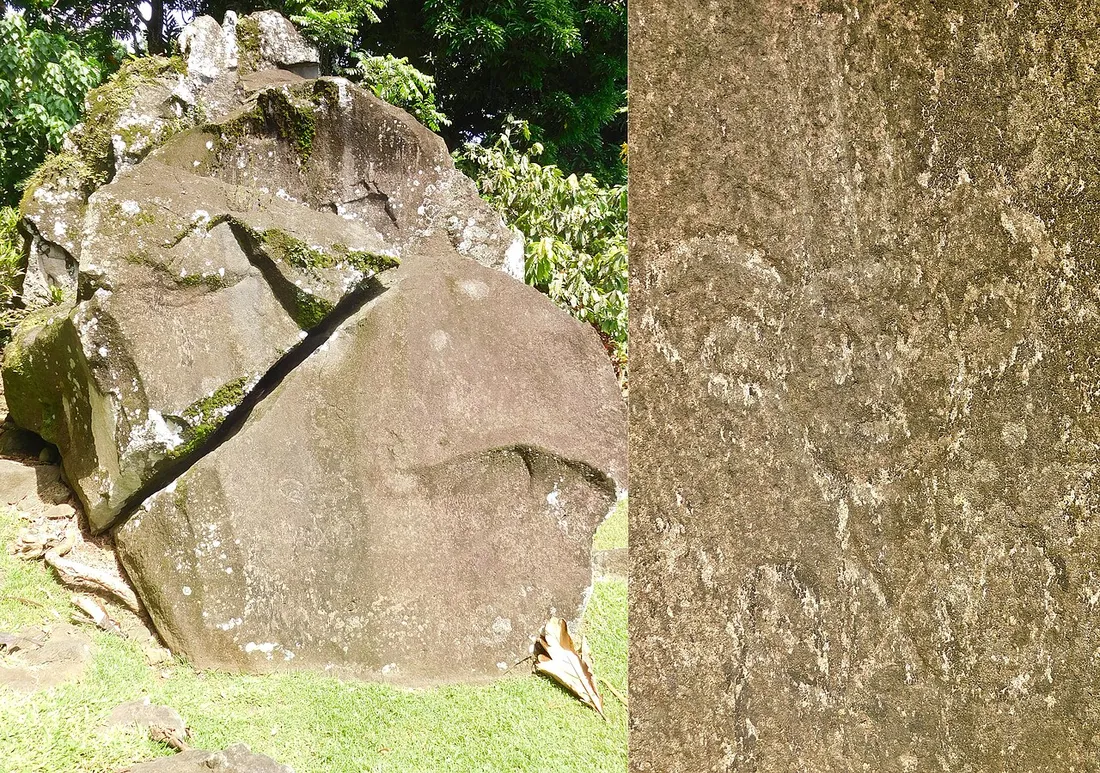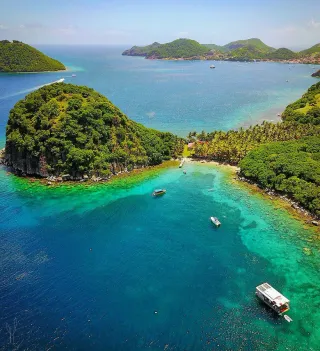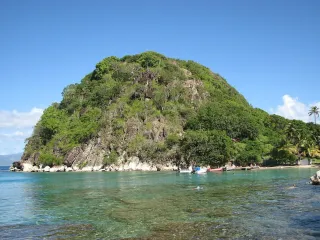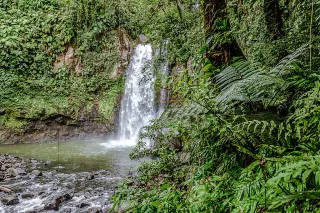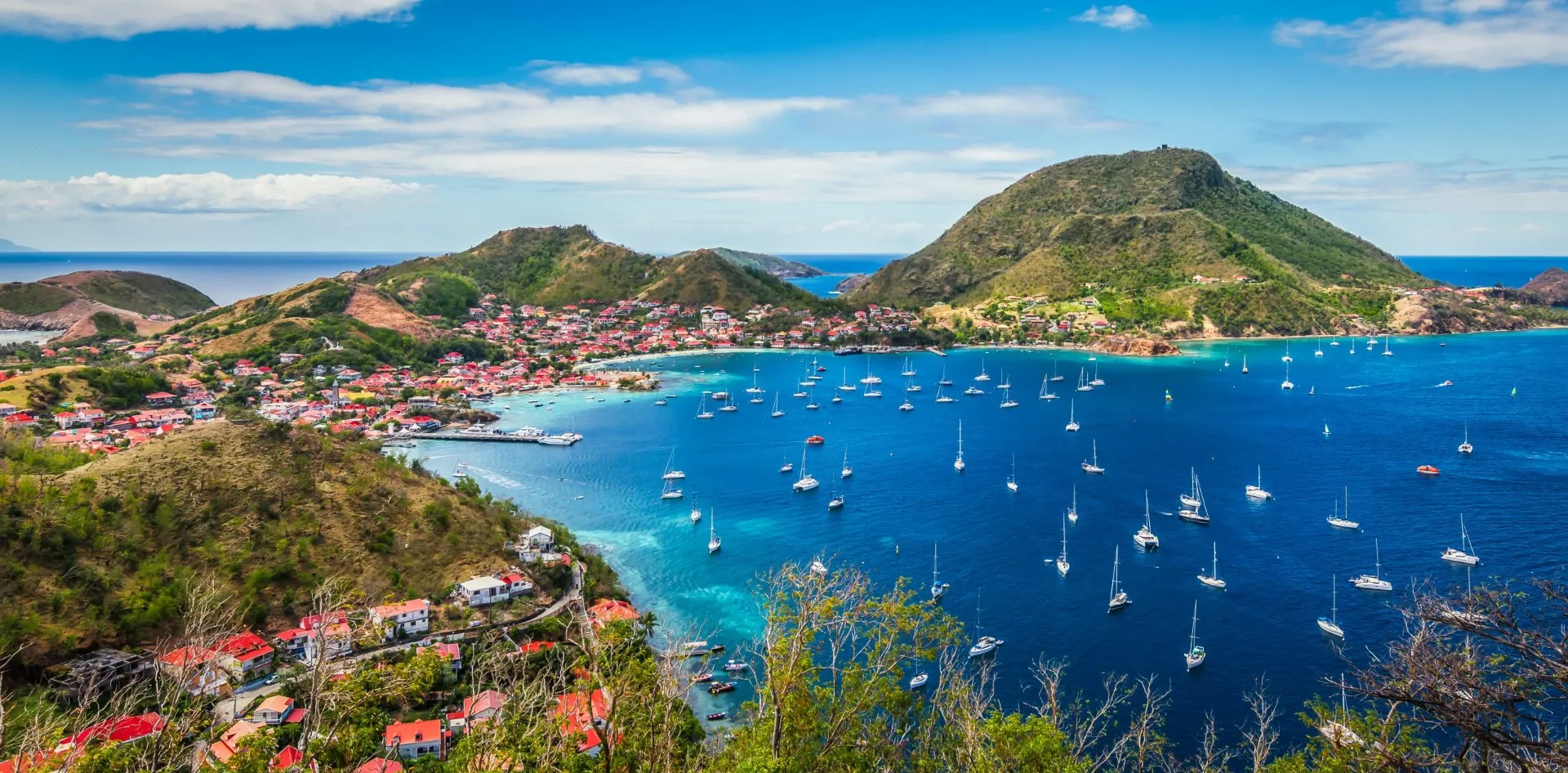
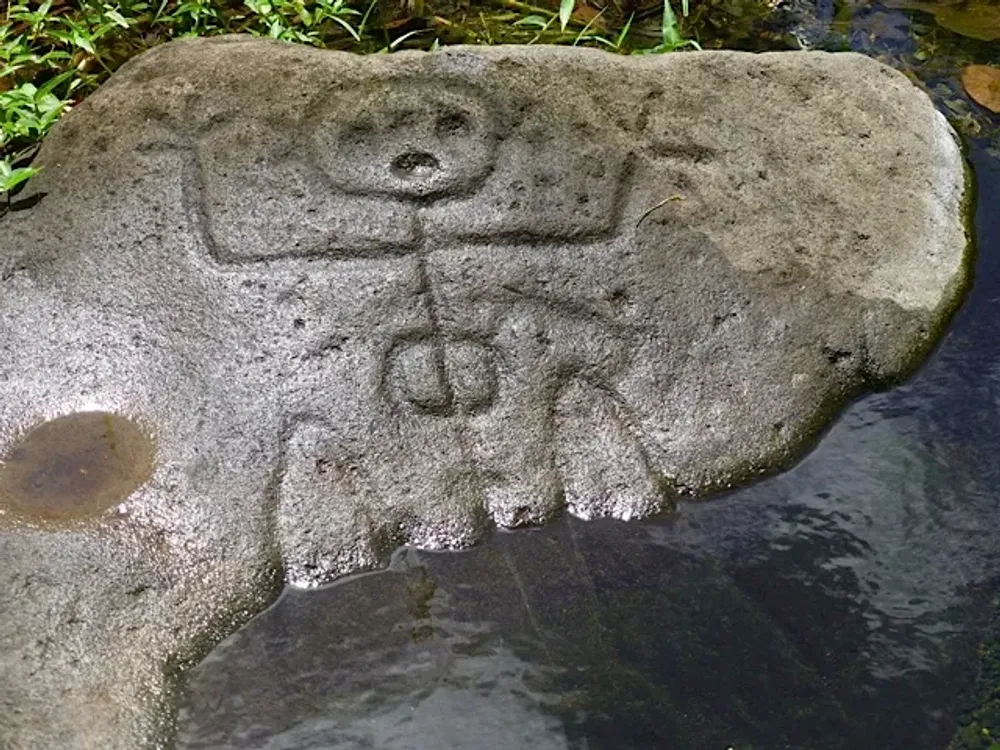
In the south of Basse-Terre, just minutes from the ferry dock for Les Saintes, hides one of the most moving sites in the archipelago: a garden of volcanic stones covered in drawings carved more than a thousand years ago. The carved rocks of Guadeloupe, gathered in the archaeological park of Trois-Rivières, are the most tangible trace of the Amerindian peoples who lived here long before the Europeans arrived. On site, you walk slowly, you scan the rock for stylized faces, and you suddenly understand that this butterfly-shaped island has a very deep memory. Here is how to visit this place, how to read its petroglyphs, and how to pair it cleverly with a crossing to Terre-de-Haut.
Why the Carved Rocks Park is worth the detour
Guadeloupe is often boiled down to the turquoise beaches of Grande-Terre and its volcano, the Soufrière (1,467 m), on the Basse-Terre side. But between the two wings of the butterfly lives a more discreet heritage, that of the Arawaks and the Kalinagos who occupied the archipelago for centuries. At Trois-Rivières, on the southwest coast of Basse-Terre, the archaeological park of the Carved Rocks brings together the finest concentration of petroglyphs on the island.
What you come here to find:
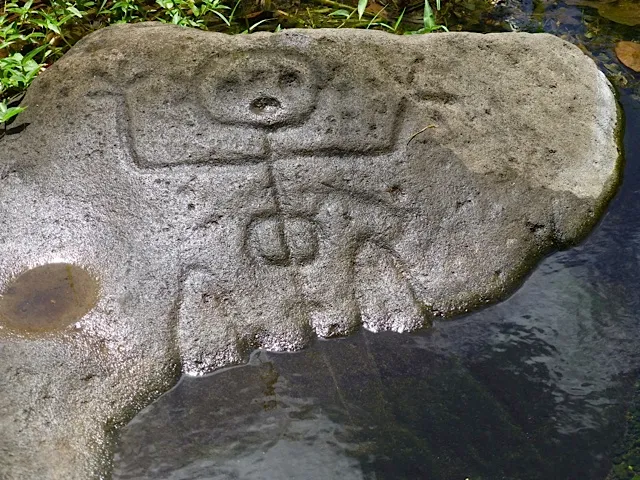
- Dozens of blocks of volcanic rock sculpted with anthropomorphic (faces, silhouettes) and geometric motifs.
- A tropical botanical garden that serves as a setting, with endemic species and Creole medicinal plants.
- A living reading of pre-Columbian history, far from the seaside clichés.
- A perfectly located stop before the ferry to Les Saintes, whose dock is just a stone’s throw away.
It is a TOFU site par excellence: ideal for a first cultural discovery of Guadeloupe, family-friendly, short but memorable.
Who carved these stones, and what do they tell us
The carvings of Trois-Rivières are attributed to the Amerindian populations settled in the Lesser Antilles, mainly between the 3rd and the 10th century of our era. We speak of pre-Columbian art: these farming and fishing communities carved the soft volcanic rock using harder stone tools, by percussion and abrasion.
How to read a petroglyph
On site, without a guide, you quickly miss the essentials. A few useful reading keys:
- The faces: the majority of the motifs represent very stylized human figures, often reduced to two round eyes and a mouth. Some researchers see in them ancestors, spirits, or deities.
- The spirals and concentric circles: interpreted as symbols linked to the sun, water, or the cycle of life.
- The orientation: many carvings are located near water (rivers, springs), which suggests a ritual dimension tied to places of passage.
- The superposition: some rocks were reworked over several generations, like a stone palimpsest.
No interpretation is definitive, and that is precisely what makes the visit captivating: in front of each block, you become a bit of an archaeologist. Take the time to walk around the stones, because the grazing light of morning or late afternoon reveals lines that are invisible in full sun.
The garden surrounding the carvings
The park is not only an archaeological site, it is also a true tropical garden. Following the shaded trail, you will come across breadfruit trees, banana trees, fragrant plants, and medicinal species used in Creole herbal medicine. Signs explain the traditional uses. It is a cool, green interlude, pleasant even in the height of the dry season.
Practical info for visiting the Carved Rocks
Here are the concrete markers to organize your visit. Always check the current opening hours before setting out, as they change with the season.
- Where: archaeological park of the Carved Rocks, town of Trois-Rivières, south of Basse-Terre.
- Visit duration: allow 45 min to 1 h for the full circuit (carvings + garden).
- Indicative price: around 3 to 5 € per adult, free or reduced for children. Small budget, big content.
- Hours: generally open in the morning and the afternoon; aim for opening time for the light and the cool air.
- Level: easy trail, partly shaded, family-friendly. Closed shoes recommended.
- What to bring: water, a hat, insect repellent (the plant cover attracts them), and a camera.
How to get there
From Pôle Caraïbes airport in Pointe-à-Pitre, allow about 1 h to 1 h 15 of driving (about 60 km) to Trois-Rivières, going along the leeward coast or via the Route de la Traversée. From the seaside towns of Grande-Terre such as Sainte-Anne or Le Gosier, plan instead 1 h 15 to 1 h 30. The rental car remains the most practical means: the archipelago is best discovered at the wheel, and Trois-Rivières lies a bit off the main tourist routes.
When to come
The dry season, from December to April, is the ideal period: less rain, dry trails, sharp light on the carvings. Since Guadeloupe is a French overseas department on euro, French, and Creole time, also bear in mind the time difference (-5 h in winter, -6 h in summer compared with Paris) if you are coordinating calls. Phone code: +590.