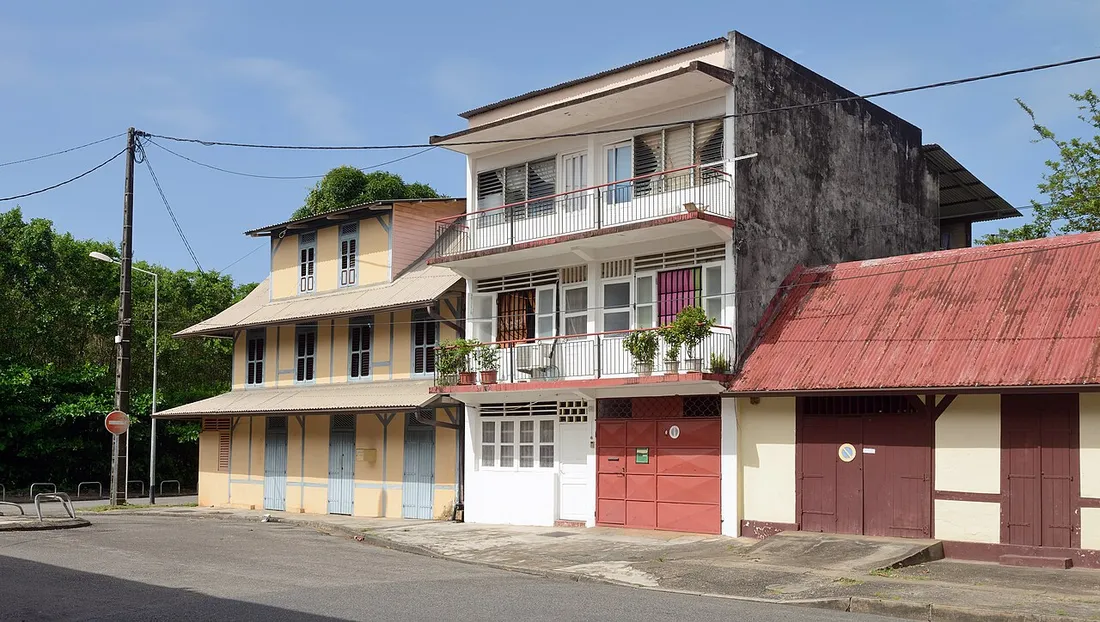
You need to deploy a team to French Guiana — a construction site in Kourou, an engineering assignment in Cayenne, a field campaign around Saint-Laurent-du-Maroni or technical work near the Guiana Space Centre — and accommodation weighs heavily on your budget. Between hotel nights that pile up, invoices that are sometimes unusable for accounting purposes and the difficulty of finding availability in high season, housing several employees for several weeks can quickly turn into an expensive headache. The good news: in French Guiana, there are para-hotel accommodation solutions designed for businesses that let you cut the cost per person while meeting accounting and tax requirements. This article gives you concrete benchmarks for housing a team without blowing the budget, all while keeping clean invoicing and an expense report that goes through without argument.
Why a standard hotel costs a lot for a team
The usual reflex is to book hotel rooms. For one or two nights, that’s simple. But as soon as the assignment lasts several weeks and involves several people, the hotel model shows its limits in French Guiana.
- The rate is per room, not per bed: two employees = two rooms, with no way to share living spaces.
- No kitchen: the team eats out morning, noon and night, which adds an expense line sometimes higher than the accommodation itself.
- Little in the way of tiered discounts: hotels rarely apply meaningful long-stay reductions, especially when demand is high (launch campaigns in Kourou, trade shows, the dry tourist season).
- Tight availability: in Cayenne and Kourou, finding several adjoining rooms over a long period can be quite a feat.
As a rough guide, a mid-range hotel room in Cayenne often falls somewhere between several dozen and more than a hundred euros a night depending on the season. Multiply that by the number of people and the number of weeks, and the budget climbs fast. That is precisely where a shared whole-home rental changes everything.
Working out the cost per person per night
The right metric for making the call isn’t the price of the accommodation, but the cost per person per night (sometimes shortened to PPN). That figure is what makes options genuinely comparable.
Take a simplified and indicative example: a villa or a large apartment able to house 4 employees. If the long-stay rate for the whole property is shared between the 4 people, the cost per head drops mechanically compared with 4 individual hotel rooms. The more the accommodation is shared among a sufficient number of people, the lower the cost per night per occupant.
What to include in the calculation
- The rent or rental rate (ideally on a tiered long-stay basis).
- Any utility charges (water, electricity, air conditioning, internet) — check whether they are included.
- Cleaning and linen, depending on the para-hotel package chosen.
- The savings on meals made possible by a fully equipped kitchen.
- Parking, valuable when the team is getting around in company vehicles.
Once these items are added up and then divided by the number of employees and nights, you get a realistic cost per person, far more meaningful than an advertised price. Our team can help you build this simulation for your assignment — contact us for a costed quote.
Long-stay furnished rentals: budget lever number one
In French Guiana, for a team staying several weeks or several months, a furnished rental at a long-stay rate is almost always the most economical option. The principle is simple: the longer the stay, the lower the nightly rate.
The duration brackets to negotiate
- Short stay (less than a week): little room for negotiation, with a rate close to the standard nightly price.
- Stay of 1 to 4 weeks: the first tiered discounts appear, to be negotiated case by case.
- Monthly stay and beyond: this is where the best terms are found, with rates designed for professional assignments.
These brackets are given for guidance only: actual terms depend on the period (the dry season, from summer to autumn, is in higher demand), the property and the number of occupants. The key point is to systematically ask for a tiered rate schedule as soon as the assignment runs beyond a few weeks.
The other advantage of long-stay furnished accommodation: stability. Your team keeps the same home from the start of the assignment to the end, with no room changes or repeat bookings, which simplifies both logistics and accounting.
Invoicing in the company’s name: the real para-hotel difference
This is the point that separates an amateur solution from one genuinely suited to businesses. A private individual renting directly cannot always issue a usable invoice; a structured para-hotel operator can.
What a business invoice must contain
For your accounting and expense reports to go through without a hitch, the accommodation invoice must be issued in the company’s name and include the expected legal details:
- Your company’s registered name and address (the client being invoiced).
- The operator’s identity and contact details, with SIREN/SIRET number.
- Invoice number and issue date.
- Breakdown of services: stay dates, property, number of nights.
- Amount excluding tax, VAT rate and amount, total including tax (where applicable).
- Payment terms and due date.
With a compliant invoice in the company’s name, the accommodation expense slots cleanly into your deductible costs, and your employees don’t have to pay out of their own pockets up front. That’s a considerable time-saver for the accounts department as well as for the teams in the field.
VAT and recovery: what you need to know
The VAT question comes up systematically for business stays. Here are the general benchmarks, to be confirmed with your accountant depending on your situation.
- Accommodation supplied by a provider registered for VAT shows the tax on the invoice, separately from the amount excluding tax.
- In France, recovering VAT on accommodation services follows specific rules: VAT on housing for company directors and employees is generally not recoverable, unlike certain ancillary services. The rules change and come with nuances: have your accountant confirm your case.
- What matters for you, in every case, is having a detailed, compliant invoice that clearly shows the taxable base and the VAT, so your accounting team can decide with full knowledge of the facts.
The key message: a para-hotel operator who issues invoices in proper form leaves all your tax options open, whereas an informal rental takes them away.