
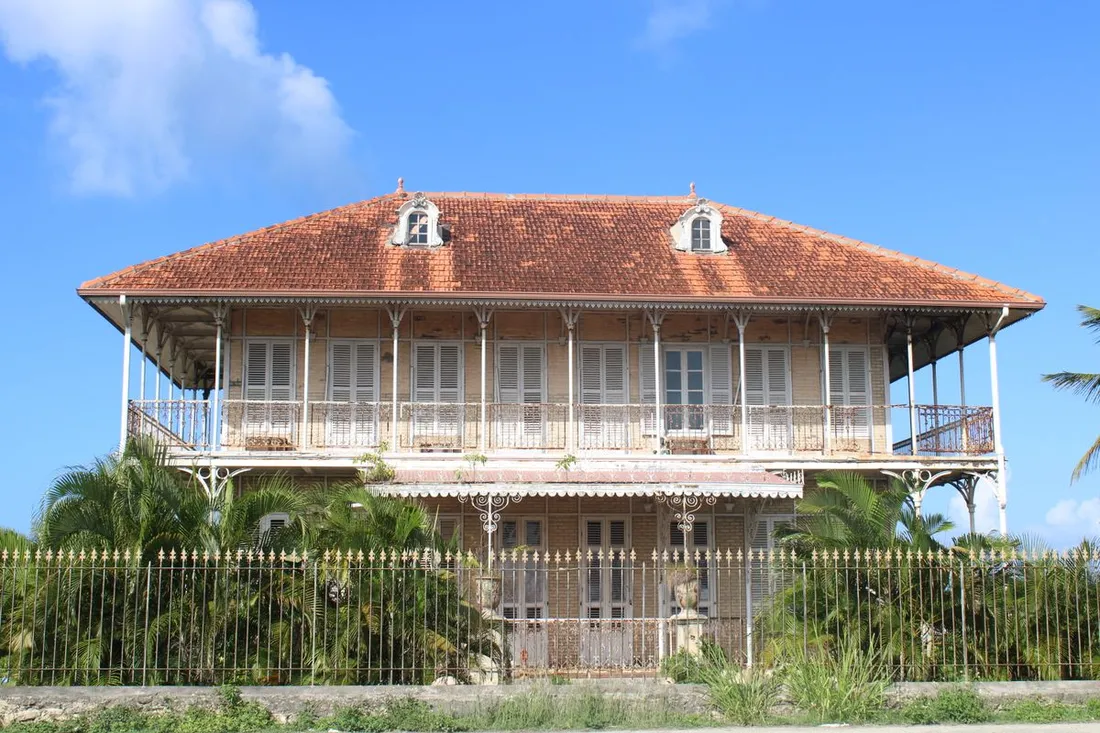
In Guadeloupe, almost every family knows that “family house”: the grandparents’ place, up in the hills of Le Moule or facing the Sainte-Anne lagoon, that everyone feels a little ownership of without anyone truly owning it alone. When the idea of renovating it into a holiday rental comes up, the inheritance of a rental property in Guadeloupe runs into two very local realities: a large family in joint ownership, and land whose title has sometimes never been formalised. Based on the archipelago and supporting owners in Sainte-Anne, Saint-François and Deshaies, we see this situation almost every month. Here’s what to understand, and in what order to move forward, before putting the property on the market.
Why joint ownership is so common in Guadeloupe
When someone dies without having organised their estate, their assets automatically pass into joint ownership (indivision): all the heirs become co-owners, each holding a share (a half, a third, an eighth…), with no specific room assigned to one person over another. This is standard French law, identical in mainland France and in the French overseas departments and regions.
But in Guadeloupe, this mechanism takes on a particular scale for historical and human reasons:
- Families are often extended, with heirs scattered between the archipelago and mainland France, sometimes the Caribbean or North America.
- Many estates are never settled: the house stays “in the family” across two or even three generations, multiplying the number of co-owners.
- The strength of attachment to the land means no one wants to sell the ancestor’s share, which freezes the situation for decades.
Real-estate joint ownership in the overseas departments therefore stands out less for its rules than for its intensity: it’s not unusual to find 8, 12 or even 20 co-owners on a single plot. And as long as the property is held jointly, no decision about long-term letting or major works can be taken by a single heir.
The golden rule: you don’t let a jointly owned property on your own
This is the point future landlords most underestimate. The Civil Code precisely frames what each co-owner can decide, and by what majority.
- Routine management acts (paying the insurance, settling the property tax): a co-owner can do these alone, but it’s not enough to let the property.
- Signing or renewing a residential lease (a standard rental): you need the agreement of co-owners representing at least two-thirds of the rights.
- Selling the property, or granting a commercial lease: unanimity is required.
Holiday letting most often goes beyond simple management: to avoid any dispute, it’s best to have a written mandate signed by all co-owners designating the person (or the concierge company) who will manage the furnished rental. Without it, a single disgruntled heir can block bookings, or even demand their share of the rents after the fact.
In practice, before the very first night, secure:
- a written joint-ownership agreement (ideally notarised), organising the management and the distribution of income;
- the appointment of a manager of the joint ownership;
- a dedicated account to collect rents and pay charges with full transparency.
Land titling: the invisible but decisive step
Here is the least-known Guadeloupean specificity. In many families, the house exists, it has been lived in for generations… but there is no title deed in the name of the occupants. This is called “untitled jointly owned land”: legally, the property belongs to no one in a provable way, which makes any sale impossible, any bank loan to renovate impossible, and even weakens the letting process.
Land titling in Guadeloupe consists of reconstituting the chain of ownership and finally establishing an enforceable deed. A few markers:
- A dedicated public scheme, the GIP Titrement (a public interest grouping set up in Guadeloupe, Martinique and elsewhere), supports families through these steps at reduced cost.
- The law also provides tax incentives: a partial exemption from inheritance duties on built and unbuilt properties located in Guadeloupe, Martinique and French Guiana, on condition that the title is regularised.
- Allow from several months to 2 or 3 years depending on the complexity of the plot and the number of heirs to track down: surveying by a chartered land surveyor, genealogical research and the notarial deed all take time.
Without a clear title, you may sometimes let the property in fact, but you expose yourself: insurance impossible, a deadlock in the event of a claim, a challenge from a co-heir. Regularising the title before turning the house into a tourist rental means protecting the whole family’s investment.
Exiting joint ownership to let with peace of mind: three routes
Once the title is cleaned up, it remains to decide how to pass the tourist rental on to the heirs and operate it without conflict. Three options come up most often.
1. Amicable division
The co-owners divide the assets (or buy out the others’ shares) before a notary. Ideal when a single heir wants to keep and let the house. Indicative cost: the notary’s fees and a division duty of 2.5% on the net value of the property, reduced by the overseas exemptions currently in force.
2. The fixed-term joint-ownership agreement
You remain in joint ownership, but in an organised and peaceful way: a manager, rules for distributing the rents, a set duration (up to 5 years, renewable). This is often the quickest solution to launch the rental while the final division matures.
3. The family civil property company (SCI)
The heirs contribute the property to an SCI and receive company shares. Rental management is decided by the majority set in the statutes, future transmission happens through gifting shares (with tax allowances), and the SCI makes bringing in a concierge service easier. It’s the preferred tool for a lasting rental project carried by several branches of the same family.
Whatever the choice, don’t forget the standard furnished-rental obligations: declaration at the town hall, registration number where it’s required, and the tourist tax to collect, which we detail in our complete guide to Guadeloupe.
Our field experience: moving forward in the right order
After supporting several families in this situation, the order of operations makes all the difference:
- Regularise the title (titling) if the land is untitled.
- Organise the joint ownership or exit it (division, agreement or SCI).
- Renovate while budgeting for tropical upkeep: salt, humidity, garden (count on €4,000 to €6,000/year, often deductible under the actual-expenses regime).
- Declare and launch the rental, ideally for the high season from December to April.
This is precisely where we step in. At Hostel Toucan, a 100% local concierge and holiday-rental company, we take over once the legal situation is cleaned up: marketing through direct booking with no platform fees, free cancellation up to 7 days before arrival for your travellers, and 7-day WhatsApp support. Visitors book your properties directly on our Guadeloupe rentals catalogue, while you delegate check-in, cleaning, maintenance and the tourist tax. If you inherit a house to turn into rental income, tell us about your project via our owners page: we work with notaries and surveyors across the archipelago and point you to the right contact before the first booking.
Passing on a property in Guadeloupe isn’t just a matter of square metres: it’s about keeping a family heritage alive. Well prepared, the inheritance of a family house becomes a rental that brings the family together around a project, rather than a file that divides it.
FAQ
Can you let a jointly owned property without all the heirs’ agreement?
Not safely. Signing a lease requires the agreement of co-owners representing at least two-thirds of the rights, and holiday letting often goes beyond simple routine management. In practice, it’s best to have a written mandate signed by all co-owners, or a joint-ownership agreement appointing a manager. Without it, a single heir can block the rental or claim their share of the rents.
What is land titling and why is it essential in Guadeloupe?
Land titling consists of reconstituting and establishing the title deed of a property that has never had one, a frequent situation in Guadeloupean families. Without a title, it’s impossible to sell, to borrow to renovate or to insure the property properly. The GIP Titrement supports these steps, and inheritance-duty exemptions encourage regularisation. It’s the step to settle before putting the house up for rent.
Do you need to set up an SCI to pass a tourist rental on to the heirs?
It’s not compulsory, but often useful when several family branches want to keep and let the property. The SCI turns the property into company shares: management is decided by the majority in the statutes, transmission happens through gifting shares with tax allowances, and bringing in a concierge service is made easier. For a single heir keeping the house, a simple amicable division is generally enough.
Are there tax advantages for settling a property inheritance in the overseas departments?
Yes. A partial exemption from inheritance duties applies to built and unbuilt properties located in Guadeloupe, Martinique and French Guiana, to encourage exiting joint ownership and titling. As the conditions and duration change regularly, review the position with a local notary when you handle your file: the savings can be substantial on an old family house.