
We get the question every week at the concierge desk, from our properties in the South as well as the centre: “The Jardin de Balata, is it really worth it, or is it a tourist trap?” The honest answer is more nuanced than a simple yes. Well planned, this visit ranks among the finest hours of a stay; poorly timed, you endure it in a crush of people, under flat light. After guiding dozens of travellers there and returning ourselves in both high and low season, here is our on-the-ground verdict with no marketing spin: what you pay, what you see, what time to come, wheelchair access, and the free alternatives just steps away if the ticket gives you pause.
What exactly is the Jardin de Balata?
The Jardin de Balata is a private botanical park created by Martinican landscape designer Jean-Philippe Thoze around the family Creole house, open to the public since the early 1980s. It occupies the lush heights above Fort-de-France, at nearly 600 metres of altitude, in a tropical rainforest zone.
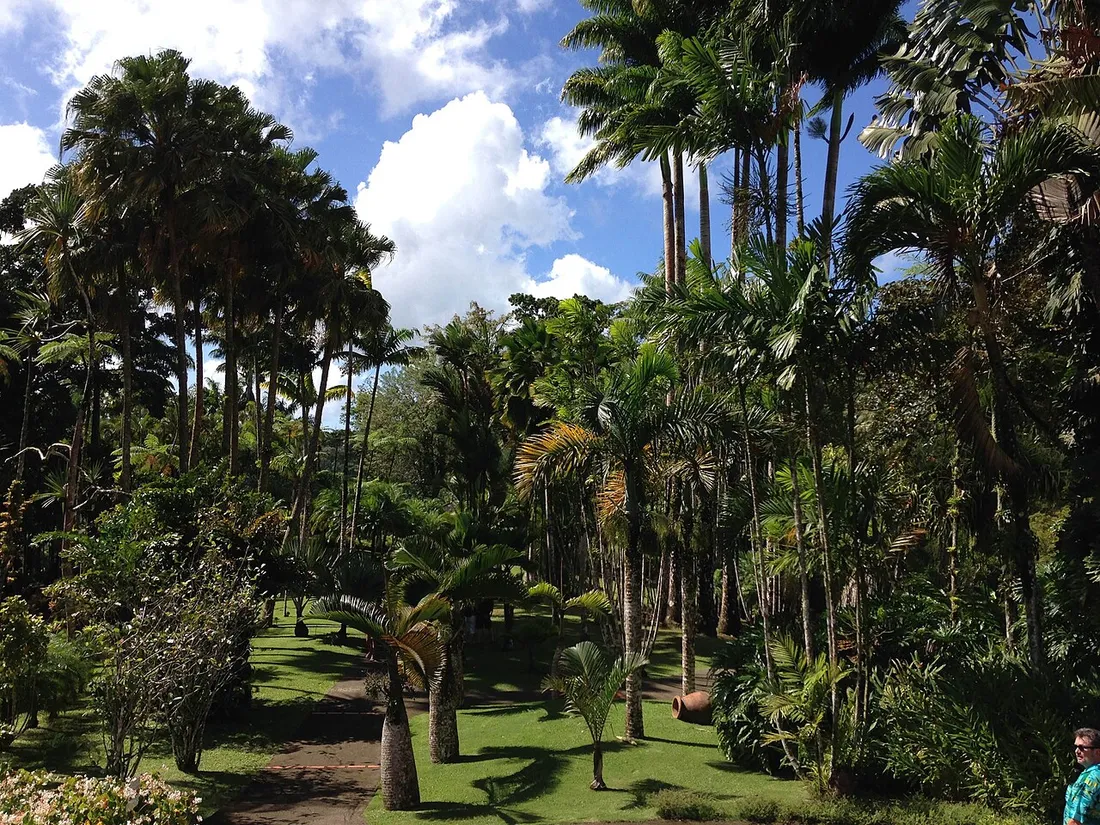
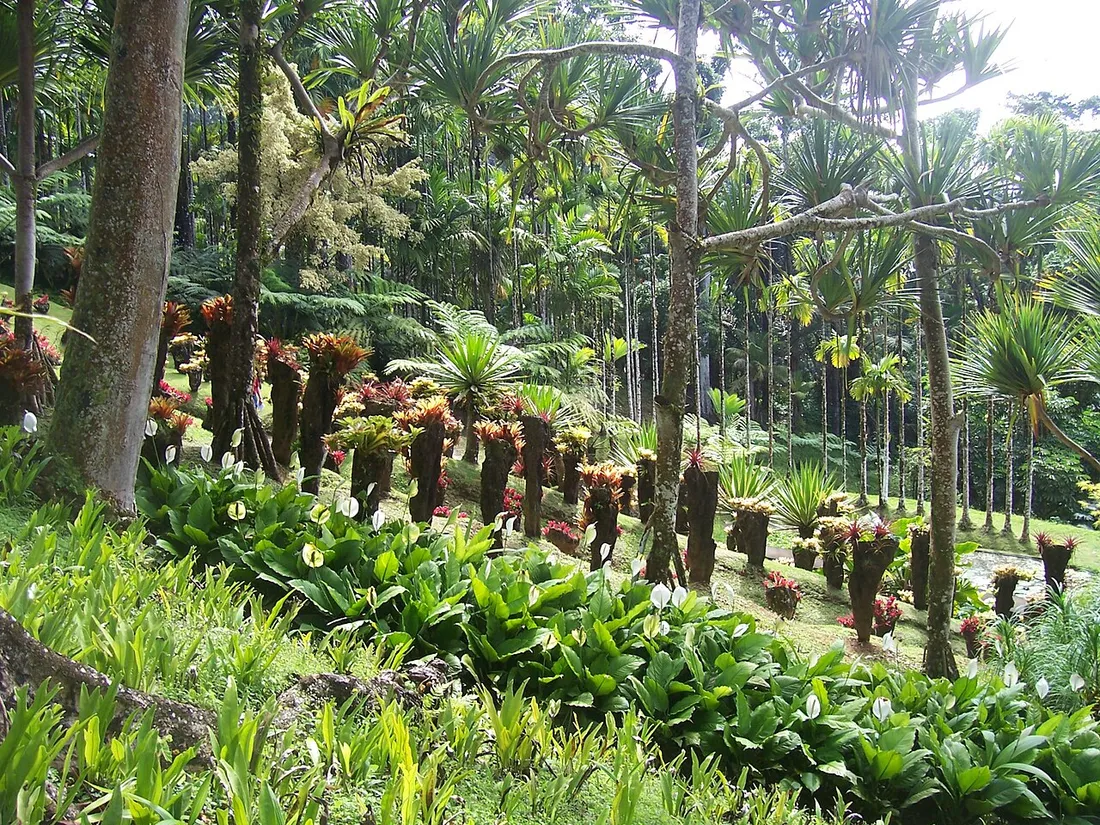
Across a few hectares, this botanical garden of Fort-de-France brings together more than 3,000 tropical species staged like a living painting: not a row of labelled plants, but a thoughtful composition, with perspectives, water reflections and plays of height. Among the stars you’ll encounter:
- the lobster-claw heliconias (balisiers) with their red, pink and yellow bracts, the garden’s emblems;
- a collection of anthuriums and bromeliads clinging to the trunks;
- giant bamboo, tree ferns and rare palms that close the canopy;
- pools of water lilies and lotus, and Madeira hummingbirds feeding within arm’s reach.
The canopy bridges: the high point
If one thing made the place famous, it’s the canopy bridges (suspension bridges) of Balata: walkways strung between the crowns of the great mahoganies, some fifteen metres above the ground. You walk at canopy level, with a plunging view over the garden and, on a clear day, over the Bay of Fort-de-France and the Pitons du Carbet.
A few things to know before you set out:
- the route chains together several bridges linked by platforms around the trunks;
- you cross one at a time, single file: hence the waits at peak hours;
- the structure sways slightly underfoot, harmless but worth knowing if you’re sensitive to heights;
- access via stairs and narrow passages makes it difficult with a wheelchair or stroller.
Our local tip: don’t “do” the bridges at a sprint. Stop on a platform, let the group pass, and take a minute at canopy height. It’s there, in the silence, that you truly grasp the garden’s appeal.
2026 prices and opening hours
Here are the rates in force, to be taken as a rough guide: the garden revises its prices every year, so check before you go.
Indicative 2026 prices:
- Adult: around €16.50
- Child (3 to 12 years): around €9
- Under 3 years: free
- Reduced rates / groups: vary by period
Hours:
- open every day, generally from 9am to 6pm;
- last entry around 4:30–5pm;
- payment by bank card accepted.
For a family of two adults and two children, the outing runs around €50, canopy bridges included. It’s the highest entry fee among the island’s paid natural sites: precisely what fuels the “tourist trap” debate.
Our verdict on value for money: the ticket is worth it if you love botany and photography, and if you take your time (canopy bridges included). It’s more debatable if you’re just after “a pretty garden” in a hurry, since Martinique is full of them for free.
Visit length, crowds and the best light
Based on our regular visits, here’s the realistic timing:
- Express visit: 45 minutes (lower loop only).
- Comfortable visit: 1h15 to 1h30 (full loop + canopy bridges + photo break).
- Contemplative visit (plant lovers, photographers): up to 2h.
At Balata, two factors play out at once: crowds and light, especially on the canopy bridges where you cross single file, one at a time.
- 9am–10:30am (ideal): garden almost deserted, cool air, soft light that makes the heliconia colours vibrate, and above all the bridges to yourself. Without a doubt, the best moment.
- 10:30am–1pm (the peak): arrival of cruise buses and organised excursions. Queues at the bridges, photos spoiled by the crowd.
- 1pm–2:30pm (the lull): the groups leave for lunch, the garden breathes again.
- 3:30pm–5pm: calm and lovely light, but watch for highland showers, frequent in late afternoon even in the dry season.
Morning light, soft beneath the canopy, is also far more flattering for the flowers and the pools than the full midday sun. The conclusion is simple: come early.
Making the most of your visit: dress and good habits
This is highland rainforest: even during Carême (the dry season, December to April), the best time to visit Martinique, Balata can catch a shower. To slip into your bag:
- good closed shoes: gravel paths and steps are slippery after rain;
- a light windbreaker: a shower is always possible, even at the height of Carême;
- some insect repellent, useful near the pools;
- your camera or a well-charged phone, and water.
Wheelchair access: the honest take
This is the angle few guides address frankly. The Jardin de Balata is laid out on a slope, with paths that climb and descend along the hillside. The main loop has gravel sections and a few steps.
- People with reduced mobility / wheelchairs: access is partial and difficult. A lower section may be manageable with assistance, but the full loop and especially the canopy bridges are not wheelchair accessible (access stairs, narrow passages).
- Strollers: tricky on the bridges, manageable on the lower paths with an all-terrain stroller.
- Seniors / slow walkers: entirely doable by taking your time; closed shoes recommended, as it can be slippery after rain.
If accessibility is a strong constraint for your group, we’d point you instead to an alternative below, or we adapt your programme. This is exactly the kind of detail our team fine-tunes with you over WhatsApp before your stay.
How to get to the Jardin de Balata
The garden sits on the Route de Balata (RN3), the old Route de la Trace that climbs from Fort-de-France towards the North through the tropical forest. Indicative distances and times:
- from Fort-de-France: about 10 km, 15 to 20 minutes;
- from Aimé Césaire Airport (Le Lamentin): about 20 km, 30 minutes;
- from the South (Les Trois-Îlets, Sainte-Anne): 40 minutes to 1h depending on Lamentin traffic;
- from Saint-Pierre (North): about 45 minutes via the Trace.
A car is strongly recommended: public transport service is very limited and the winding road is best savoured behind the wheel. Parking on site is free. A little local tip: the famous Balata church, a replica of the Sacré-Cœur of Montmartre, is two minutes away for a free photo stop. Bear in mind too the time difference on arrival (-5h in winter, -6h in summer vs Paris): the first mornings, waking early to tackle Balata in the cool will happen all by itself.
So, is it worth the detour? Our on-the-ground verdict
Yes, if: you’re staying in the centre or the North, you love nature and photography, you come early, and you combine Balata with the rest of the Route de la Trace (Montagne Pelée, Depaz distillery, UNESCO-listed Saint-Pierre). In that case, it’s a memorable stop.
Worth a second thought, if: you’re staying in the South (Sainte-Anne, Le Diamant) with a tight, beach-focused schedule, or if the family budget is a factor. The detour alone from the South isn’t obvious for a 1h30 visit.
The free alternatives nearby
Martinique offers pockets of greenery with no entry ticket. Our favourites around the Route de la Trace and Fort-de-France:
- The Route de la Trace (RN3) itself: the crossing of the tropical rainforest is spectacular and free. Several pull-offs let you stop.
- The Caravelle trail (Caravelle peninsula, towards Tartane / La Trinité): a free hiking loop between mangrove, cliffs and the ruins of Château Dubuc. Magnificent.
- The Gorges de la Falaise (Ajoupa-Bouillon, paid but modest) and the many ONF trails, often free.
- The Fort-de-France seafront and La Savane: free urban green spaces for a light botanical break.
- Anse Couleuvre and the northern forest (beyond Le Prêcheur): a shaded trail lined with lush tropical flora, free access.
For “postcard” tropical flora, none of these places replaces the collection and bridges of Balata, but for zero budget and authenticity, they’re unbeatable.
Optimising your day around Balata
The garden is best slotted into a northern loop via the Route de la Trace. Our favourite sequence for a stay based in the centre:
- 9am: Jardin de Balata, right at opening, for the canopy bridges in peace.
- 11am: photo stop at the Balata church and view over the bay.
- 12:30pm: lunch on the Trace, then descent towards Saint-Pierre.
- 2pm: ruins of Saint-Pierre (UNESCO-listed) and Depaz distillery at the foot of Montagne Pelée.
- 5pm: head back, or a break at a distillery on the Route des Rhums (AOC agricultural rum).
This kind of combined day turns a “€16 detour” into a complete northern loop that fully justifies the trip.
Plan your stay with Hostel Toucan
The right base changes everything: from the centre or the North, the botanical garden of Fort-de-France and the Route de la Trace are within reach; from the South, we’d rather slot your visit into a transfer day. At Hostel Toucan, concierge service and seasonal rentals in Martinique, we know these trade-offs by heart.
- Direct booking with no platform fees: you pay the fair price, not the commissions.
- Free cancellation up to 7 days before arrival.
- WhatsApp assistance 7 days a week: we give you the right time slots, adapt your itineraries (accessibility, families, rain) and book your excursions.
Discover our accommodation in Martinique, browse our complete Martinique guide to build your stay, and if you own a property, see how we manage it for owners. The Jardin de Balata is only one stop: we compose the rest with you.
FAQ
What is the entry price for the Jardin de Balata in 2026?
Reckon on around €16.50 per adult and €9 per child aged 3 to 12; free for under-3s. Card payment is accepted and the garden revises its rates every year, so check before you go. For a family of two adults and two children, the outing comes to around €50, canopy bridges included.
What are the opening hours of the Jardin de Balata?
The garden is open every day, generally from 9am to 6pm, with last entry around 4:30–5pm. To enjoy the canopy bridges in peace and soft light, the best slot is at opening, between 9am and 10:30am, before the excursions and cruises arrive.
How much time should I allow to visit the Jardin de Balata?
Allow 45 minutes for an express visit of the lower loop, 1h15 to 1h30 for a comfortable visit including the canopy bridges and photo breaks, and up to 2h if you’re a botany or photography enthusiast. Bring good shoes and a light windbreaker, as this is highland rainforest.
What time should I visit the Jardin de Balata to avoid the crowds?
Come right at opening, between 9am and 10:30am: the garden is almost deserted, the light is soft and the canopy bridges are clear. The crowd peaks between 10:30am and 1pm with the arrival of excursions and cruises. A lull returns in the early afternoon.
Is the Jardin de Balata accessible to people with reduced mobility?
Access is partial and difficult. The garden is laid out on a slope with gravel paths and steps. The lower part may be manageable with assistance, but the full loop and especially the canopy bridges are not accessible by wheelchair or stroller. For slow walkers and seniors, the visit remains doable by taking your time.