I’ve lived in French Guiana for several years, and if there’s one piece of advice I repeat to every traveller who writes to me before landing at Félix-Éboué, it’s this: book your car before your return ticket, not after. Renting a car in French Guiana isn’t a comfort option like in the West Indies — it’s the very condition of your trip: no train, rare intercity buses, and 290,000 inhabitants spread across a territory the size of Portugal. Without a vehicle, you’ll be stuck between your accommodation and the Place des Palmistes. But renting here has its rules: roads that vary wildly between the RN1 and the RN2, insurance clauses that exclude precisely what you intend to do, and a limited fleet that empties out with every Ariane 6 launch.
Why a car is essential in French Guiana
A few distances from Cayenne to set the scene:
- Kourou and the Guiana Space Centre: 60 km, about 50 minutes via the RN1
- Saint-Laurent-du-Maroni (Camp de la Transportation, departure point for pirogues on the Maroni): 250 km, allow 3 to 3.5 hours
- Awala-Yalimapo (leatherback turtles, April to July): 270 km, nearly 4 hours
- Cacao, the Hmong village and its Sunday market: 75 km including a winding road, 1 h 15
- Roura and the landing stage for the Kaw marshes: 80 km including 35 km of degraded mountain road
- Saint-Georges-de-l’Oyapock, on the Brazilian border: 190 km via the RN2, about 2 h 30
The shared taxis (“taxicos”) leave when they’re full, and there’s almost no service after 6 p.m. For the headline outings described in our complete guide to French Guiana — a rocket launch at Kourou, the Salvation Islands, a pirogue trip on the Kaw — a car is the only way to be on time.
Renting a car in French Guiana: real budget and where to book
The supply is concentrated at Félix-Éboué airport (Matoury) and in Cayenne: international brands (Europcar, Avis, Hertz, Sixt) and local rental companies that are often cheaper but have older fleets.
Prices observed in 2026, unlimited mileage included:
- City car (Clio, 208): €35 to €50 per day, around €280 a week
- Compact SUV (Duster, Captur): €55 to €75 per day
- 4x4 pick-up (Hilux, L200): €90 to €130 per day, often unavailable at the last minute
- Fuel: around €1.85/L for unleaded (regulated price, the same everywhere)
Three calendar pitfalls to know about:
- Rocket launches: with every Ariane 6 or Vega launch from Kourou, the fleets empty out within 48 hours. Check the launch schedule and book 4 to 6 weeks ahead.
- The dry season (mid-July to mid-November): this is the high tourist season, and prices climb 15 to 25%.
- Carnival (January–February): on the “vidé” weekends, some agencies close and vehicle returns are pushed back.
Book online with free cancellation, and photograph the odometer and fuel level at both pick-up and return: disputes over a missing full tank are our travellers’ number one complaint.
RN1 and RN2: the real state of French Guiana’s roads
French Guiana has only two national roads, and they’re nothing alike.
The RN1, from Cayenne to Saint-Laurent-du-Maroni
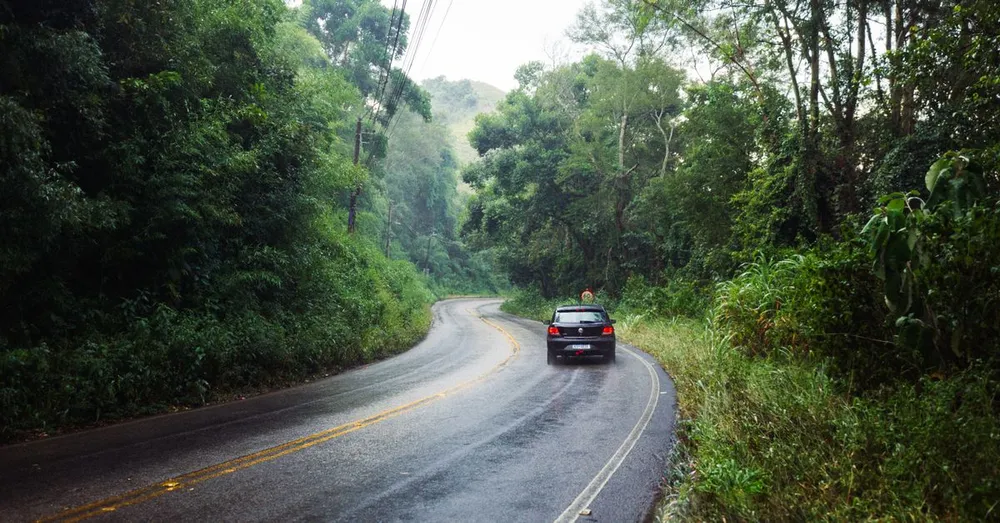
This is the backbone of the coastline: 250 km of generally decent tarmac, but a single lane in each direction, with no lighting outside built-up areas. The real dangers of the RN1 in French Guiana aren’t the potholes:
- Equatorial rain: in the rainy season (January to June), sheets of water cut visibility to 20 metres in a matter of seconds. You pull over, hazard lights on, and wait ten minutes.
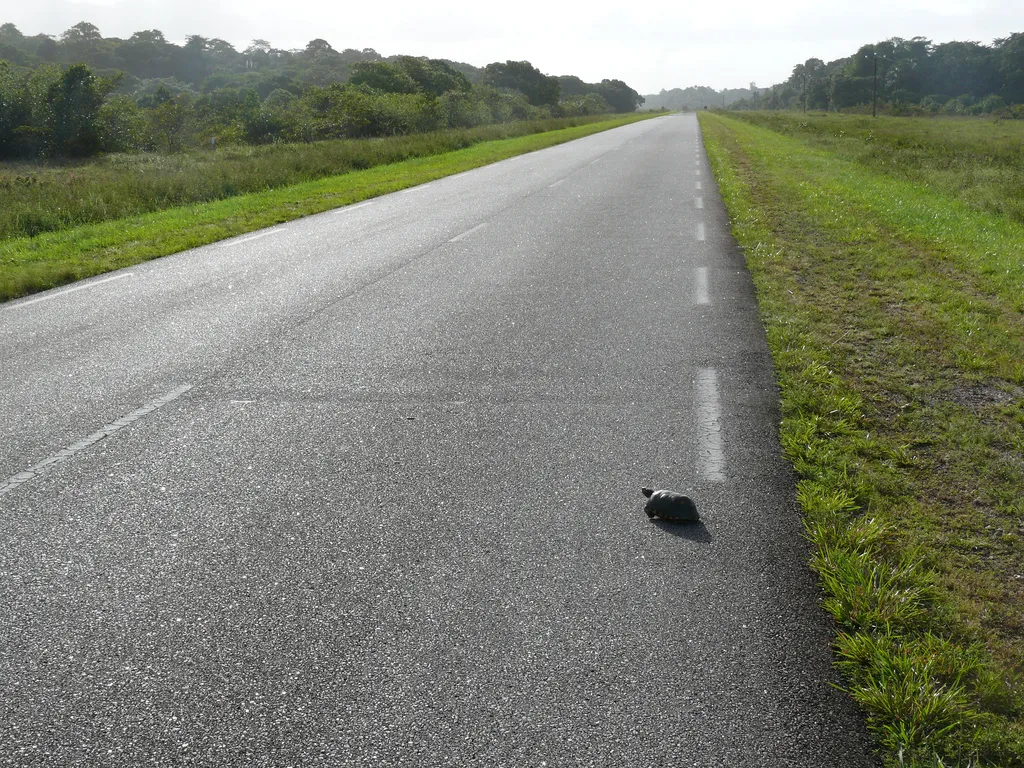
- Wildlife: stray dogs near the villages, and at night, armadillos, iguanas or deer crossing. The local rule: avoid driving at night outside built-up areas.
- The PAF checkpoint at Iracoubo: a permanent border police checkpoint between Sinnamary and Iracoubo. Keep your ID, driving licence and rental contract within reach.
The RN2, from Cayenne to Saint-Georges-de-l’Oyapock
The RN2 to Saint-Georges, fully paved since the 2000s, crosses 190 km of almost unbroken forest after Roura. Magnificent and deserted: past Régina, you sometimes drive for 45 minutes without passing a soul. Practical consequences:
- Fill up in Cayenne or Régina: no reliable petrol station between Régina and Saint-Georges.
- No mobile signal on long stretches: download your offline maps before setting off.
- PAF checkpoint at Bélizon on the RN2, same principle as at Iracoubo.
- The road surface breaks up in patches after heavy rain: a cautious 80 km/h beats the permitted 90.
And beyond the tarmac: the tracks
Kaw beyond the river crossing, the Saint-Élie track, certain carbet access routes or the Coralie track: it’s laterite, slippery as wet soap in the rainy season. This is exactly where the question of a 4x4 in French Guiana arises — and where your rental contract becomes crucial.

Insurance and contract: the clauses that change everything
This is the trap most first-time visitors fall into. Before you sign, check in black and white:
- The “tracks and unpaved roads” clause: nearly all standard contracts exclude off-tarmac driving. A chipped windscreen on the Kaw track with a rental Clio = zero coverage, repair at your own expense. If your itinerary includes tracks, insist on a 4x4 with off-road authorisation written into the contract (some local rental companies offer it, for €10 to €20 extra per day).
- The excess: count on €800 to €1,200 for a city car, up to €2,500 for a pick-up. Partial excess waiver costs €8 to €15 a day; on the deserted RN2, it’s worth it.
- Glass breakage and underbody damage: often excluded from the basic excess waiver. Yet these are the two most frequent claims here (gravel, unmarked speed bumps).
- Assistance and recovery: ask for the real response time at Régina or Iracoubo. Some contracts charge for towing beyond 50 km from the agency — which is to say, everywhere.
- The authorised zone: crossing into Brazil via the Oyapock bridge or into Suriname via the Albina ferry is prohibited by all contracts. You park the car on the French side.
- The second driver: €5 to €8 a day, indispensable for the long trips towards the Maroni.
My resident’s tips for stress-free driving
- Bring your driving licence and a bank card in the driver’s name: a deposit by card imprint is standard, so allow for a sufficient limit (often €1,500).
- Air conditioning: check it really blows cold before leaving the car park — at 32°C and 90% humidity, it’s no luxury.
- Keep a bottle of water and an umbrella in the car at all times.
- Set off early in the morning: superb light, no traffic, and you arrive before the afternoon storms.
- In Cayenne, favour supervised car parks and leave nothing visible inside the cabin.
Car booked? Think about the accommodation that goes with it
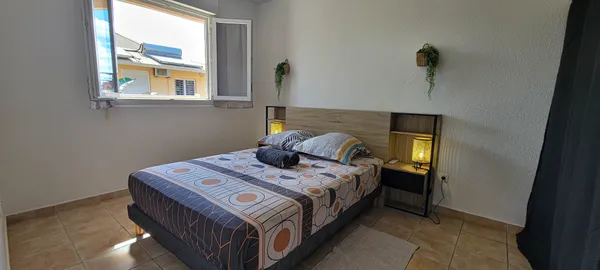
A good car rental deserves a good home base. At Hostel Toucan, our accommodations in Cayenne, Rémire-Montjoly, Matoury and Kourou have private or secure parking, and on arrival we tell you the real state of the roads and tracks for the season. By booking directly through our French Guiana accommodation page, you avoid platform fees and benefit from free cancellation up to 7 days before arrival and 7-day WhatsApp support — handy when a storm strands you in Régina. Own a property in French Guiana? Our concierge service makes it profitable with this car-equipped clientele, from A to Z.
FAQ
Do you need a 4x4 to visit French Guiana?
No, not for the classic itinerary: Cayenne, Kourou, Saint-Laurent-du-Maroni and Saint-Georges are accessible in a city car via the RN1 and RN2, both fully paved. A 4x4 becomes necessary for the laterite tracks (isolated carbets, the Kaw track beyond the river crossing), provided the contract explicitly authorises off-tarmac driving.
How much does it cost to rent a car in French Guiana?
Count on €35 to €50 per day for a city car with unlimited mileage, €55 to €75 for a compact SUV and €90 to €130 for a 4x4 pick-up, plus the excess waiver (€8 to €15/day) and fuel at around €1.85/L. Prices rise 15 to 25% in the dry season and around rocket launches.
Can you cross into Brazil or Suriname with a rental car?
No. All French Guiana contracts forbid leaving the territory, whether via the Oyapock bridge to Brazil or the Albina ferry to Suriname. You leave the vehicle in a car park on the French side (Saint-Georges or Saint-Laurent-du-Maroni) and cross on foot or by pirogue.
Are French Guiana’s roads dangerous?
The RN1 and RN2 are in decent condition, but three factors call for caution: sudden equatorial rains, wildlife crossing at night, and the absence of lighting outside built-up areas. The residents’ rule: avoid driving at night, ease off the throttle in a downpour, and fill up before the long deserted stretches of the RN2.