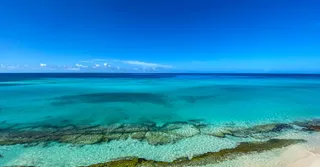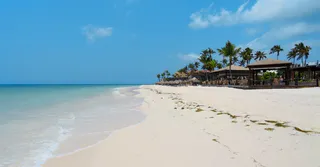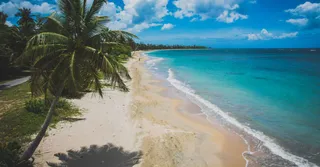
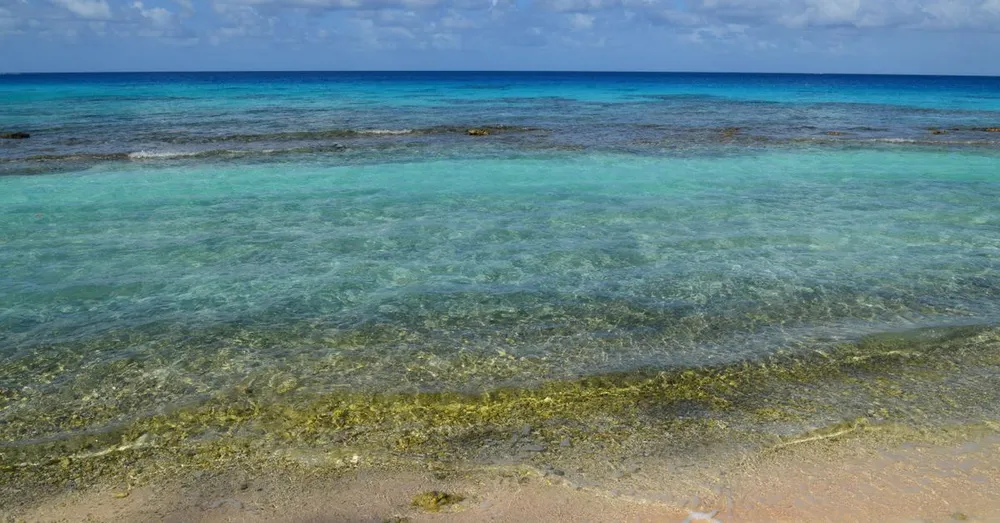
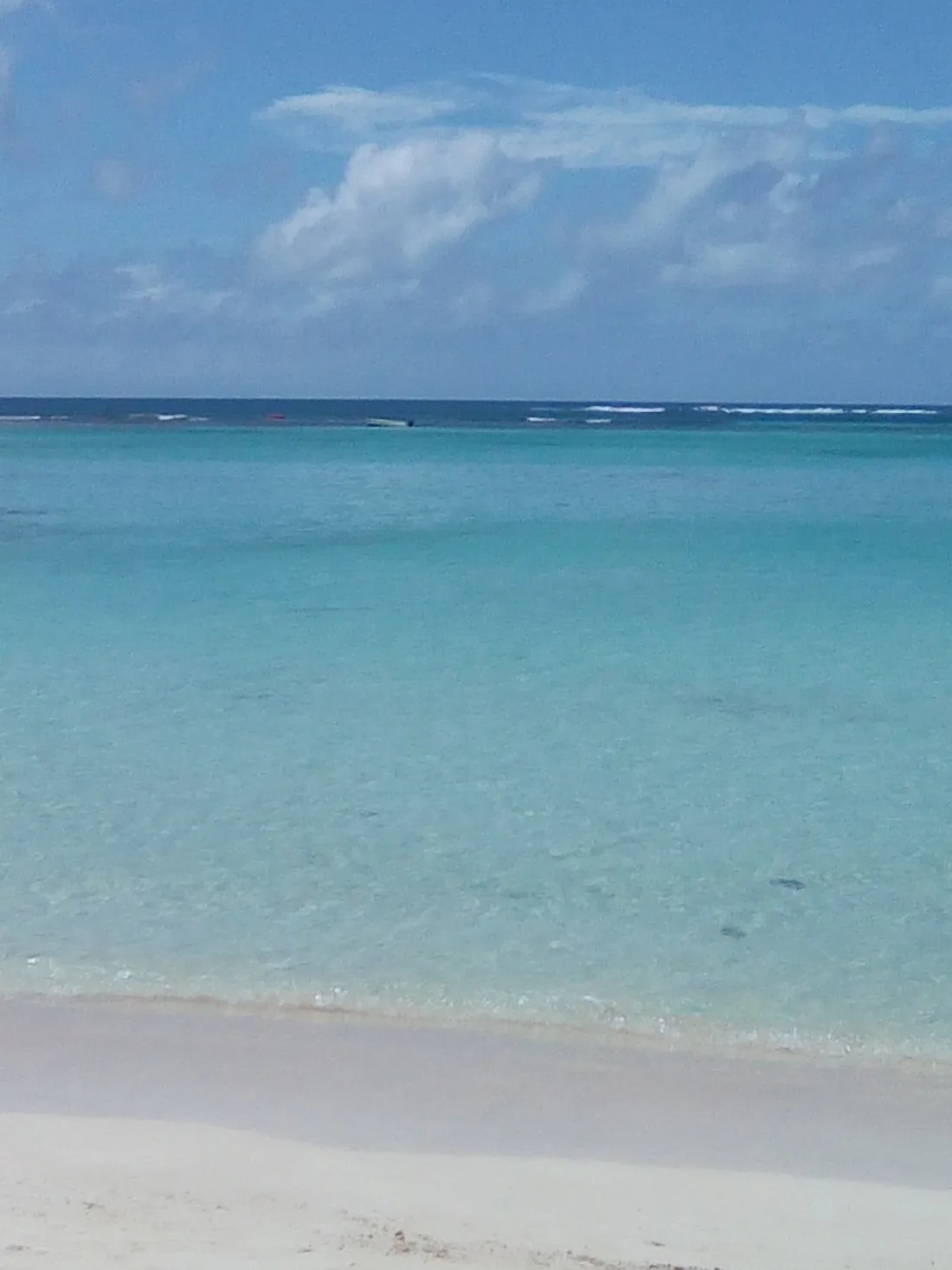
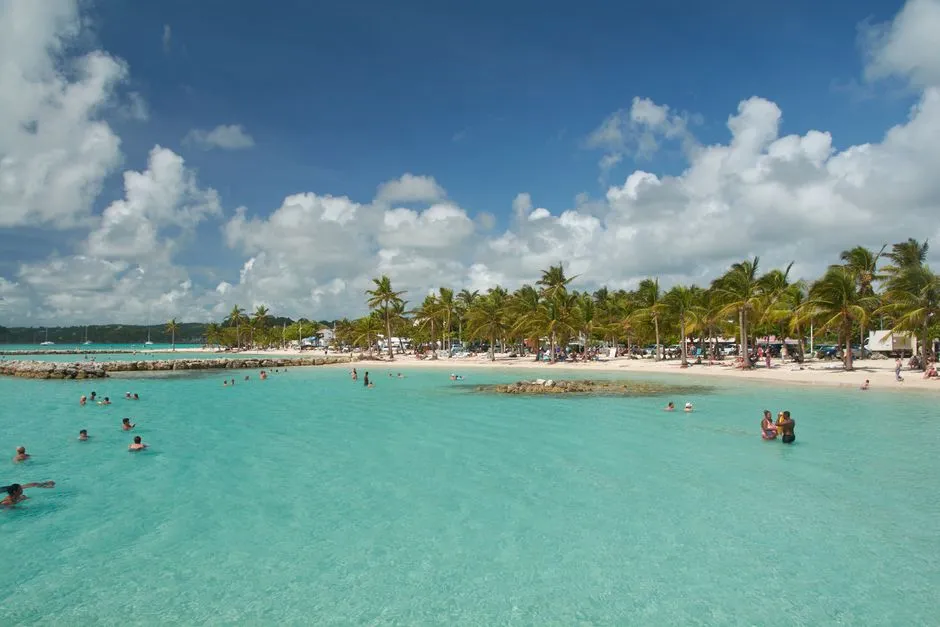
If you’re looking for the perfect beach to settle a family with young children in Guadeloupe, Bois Jolan Beach in Sainte-Anne tops nearly all our recommendations to the travelers we host. A ten-minute drive from the town of Sainte-Anne, on the southern coast of Grande-Terre, this ribbon of golden sand stretching over a kilometer opens onto a turquoise lagoon protected by the coral reef. The result: water that rarely rises above an adult’s waist for dozens of meters, almost no waves, and generous shade from coconut palms and seaside grape trees. Here is our complete on-the-ground guide, with the details the brochures forget: seagrass beds, sea urchins, parking, and the best times to go.
Why the Bois Jolan lagoon is ideal with children
The Bois Jolan lagoon is one of the safest in Guadeloupe for little ones to swim in, and that’s no marketing claim: it’s simply how the geography works.
- Very gradual depth: you walk 30 to 50 meters before the water reaches your waist. Across most of the lagoon, a 6-year-old can touch the bottom.
- Swell broken by the reef: the coral reef, visible 200-300 meters offshore by its line of foam, absorbs the Atlantic waves. Inside the lagoon, the water stays calm even when the trade winds blow at 25 km/h.
- Water at 27-29 °C year-round: no thermal shock, even for a baby.
- Mostly sandy bottom near the shore, with seagrass areas farther out (more on that below).
Compared to its famous neighbor, Caravelle Beach, Bois Jolan is longer, less crowded on weekdays, and free of hotel clusters. It’s the quintessential “quiet Sainte-Anne beach” option.
What kids love to do here
- Build sandcastles on the fine sand of the eastern section, which widens at low tide.
- Watch sergeant majors and juvenile fish with a simple mask in 80 cm of water.
- Walk on the sandbar that emerges at low tide: ankle-deep water 100 meters from shore.
Access, parking, and facilities: the local how-to
How to get there and where to park
The beach runs along the N4, between the town of Sainte-Anne and Saint-François, at the locality of Bois Jolan (sometimes spelled Bwa Jolan).
- From Sainte-Anne town: 4 km, or 7 to 10 minutes by car.
- From Saint-François: about 9 km, 15 minutes.
- From Pôle Caraïbes airport (Pointe-à-Pitre): allow 35 to 45 minutes depending on N4 traffic, more between 7 and 9 a.m. on weekdays.
Several sandy paths lead down from the road to the beach. Parking is free under the trees, along the coast, on packed-earth lots. Our resident tips:
- Arrive before 9:30 a.m. on weekends: the shaded spots fill up fast, and Guadeloupean families set up early with coolers and barbecues.
- Leave nothing visible in the car (a rule that applies on every beach on the island).
- During the rainy season (June to November), some dirt access roads turn muddy: a regular vehicle gets through, but drive slowly.
Facilities on site: come prepared to be self-sufficient
Bois Jolan remains a wild, natural beach, and that’s exactly its charm. In practical terms:
- No permanent lifeguard station and no lounge-chair rentals.
- A few roving vendors (coconut sorbets around €3, local juices €3-4) on weekends and in high season, but nothing guaranteed on weekdays.
- One or two food trucks sometimes set up on the western side during the dry season (bokits €6-8, Creole plates €10-13); otherwise the lolos (food stalls) in Sainte-Anne town are 10 minutes away.
- Bring water, a beach umbrella (even though natural shade is plentiful), and snacks.
Seagrass, sea urchins, tides: the precautions to know
This is the paragraph we repeat to every family staying in our rentals, because it prevents nearly all the little mishaps.
Seagrass beds: useful, not dangerous
Beyond the strip of sand at the shore, the lagoon is carpeted in places with seagrass beds (the dark “grass” visible from the beach). They feed turtles and juvenile fish: don’t pull them up. With children, spot the light sand channels between the dark patches to enter the water.
Sea urchins: the real instruction
The seagrass and rocky areas shelter black sea urchins (diadem urchins). A spine in the foot is painful, and the tip breaks off under the skin. The right habits:
- Water shoes for the whole family (€8 to €15 at a supermarket or sports store locally) as soon as you leave bare sand.
- Teach children to watch where they put their feet in dark areas, and to swim rather than walk as soon as the water is deep enough.
- In case of a sting: remove the accessible spines, disinfect, and visit a Sainte-Anne pharmacy if fragments remain embedded.
Tides and weather
The tidal range is small in Guadeloupe (30 to 50 cm), but at low tide the lagoon becomes very shallow: perfect for toddlers, frustrating for swimmers, who will prefer high tide. Don’t approach the coral reef: the current is stronger there and the reef flat is sharp.
When to come and what to do around Bois Jolan
The best times and seasons
- Weekdays, 9 to 11:30 a.m.: superb light, minimal crowds.
- Late afternoon (4 to 5:30 p.m.): the coconut-palm shade lengthens, and the lagoon takes on golden tones.
- Dry season (December to April): the best period, clear sea and steady trade winds; it’s also high season, so aim for weekdays.
- Sundays: local atmosphere, music, and family picnics. Authentic, but noisy if you’re after quiet.
To combine in a day
- Caravelle Beach (8 minutes) to compare Sainte-Anne’s two iconic lagoons.
- Sainte-Anne market in the morning: local fruits, spices, accras (cod fritters).
- Pointe des Châteaux (25 minutes via Saint-François) for the climb to the cross at day’s end.
- A snorkeling excursion to Petite-Terre from Saint-François if your children are confident with a mask and snorkel.
To build a complete itinerary across Grande-Terre and Basse-Terre, see our Guadeloupe guide, written and updated by our teams on the ground.
Staying near Bois Jolan: the smart choice for families
Staying between Sainte-Anne and Saint-François puts the island’s most beautiful lagoons less than 15 minutes from your door — your youngest one’s nap included. At Hostel Toucan, a concierge service based in the French overseas territories, we manage vacation rentals in Guadeloupe selected for families: equipped kitchen, baby cots on request, and our personalized on-the-ground recommendations on arrival (including the map of our favorite spots at Bois Jolan).
Booking directly with us means:
- No platform fees: the price shown is the price you pay.
- Free cancellation up to 7 days before arrival.
- WhatsApp support 7 days a week during your stay, in French, from people who live here.
Do you own a villa or apartment in the Sainte-Anne area? Our owners page explains how we promote properties near family beaches, among the most sought-after in Guadeloupe.
FAQ
Is Bois Jolan beach supervised?
No, there is no permanent lifeguard station at Bois Jolan. The lagoon is naturally calm and shallow, but children should remain under their parents’ supervision. In an emergency, dial 18 or 112; the Sainte-Anne fire brigade responds within about ten minutes.
Can you snorkel at Bois Jolan?
Yes, modestly: you’ll spot juvenile fish, starfish, and sometimes a turtle above the seagrass, in 1 to 2 meters of water. For a real snorkeling spot, head to the Cousteau Reserve at Malendure (west coast of Basse-Terre) or take an excursion to Petite-Terre.
Is parking at Bois Jolan paid?
No, parking along the coast is free, on shaded sandy lots. They fill up fast on Sundays and during school holidays: arrive before 9:30 a.m. and leave nothing visible in the vehicle.
Bois Jolan or Caravelle with children?
Both lagoons are shallow, but Bois Jolan is longer, wilder, and less crowded on weekdays, with abundant natural shade. Caravelle offers more services (restaurants, equipment rental) thanks to its proximity to the Club Med. Our pick as residents with young children: Bois Jolan in the morning, lunch at a lolo in Sainte-Anne town.