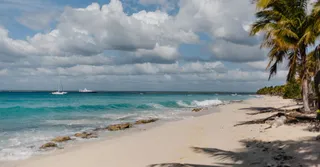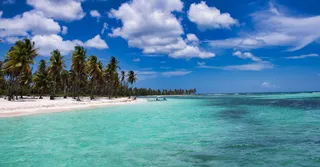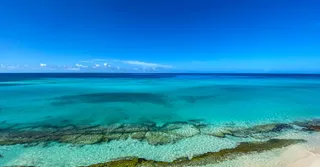
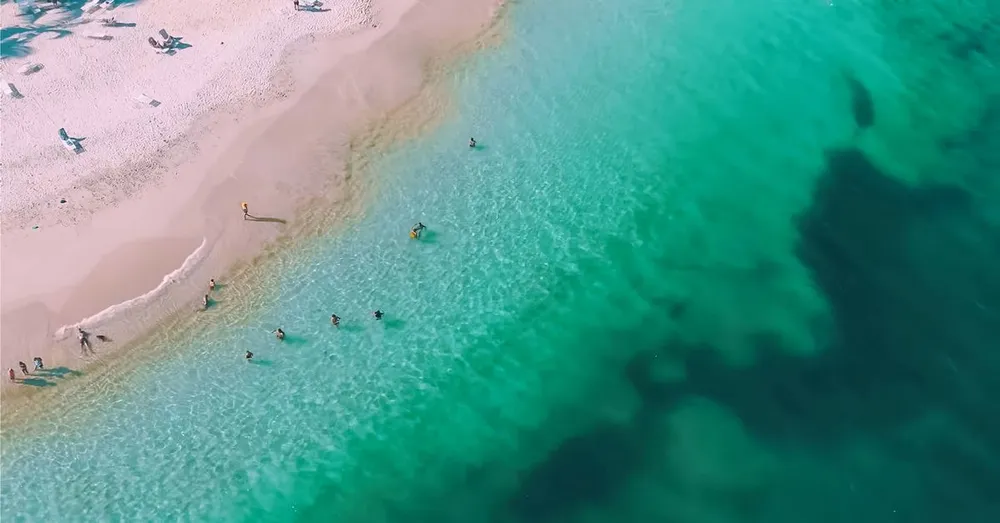
Everyone knows the Caravelle in Sainte-Anne with its turquoise lagoon, or the Pointe des Châteaux with its postcard-perfect panoramas. But when you live here year-round and crisscross Grande-Terre every week to manage your rentals, you eventually come to know another Guadeloupe: the one of hidden coves, with no snack bar, no paved parking, sometimes no phone signal. It’s our cleaning teams, from walking the coastline between two check-outs, who scouted out these inlets where you’ll meet more hermit crabs than tourists.
Here is our little black book of Guadeloupe’s secret beaches, focused on the east coast of Grande-Terre, between Le Moule and Saint-François. Pack a good pair of shoes, plenty of water, and forget any hope of renting a sun lounger.
Why the east coast of Grande-Terre remains unspoiled
Grande-Terre is the “flat” wing of the Guadeloupean butterfly: a limestone plateau that gives those clear seabeds and that turquoise water. But the coastline isn’t the same all the way around. The south (Le Gosier, Sainte-Anne, Saint-François) concentrates the seaside activity, the hotels and the marinas. The Atlantic coast, on the other hand, is buffeted by the trade winds and the swell: fewer hotel complexes, more dirt roads, and therefore far fewer people.
It’s precisely this exposure to the wind that has protected these coves. Access is often complicated, swimming sometimes tricky, and the complete absence of services discourages mass tourism. The result: 20 minutes from Saint-François, you can have 300 metres of sand all to yourself on a Tuesday in January.
Good to know: the best window remains the dry season, from December to April. During the wet season (July to November), the dirt tracks turn muddy and some coves are strewn with sargassum along the Atlantic side.
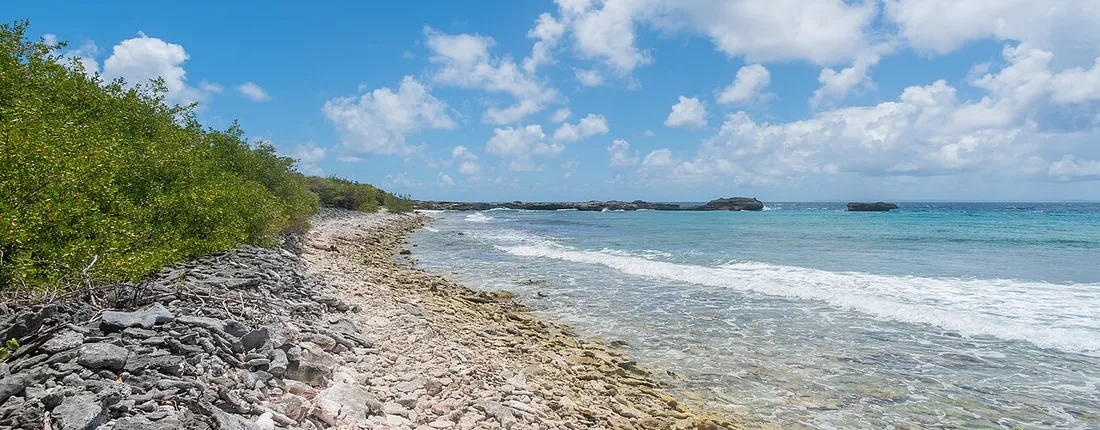
Our hidden coves, scouted on the ground
Anse Salabouelle and its neighbours (Le Moule area)
North of Le Moule, several small coves nestle behind the mangrove and the seaside sea grapes. Anse Salabouelle and its neighbours offer beige sand, coconut palms bent over by the wind, and a lagoon partly sheltered by the coral reef.
- Access: departmental road, then 1.5 km of dirt track. Passable in a regular car in dry weather, but a 4x4 or a raised SUV is more reassuring after rain.
- Approach on foot: 5 to 10 minutes from the end of the track.
- Swimming: pleasant in the lagoon section, with caution as soon as you move out towards the open sea (current).
- Services: none. No water, no bin, no guaranteed shade.
Pointe de la Grande Vigie and its hidden coves
At the very north of Grande-Terre, the Pointe de la Grande Vigie is known for its cliffs (up to 80 m) and the panorama towards La Désirade and Antigua on a clear day. What gets less mention: down below, discreet paths descend to tiny coves of pebbles and sand.
- Access: car park at the point (free), then the coastal hiking trail.
- Approach on foot: allow 15 to 30 minutes of walking depending on the cove, with some elevation change.
- Profile: spectacular but wild. Swimming not advised in swell. Reserved for the contemplative and for strong walkers.
- Tip: set off early, before 9 a.m. — there’s no shade and the return climbs.
The coves around Saint-François – Anse à la Gourde
Between Saint-François and the Pointe des Châteaux, Anse à la Gourde is an increasingly open secret, but it stays calm on weekdays and early in the morning. Golden sand, shallow water, Amerindian archaeological remains nearby: it’s our ideal compromise for anyone who wants the wild without too much effort.
- Access: paved road, then a small path; a regular car is fine.
- Approach on foot: 2 to 5 minutes.
- Swimming: easy, ideal for families in calm seas.
- Local tip: arrive before 10 a.m. for the peace and quiet, and leave before the afternoon peak.
The wild coves of Sainte-Anne (Atlantic side)
We associate Sainte-Anne with the Caravelle and its crowded lagoon. Yet, heading up the Atlantic side of the township, you’ll find far more discreet coves, lined with coconut groves. The wind is more present there, but that’s exactly what keeps the crowds at bay.
- Access: secondary tracks; 4x4 recommended on the final stretches.
- Approach on foot: 5 to 15 minutes depending on the spot.
- Profile: superb for photos and picnics, swimming variable depending on the swell.
Our survival kit for a beach with no services
These coves have no snack bar, no shower, no equipment rental, no lifeguard. That’s their whole charm, but it takes preparation. Here’s what our teams always bring along:
- 2 litres of water per person minimum — it’s hot and there’s nothing to buy on site.
- Sunscreen and a hat: the shade of the sea grapes isn’t enough at midday.
- Closed walking shoes for the approach, plus water sandals for the rocky seabeds.
- A waterproof bag for your phone (signal is patchy, some areas are dead zones).
- Picnic supplies bought before you set off (the Saint-François bakery or the Le Moule supermarket).
- A large bin bag: you take ALL your rubbish home. These sites are fragile — let’s help keep them that way.
- A full tank of fuel: petrol stations are rare on the north-east coast.
A few concrete markers for planning your day
To place your distances from the usual logistics hubs:
- Pôle Caraïbes Airport (Pointe-à-Pitre) → Saint-François: about 40 km, 45 min to 1 hr of driving.
- Saint-François → Le Moule: around twenty kilometres, 25 to 30 min.
- Saint-François → Pointe de la Grande Vigie: allow 45 min to 1 hr depending on the route.
On the budget side, renting a vehicle is all but essential: plan on 30 to 50 € per day for a compact car, and 60 to 90 € per day for an SUV or a 4x4 if you’re aiming for the dirt tracks. Fuel runs around 1.70–1.90 € per litre. None of these beaches has an entrance fee: here, nature stays free.
A quick practical reminder: Guadeloupe is a French overseas department, you pay in euros, French and Creole are spoken, and the time difference is -5 hrs in winter / -6 hrs in summer compared to Paris. So you have neither currency exchange nor any special formalities to plan for.
Enjoying without spoiling: the ethics of the hidden cove
If we share these spots, it’s on one condition: respecting them. These coves survive precisely because they aren’t equipped. A few golden rules we apply ourselves:
- We park without blocking the farm tracks or the private accesses.
- We don’t pick anything, we don’t carve anything into the sea grapes.
- We stay discreet: no Bluetooth speaker — the sound of the waves is enough.
- We watch the children: there’s no lifeguard, and some Atlantic currents are treacherous.
Where to base yourself for easy day trips
To string these coves together without spending two hours on the road every morning, the best option is to stay between Saint-François and Le Moule, in the heart of Grande-Terre. That’s exactly the area we cover with our rentals.
At Hostel Toucan, we know these beaches because we live here. By booking direct, you enjoy a booking with no platform fees, free cancellation up to 7 days before arrival, and WhatsApp support 7 days a week: one message is all it takes for us to point you to the cove best sheltered from the day’s swell. It’s that on-the-ground advice that makes the difference between an average day and an unforgettable one.
To prepare your stay, browse our complete guide to Guadeloupe, discover our accommodation in Guadeloupe ideally located to explore Grande-Terre, and if you own a property on the archipelago, see how our concierge service supports owners.
Guadeloupe isn’t just its famous beaches. The finest surprises are earned, at the end of a track or a trail — and that’s all for the better.
FAQ
What are the finest secret beaches in Guadeloupe accessible without a 4x4?
On Grande-Terre, Anse à la Gourde near Saint-François and several coves in the southern part of Sainte-Anne are accessible in a regular car with only a few minutes’ walk. Leave the dirt tracks and the Atlantic coves of Sainte-Anne or Le Moule to an SUV or a 4x4, especially after rain.
What’s the best time to discover Grande-Terre’s hidden coves?
The dry season, from December to April, is ideal: passable dirt tracks, calmer seas and less sargassum along the Atlantic side. During the wet season (July to November), the paths turn muddy and some exposed coves can be clogged with seaweed.
Are there any services on these secret beaches (water, shower, food)?
No, that’s their main feature. These coves have no snack bar, no shower, no equipment rental, no lifeguard. Plan for your own water (2 litres per person), your picnic bought before setting off, sunscreen and a bag to take all your rubbish home.
How do I know which cove to choose based on the day’s weather?
On the Atlantic coast of Grande-Terre, the swell changes everything: a cove that’s superb in a calm sea can be dangerous in heavy swell. Your Hostel Toucan hosts steer you in real time via WhatsApp, 7 days a week, towards the cove best sheltered for the conditions of the moment.