Do you own a studio, a one-bedroom or a villa in Sainte-Anne and want to offer it to travellers? Good idea: furnished rental in Sainte-Anne is one of the most profitable on Grande-Terre, driven by Caravelle beach, the Bois Jolan lagoon and steady demand from December to April. But before you collect your first night’s rent, a precise administrative path awaits: town hall registration, registration with the authorities, tourist tax, taxation. After several years managing properties for owners in Guadeloupe, here is the exact process, step by step.
Why Sainte-Anne is a thriving market for furnished tourist rentals
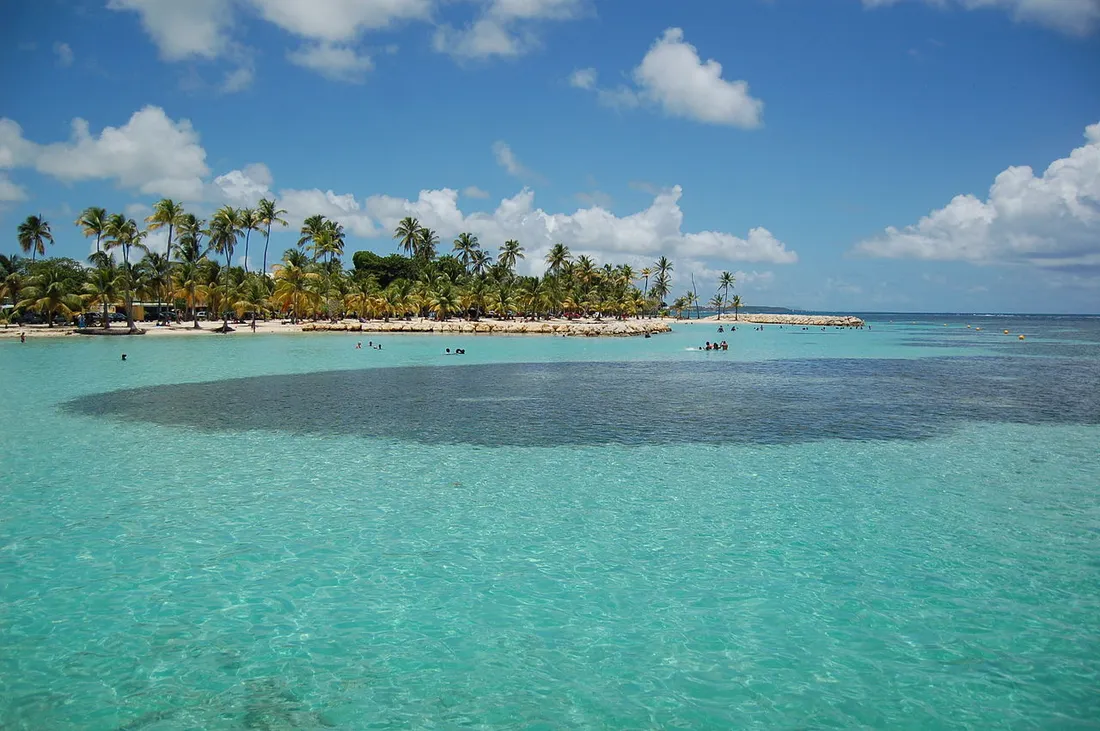
Sainte-Anne enjoys an ideal location on the southern coast of Grande-Terre: roughly 25 minutes by car from Pôle Caraïbes airport (Pointe-à-Pitre), 15 minutes from Le Gosier, 10 minutes from Saint-François. The town is home to some of the most photographed beaches in the archipelago:
- Caravelle beach: white sand, turquoise water, the town’s iconic spot;
- Bois Jolan: a shallow lagoon sheltered by the coral reef, very popular with families;
- Plage du Bourg: a short walk from the craft market and the restaurants of the town centre.
On the properties we manage in the area, occupancy rates reach 75 to 85% between December and April (dry season), and 50 to 60% the rest of the year thanks to long stays and visiting-friends-and-relatives travellers. Average rates observed: €60 to €90 per night for a well-located studio, €90 to €140 for a one- or two-bedroom with outdoor space, €180 to €350 for a villa with a pool. To place Sainte-Anne within the archipelago, see our complete guide to Guadeloupe.
Furnished rental in Sainte-Anne: the mandatory procedures
Step 1: register your furnished tourist rental at the town hall
Any seasonal rental of a furnished property to a passing clientele (stays by the night, week or month, without establishing a primary residence) must be declared at the Sainte-Anne town hall. In practice:
- Fill in form Cerfa no. 14004 (furnished tourist rental declaration); allow 15 minutes;
- Submit it at the town hall or send it by registered mail; the process is free;
- Keep the receipt: the platforms will ask for it, as will the authorities in the event of an inspection.
If the property is your second home (the most common case), the declaration is mandatory with no minimum duration. If it is your primary residence, you are limited to 120 rental nights per year. Renting without a declaration risks a fine of up to €450, and inspections are intensifying since the registration number became widespread.
Step 2: obtain a SIRET number
Furnished rental, even on a non-professional basis, is a commercial activity for tax purposes. You must register via the INPI single window (procedures.inpi.fr):
- Online procedure, free, usually within 10 working days;
- You receive a SIRET number tied to the property’s address in Sainte-Anne;
- You will then be liable for the CFE (business property tax), often between €150 and €400 per year for a furnished rental in the town, with a possible exemption in the first year.
Step 3: tourist classification, optional but strategic
The 1-to-5-star classification (Atout France standard) is not mandatory, but it changes everything:
- Higher tax allowance under micro-BIC (see below);
- Tourist tax at a fixed rate instead of the proportional rate;
- A genuine selling point with travellers and corporate works councils.
The classification visit is carried out by an accredited body; allow €150 to €250 depending on the size of the property, for a classification valid for 5 years. On a one-bedroom in Sainte-Anne rented at €110 per night, the tax saving generally covers the cost of the visit within the first year.
Tourist tax in Sainte-Anne: who collects it, how much, how to remit it
This is the point that generates the most questions among the owners we support. The tourist tax in Sainte-Anne is set at the inter-municipal level: the town belongs to the La Riviera du Levant agglomeration community (along with Le Gosier, Saint-François and La Désirade), which sets the rates and collects the remittances.
The key principles
- The tax is due per person and per night, only by adults (minors are exempt);
- For a classified furnished rental, the rate is fixed according to the number of stars: roughly €0.80 to €1.50 per adult per night depending on the category;
- For a non-classified furnished rental, the rate is proportional: a percentage of the pre-tax night rate per person (between 1 and 5% depending on the resolution in force), with a per-night cap;
- The rates are reviewed by resolution: check the scale in force each year with the agglomeration or on the online declaration platform before drawing up your contracts.
A concrete example: a non-classified villa rented at €200 a night to 4 adults, with a capped 5% rate, can generate €4 to €6 of tax per night, or roughly €30 to €40 over a week. This amount is added to the rent and must appear separately on the traveller’s invoice.
Platforms vs direct bookings: two different circuits
- Airbnb, Booking.com and the major platforms automatically collect the tourist tax and remit it directly to the local authority: you have nothing to collect, but you must still keep a register of your nights;
- For direct bookings (personal website, word of mouth, concierge service), you collect the tax from the traveller and remit it to the agglomeration, usually via an online declaration platform, on a quarterly or half-yearly schedule.
At Hostel Toucan, the declaration and remittance are part of the rental management in Sainte-Anne we provide for our owners: an up-to-date register of nights, declarations filed on time, zero penalties.