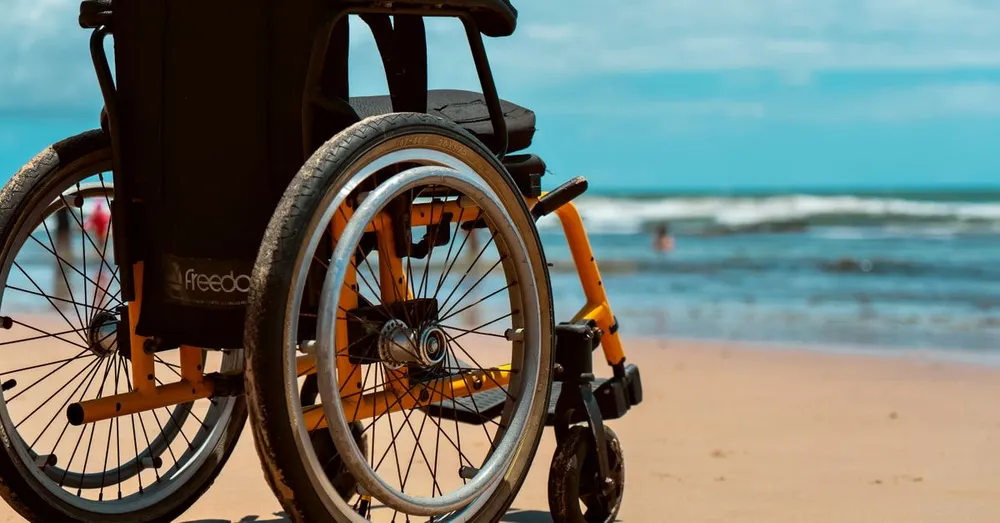
Travelling in a wheelchair under the tropics is possible — and a wheelchair-accessible Guadeloupe is no marketing slogan: free-to-borrow beach wheelchairs, Handiplage stations, paved national park trails and standards-compliant museums genuinely exist. The trouble is that the information is scattered, often outdated, and rental platforms do a poor job of filtering for truly adapted properties. After several seasons hosting travellers with reduced mobility in our rentals, here’s what really works on the ground, beach by beach and site by site, with prices, durations and the pitfalls to avoid.
Why Guadeloupe is a credible wheelchair-accessible destination
The butterfly-shaped archipelago has three structural advantages that often go unmentioned:
- It’s France. Public-building accessibility standards, the 2005 disability law, the Inclusion Mobility Card (CMI) valid everywhere: your mainland rights apply identically. No visa, no currency exchange (euro), your phone plan just works. In practice, that means reserved parking spaces in most towns and recent establishments built to standard.
- Grande-Terre is flat. The island’s limestone wing (Sainte-Anne, Saint-François, Le Gosier) packs its turquoise beaches onto near-zero relief, with paved seafronts and parking close to the sand. This is where you should base yourself.
- Pôle Caraïbes Airport (Pointe-à-Pitre) is recent, step-free on the arrivals side, with free reduced-mobility assistance (to be booked with your airline at least 48 hours before the flight) and jet bridges on most transatlantic flights.
Conversely, Basse-Terre (La Soufrière, the Carbet Falls, the rainforest) remains tougher terrain in a wheelchair: root-strewn trails, steep gradients, distant parking. Lovely excursions there are still possible by car, but the heart of a successful accessible trip plays out in Grande-Terre, with day trips out to Basse-Terre. Road surfaces are decent in the towns of Sainte-Anne, Saint-François and Le Gosier; patchier in the rural stretches of Basse-Terre, where a companion is a real asset for the high kerbs. For details on which areas to stay in, see our complete guide to Guadeloupe.
When to go? The dry season, from December to April, is the best window: firmer sand for wheels, no rain to soak the boardwalks, calm water on the lagoon side, less muddy park trails. Expect a -5 h time difference in winter (-6 h in summer) compared with Paris.
Accessible beaches: Tiralo and Handiplage, how it works
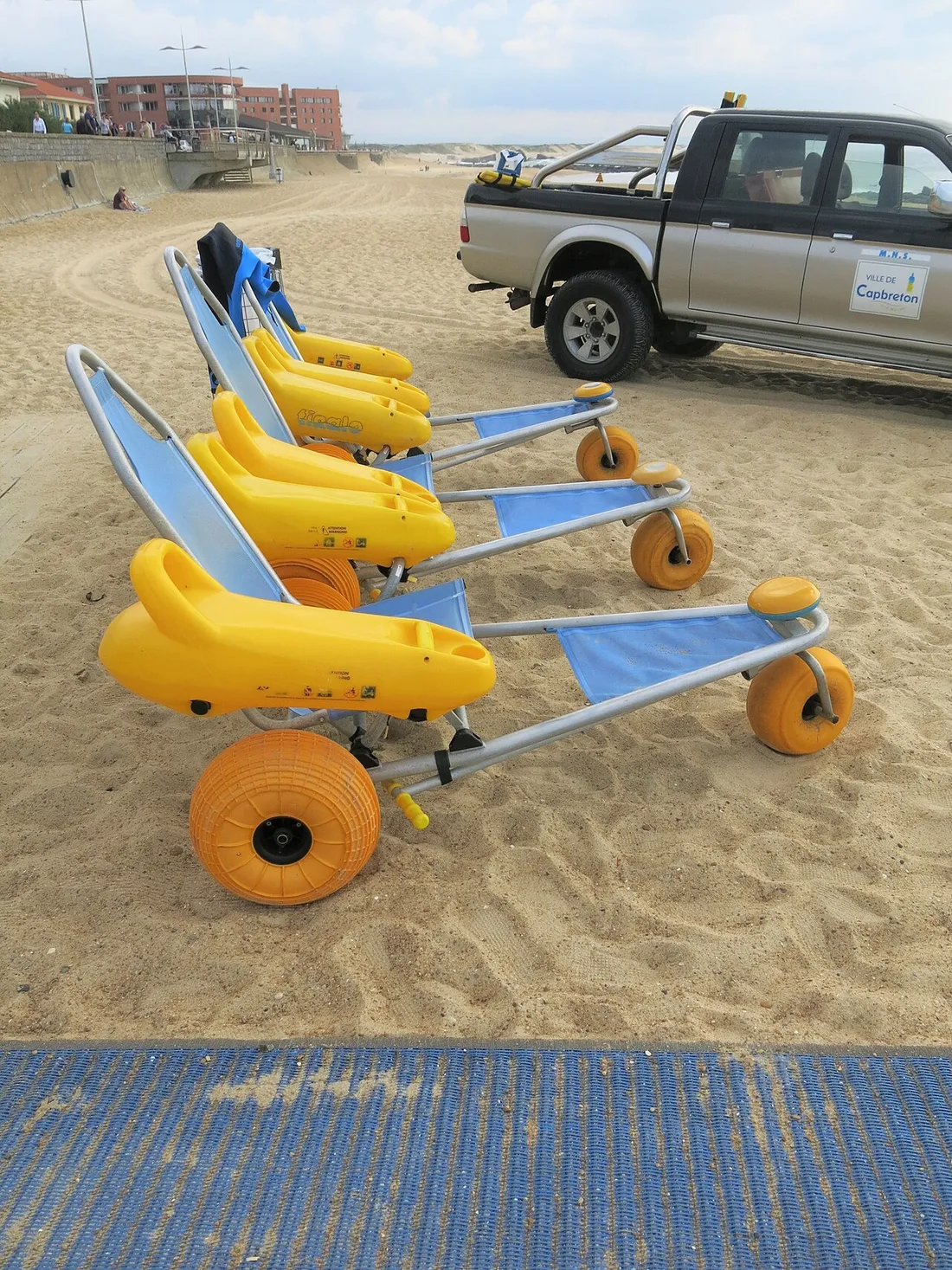
This is the island’s strong suit. Several towns have invested in amphibious beach wheelchairs (Tiralo or Hippocampe) with large floats, which let you enter the water with assistance.
Sainte-Anne, the archipelago’s benchmark Handiplage
The beach in the town of Sainte-Anne is the most fully developed spot in Guadeloupe for wheelchair users, and one of the rare Handiplage-certified beaches in the Caribbean:
- Tiralos on free loan in high season (generally December to April), with assistance from trained staff or the lifeguards — call Sainte-Anne town hall on +590 590 85 38 00 for the day’s hours.
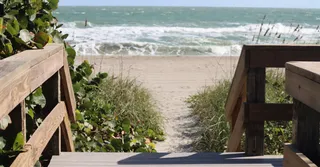
- Boardwalks from the parking lot to the tide line, reduced-mobility parking spaces less than 50 m from the sand (they fill fast: come before 9.30 a.m.), and adapted toilets and a shower on the market side.
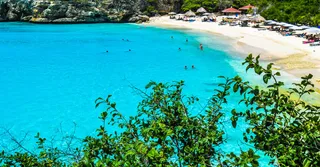
- A lagoon sheltered by the coral reef: water at 28 °C, sandy bottom, gradual depth, virtually no waves. Ideal for a safe entry by Tiralo.
The famous Caravelle beach, 2 km from the town centre, is more photogenic but less equipped (deep sand, no continuous boardwalk): save it for a rum punch at sunset on a terrace.
La Datcha in Le Gosier, the option near Pointe-à-Pitre
Just 10–15 minutes from the airport, La Datcha beach (Le Gosier) offers an access ramp, reduced-mobility spaces along the seafront, a first-aid post that handles the amphibious wheelchair loan (free, ID required) and a rollable promenade with beach restaurants at wheelchair height. Handy for combining a morning swim and lunch without getting back in the car. The Îlet du Gosier opposite, however, is inaccessible (the shuttle drops you directly onto the sand).
Les Raisins Clairs, Saint-François
A wide beach with compact sand, reduced-mobility parking, boardwalks laid out in high season and a water-entry wheelchair available through the town hall; the lagoon promenade is flat and paved, and the shade of the sea grape trees lets you stay all day without renting a lounger. Adapted toilets near the parking lot, and water entry possible on the north side with help.
And the other beaches?
Let’s be honest, two magnificent sites remain difficult:
- Grande Anse in Deshaies: sublime, but thick sand, a marked slope and waves — best admired from the beachfront restaurants rather than attempted unaided.
- Pointe des Châteaux: the cross lookout is inaccessible (stairs), but the first section of the site, redeveloped near the parking lot, rolls well and the view over La Désirade is already spectacular.
Our on-the-ground tip: always call the town hall or tourist office the day before. The Tiralos sometimes go in for maintenance without notice off-season, and the Handiplage scheme runs on seasonal staff whose hours change.
Basse-Terre: tropical nature without steps
The volcanic wing of the butterfly looks hostile in a wheelchair, but the national park has developed several remarkable sites.
Cascade aux Écrevisses: the park’s accessible gem
On the Route de la Traversée, about 35 minutes from Pointe-à-Pitre, a paved trail and a wooden boardwalk lead from the parking lot to the waterfall in 10 minutes, with no steps at all. Free access, picnic area with adapted tables. It is, to our knowledge, the only point in the tropical rainforest where you can reach the foot of a waterfall in a wheelchair. Heavy crowds on Sundays: aim for a weekday visit before 10 a.m.
Maison de la Forêt and riverbanks
Five minutes by car from the waterfall, the Maison de la Forêt offers a step-free exhibition on the park’s ecosystem and easy access to the banks of the Corossol River. Free entry, allow 45 minutes.
Carbet Falls: the first fall as an option
The Carbet Falls site (entry €2.50 per adult) has a lookout near the parking lot with a view of the second fall, reachable with help over about 200 m of stabilised path. The full trail, however, is not adapted. La Soufrière (1,467 m) remains out of reach in a wheelchair, but the Route des Mamelles offers viewpoints accessible by car over the whole canopy.
Cousteau Reserve: adapted snorkelling and diving
At Malendure (Bouillante), facing the Pigeon Islets, two clubs run adaptive diving with handisub-trained instructors (adapted intro dive around €60 to €90, by reservation). The glass-bottom boats accept folding manual wheelchairs with boarding assistance: budget about €25 for 1 h 30 over the reserve. Always call the day before to confirm the state of the jetty. It’s one of the finest memories you can bring home from here.
Culture and islands: Mémorial ACTe, distilleries and Marie-Galante
- Mémorial ACTe (Pointe-à-Pitre): the great Caribbean museum of the memory of slavery is exemplary — lifts, audio guides, wheelchairs on loan, adapted toilets on every floor, reduced rate with the CMI. Entry around €15, duration 2 to 3 h. The most fully accessible cultural outing on the island, and the best idea for rainy days.
- Aquarium de la Guadeloupe (Le Gosier): an entirely step-free route, around €13, 1 h 30 visit.
- Damoiseau Distillery (Le Moule): accessible cellars and shop, free tasting, flat aisles between the distillation columns.
- Marie-Galante: the crossing (about 45 minutes, €25 to €45 round trip depending on the operator) is done with dockside assistance — notify the company 48 hours ahead. On the island, the Bielle distillery and Feuillère beach on the Capesterre side offer decent access with a companion; rent a car on the island rather than a scooter.
- Les Saintes: Terre-de-Haut and its listed bay are worth visiting, but the disembarkation and steep little streets demand a sturdy companion. Best reserved for manual wheelchairs with help.
Accessible accommodation in Guadeloupe: what you really need to check
This is where most trips go off the rails: on the big platforms, the “accessible” filter is purely self-declared — we’ve seen “adapted villas” with three steps at the entrance. Before booking, insist on precise photos and check:
- Outdoor path: from parking to door, is there a slope ≤ 5%, with no step or loose gravel?
- Door widths: 83 cm minimum (90 cm comfortable), including the bathroom door — it’s almost always the one that’s too narrow.
- A genuine roll-in shower (no lip), with a shower seat and grab bars; bed height between 45 and 55 cm for transfers.
- Kitchen: a worktop with clearance underneath changes everything for a 10-day self-catering stay.
- Pool: very few rentals have an adapted entry; an infinity pool at ground level with wide steps and a handrail is often the best realistic compromise.
On budget, in Grande-Terre expect €80 to €120 a night for a properly adapted single-storey one-bedroom, €150 to €250 for a villa with an accessible pool. At Hostel Toucan, we visit every property in our portfolio: when a listing in our selection of rentals in Guadeloupe says “wheelchair-adapted”, we’ve measured the doors and tested the shower ourselves, and documented the exact distance to the nearest equipped beach. Booking direct, with no platform fees, free cancellation up to 7 days before arrival, WhatsApp support 7 days a week with photos to back it up — invaluable for having a medical bed delivered before you arrive (local suppliers deliver within 48 h, around €8 to €12/day on prescription).
Do you own a single-storey property in Guadeloupe? Adapting it (grab bars, roll-in shower: €1,500 to €4,000 of work) opens up a market with almost no competition and very loyal guests. We talk about it on our owners’ page.
Getting around: transfers and adapted vehicle rental
- Airport transfer: a few licensed taxis have wheelchair-accessible vehicles with a ramp. Budget €35 to €50 for Pôle Caraïbes → Le Gosier, €50 to €70 to Sainte-Anne (20 to 35 minutes). Book 72 hours ahead, as the fleet is very limited.
- Car rental: 2 to 3 rental firms offer vehicles with hand controls or a ramp — book 3 to 6 weeks ahead in high season, from €60 to €90/day. A standard SUV (€35–45/day) is enough for many travellers with a companion.
Our typical one-week accessible itinerary
- Days 1–4 — Sainte-Anne: Tiralo in the morning at the town beach, the night market on Friday, lunch with your feet in the sand.
- Day 5 — Pointe-à-Pitre: Mémorial ACTe then the spice market.
- Day 6 — Leeward coast: the Route de la Traversée, Cascade aux Écrevisses, a break at Malendure, an adaptive intro dive if booked.
- Day 7 — Saint-François: the lagoon promenade, Pointe des Châteaux, a last swim at La Datcha before the evening flight.
One final field tip: concentrate your outings in the morning (less heat and fewer crowds), keep the time difference in mind for your calls to the mainland, and always phone the day before to confirm Tiralo availability. Would you like us to plan this trip turnkey, verified adapted accommodation included? Write to us on WhatsApp: the Hostel Toucan team answers 7 days a week, and booking direct saves you 12 to 15% in platform commissions.
FAQ
Which Guadeloupe beaches lend out a Tiralo wheelchair?
The town beach of Sainte-Anne (the best equipped, with Handiplage assistance), La Datcha in Le Gosier and Les Raisins Clairs in Saint-François have amphibious wheelchairs on free loan, generally managed by the first-aid posts in high season (December to April). Show ID and call the day before to check that the equipment is available.
How much does accessible accommodation cost in Guadeloupe?
Expect €80 to €120 a night for a genuinely adapted single-storey one-bedroom in Grande-Terre, €150 to €250 for a villa with an accessible pool. Booking direct through Hostel Toucan avoids platform fees and guarantees a property checked on site, with the exact distance to the equipped beach.
Can you visit the Basse-Terre rainforest in a wheelchair?
Yes, at two sites: the Cascade aux Écrevisses, accessible via a step-free boardwalk from the parking lot (free, 10 minutes of path), and the neighbouring Maison de la Forêt, which is step-free. The Carbet Falls offer a lookout near the parking lot, but the full trail and the summit of La Soufrière are not adapted. The Route de la Traversée is done by car.
Is there adaptive diving for people with disabilities in Guadeloupe?
Yes, at the Cousteau Reserve (Malendure, Bouillante). Clubs certified in adaptive diving offer adapted intro dives between €60 and €90 with handisub-trained instructors, and the glass-bottom boats take folding manual wheelchairs with assistance (about €25 per outing). Call the day before to confirm the state of the jetty.
What’s the best time for an accessible trip to Guadeloupe?
The dry season, from December to April: more compact sand, boardwalks and Tiralos deployed on the equipped beaches, less muddy national park trails. Book the adapted vehicle and airport assistance 3 weeks ahead, as reduced-mobility provision is limited in high season.
Is reduced-mobility assistance available at Pointe-à-Pitre Airport?
Yes, Pôle Caraïbes Airport offers free assistance from drop-off to your seat on the plane: request it from your airline at least 48 hours before departure. Then plan for a wheelchair-accessible taxi booked 72 hours ahead (€35 to €70 depending on the town).