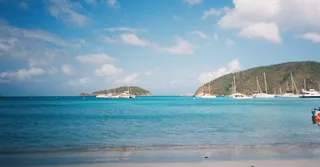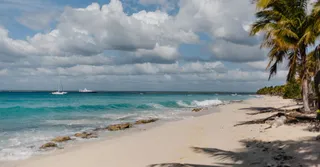
Sargassum in Guadeloupe is THE question I get asked most before a booking: “Will the beach be covered in seaweed?”. Living here, I can reassure you: strandings are seasonal, very localized, and concern almost exclusively the coast exposed to the Atlantic. With a little information, you can spend two weeks in Guadeloupe without crossing a single patch of seaweed. Here are the essentials: the at-risk season, affected towns, safe-haven beaches and the health impact.
Understanding the sargassum phenomenon in Guadeloupe
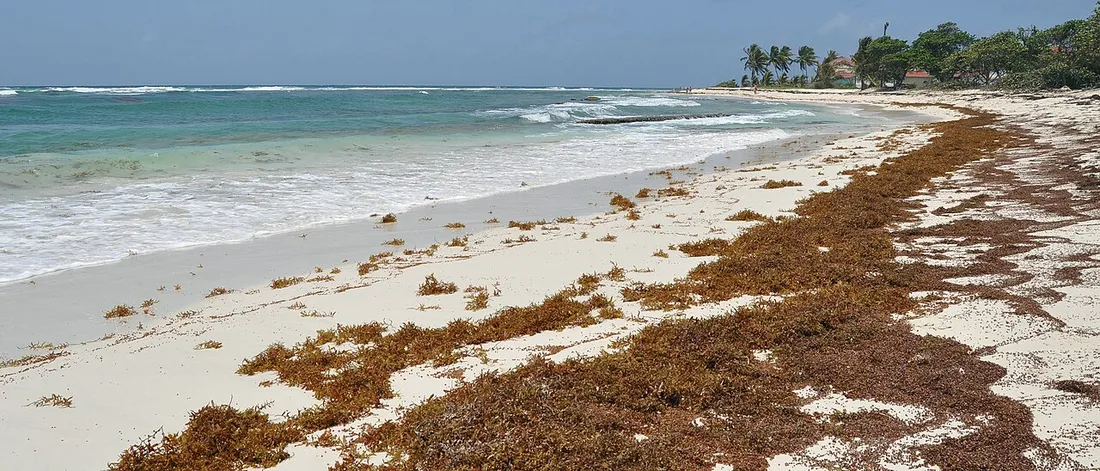
Sargassum are pelagic brown algae: they drift in the open sea, carried by currents and trade winds, from the “Great Atlantic Sargassum Belt” between Brazil and West Africa. Once they reach the Antilles arc, the rafts wash up on the east-facing coasts. At sea they are harmless; the problem starts on land, when their decomposition releases a characteristic rotten-egg smell.
Why is the windward coast the most affected?
Guadeloupe is shaped like a butterfly: Grande-Terre to the east, Basse-Terre to the west, and trade winds blowing from east to west all year round. The mechanical result: the rafts pile up on the windward coast (the Atlantic side), while the leeward coast (the Caribbean side, sheltered by the relief of Basse-Terre and the Soufrière) stays very largely spared. This is the number-one key to choosing your beach — and your accommodation.
Sargassum strandings: what season?
There is no guaranteed calendar, but the trends observed since 2011 are clear:
- December to March: the calmest period, with rare and weak strandings. This coincides with the dry season, the best time to visit Guadeloupe.
- April to August: the heart of the sargassum season, with a peak generally between May and July. This is when the Atlantic beaches can occasionally become unusable.
- September to November: a gradual decline, with residual arrivals depending on the year.
These trends nonetheless vary from one year to the next depending on the currents: a record year can extend strandings into October. Hence the value of checking the forecasts (see below).
Which beaches to avoid? The map of exposed towns
In practice, here are the areas where the stranding risk is highest between April and August, from north to south:
- Le Moule (Grande-Terre, Atlantic side): the Autre Bord beach and the coastline of the town center are regularly hit in season, despite frequent clean-up operations.
- Saint-François, east coast: the coves between the town center and the Pointe des Châteaux (Anse à la Gourde, Anse Tarare) take the rafts head-on; the lagoon on the marina side often stays in better shape.
- Sainte-Anne, eastern sector: the Caravelle beach is partly protected by its coral reef, but the town center and Bois Jolan can be affected during heavy arrivals.
- Capesterre-Belle-Eau and Goyave (Basse-Terre, east coast): the coastline south of the Carbet Falls road is one of the most impacted in the archipelago, notably Sainte-Marie and Roseau.
- La Désirade: exposed full Atlantic, the island suffers regular strandings on its south coast in season.
- Marie-Galante, east coast: the town of Capesterre-de-Marie-Galante (Feuillère beach) can be affected, while the west coast toward Saint-Louis often stays clean.
- Petite-Terre: the nature reserve sometimes sees its lagoon partly invaded; operators cancel or adapt outings on those days.
Note: “beach to avoid” does not mean “beach written off”. Floating barriers and daily clean-ups mean a beach covered on a Monday can be spotless by Thursday. But booking right on the water in these areas between May and July remains a gamble.
Sargassum-free beaches: the safe bets on the Caribbean side
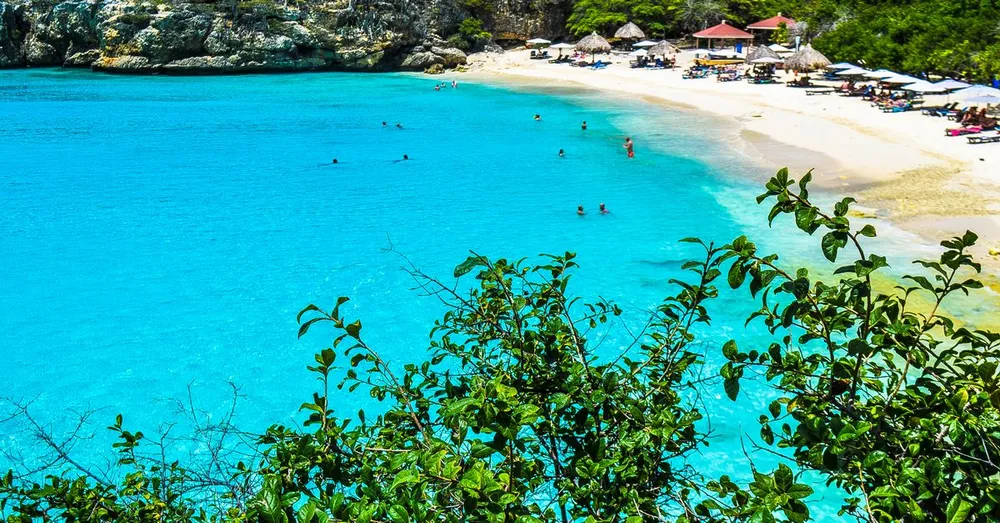
Good news: the entire western half of the archipelago lives almost without sargassum, even at the peak of the season. My resident’s safe bets:
- Grande Anse in Deshaies: 800 m of golden sand facing the sunset, protected by its northwest position. I’ve practically never seen seaweed there.
- Plage de la Perle and Anse Leroux (Deshaies): same guarantees, a wilder atmosphere.
- Malendure in Bouillante: the volcanic-sand beach facing the Cousteau Reserve and the Pigeon Islets. Snorkeling and diving stay doable year-round (intro dive around 60-70 € at the local clubs).
- Petite Anse and Anse à la Barque (Bouillante/Vieux-Habitants): sheltered coves on the leeward coast.
- Le Gosier, the Gosier islet and Petit-Havre: facing south and protected by the reefs, rarely hit and cleaned very fast. Shuttle to the islet: about 5 € round trip.
- Les Saintes (Terre-de-Haut): Pain de Sucre and the Pompierre cove, in a bay ranked among the most beautiful in the world, are almost always immaculate. Crossing from Trois-Rivières in 20-30 minutes, 25-28 € round trip per adult.
- Marie-Galante west side: Anse Canot and the Saint-Louis beach, ideal after a visit to the Bielle or Père Labat distilleries.
By basing your stay between Deshaies, Bouillante and Le Gosier, you’ll get through the sargassum season without seeing a single patch. Our complete guide to Guadeloupe details every sector.
Sargassum and health: what to know about H2S
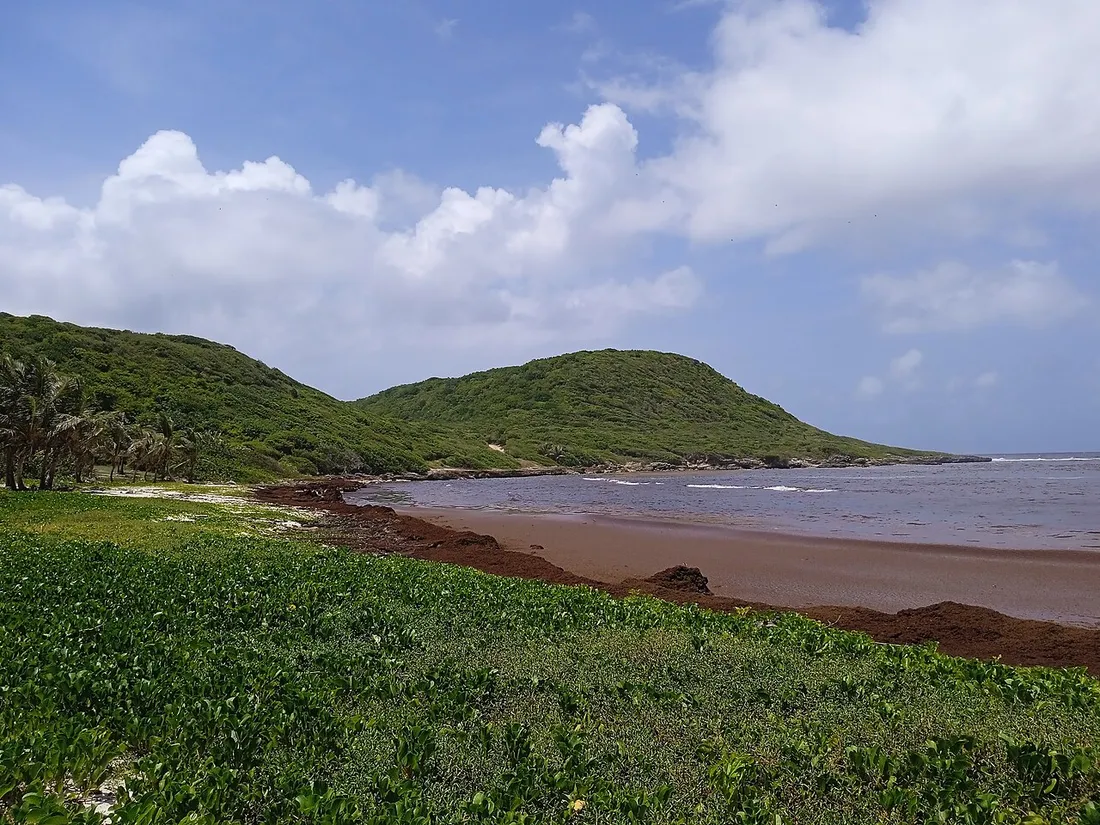
As they decompose on land, sargassum release hydrogen sulfide (H2S) and ammonia. At a low dose, it’s mostly an odor nuisance; near large decomposing piles, headaches and irritation of the eyes and throat are possible. The recommendations of the ARS Guadeloupe (regional health agency):
- Do not park or picnic next to decomposing heaps.
- Avoid swimming in the middle of stranded rafts, which sometimes harbor small stinging organisms.
- People with asthma, pregnant women and young children: keep away from areas of massive stranding, ideally staying on the Caribbean side in season.
- Useful anecdote: H2S blackens silver jewelry — a very reliable indicator of exposure.
H2S sensors are installed in the most exposed towns (Capesterre-Belle-Eau in particular) and the readings are published by the health authorities.
How to check the situation before and during your stay
- Stranding forecast bulletins: the DEAL Guadeloupe and Météo-France publish regular sargassum bulletins, with a 3-4 day forecast per coast.
- Satellite imagery: the maps from the University of South Florida show the density of the rafts in the Atlantic, to anticipate a few weeks ahead.
- Webcams and town Facebook groups: arrivals are reported there in real time.
- Ask your host: our teams live here and know whether the Caravelle is clean this morning.
Choosing the right accommodation in sargassum season
This is our job at Hostel Toucan: our properties for rental in Guadeloupe are managed by a local team that knows the exposure of each beach. Three concrete advantages:
- Direct booking with no platform fees: the displayed price is the price paid, often 10-15% less than going through the big sites.
- Free cancellation up to 7 days before arrival: if an exceptional stranding episode hits your area, you keep control.
- WhatsApp assistance 7 days a week: one message and we’ll point you to the nearest clean beach, the sea conditions at Malendure or the shuttle to Les Saintes.
Do you own a property in Guadeloupe? Managing reviews and travelers’ “sargassum” questions is part of our owner support service.
FAQ
When are there the fewest sargassum in Guadeloupe?
From December to March, strandings are rare and weak: it’s also the dry season, so the best overall window to visit the archipelago. The sargassum peak is generally between May and July, with strong variations depending on the year.
Which Guadeloupe beaches are sargassum-free?
The entire leeward coast (Caribbean side) is almost spared: Grande Anse and la Perle in Deshaies, Malendure in Bouillante, the coves of Vieux-Habitants, as well as Pain de Sucre and Pompierre in Les Saintes. On the south side, Le Gosier and Petit-Havre do very well too.
Is sargassum dangerous for health?
At sea and freshly stranded, no. When decomposing, it releases H2S and ammonia: irritation and headaches possible right next to large heaps. You just need to avoid lingering near rotting piles; sensitive people (asthma, pregnancy) should favor the Caribbean coast in season.
Should you cancel your trip to Guadeloupe because of sargassum?
No. Strandings only affect part of the Atlantic coast; the western half stays superb all year round. With well-located accommodation — and Hostel Toucan’s free 7-day cancellation — the risk to your holiday is virtually nil.