Are you preparing a job transfer, a new posting or a move to Martinique and trying to get a clear picture of your housing budget? Fort-de-France, the island’s main town, concentrates most of the administration, services and salaried employment: it is naturally the first area people look at when arriving from mainland France. But “average rent” covers very different realities there depending on the neighbourhood, the condition of the property, the view and how close the amenities are. This article takes stock, with figures given purely as an indication (ranges that shift with the season and the available supply), to help you frame your search without nasty surprises.
First, an honest caveat: nobody can give you a “guaranteed” rent down to the euro for a given neighbourhood. The Martinique market is tight, supply is limited and many deals are struck privately. So take the ballpark figures below as starting points for your negotiation and your budget, not as absolute truths.
Understanding the Fort-de-France rental market
Fort-de-France remains the most populated town in Martinique, even though its population has been declining for years in favour of surrounding municipalities such as Le Lamentin, Schœlcher and Ducos. This trend has a concrete consequence for anyone looking to rent: part of the demand has shifted to the outer ring, which keeps strong pressure on well-located properties in good condition, while some older properties in the centre sometimes struggle to find takers.
A few local realities to keep in mind:
- Seasonality matters. Between the arrival of students (start of the university year), civil servant transfers (often in summer) and the dry tourist season (December to April), pressure varies. Looking for a home in July-August means arriving at peak demand.
- The housing stock is uneven. You will find very old buildings (in the centre, sometimes without a lift or air conditioning) and recent ones (residences in the heights and on the outskirts). The rent gap reflects condition as much as location.
- Air conditioning and a view come at a price. An air-conditioned home with a view over the bay or close to the sea will systematically sit at the top of the range.
- Furnished lets are common. Many properties are offered furnished, particularly for newcomers, which pushes the rent up a little but saves you the cost of furnishing on arrival.
Rent “per square metre”: a benchmark to handle with care
People often think in euros per square metre. In Fort-de-France, depending on the type of property and the neighbourhood, levels indicatively range from roughly 11-12 €/m² for older properties in need of renovation up to 17-18 €/m² (or more) for recent, furnished and well-located homes. Once again, these are ballpark figures: a studio always rents for more per square metre than a large three-bedroom flat, and a property with secure parking or a sea view falls outside these bounds.
Indicative ranges by property type
Here are monthly budget benchmarks excluding charges, to be treated as broad ranges valid “depending on the season” and the condition of the property. They are no substitute for checking current listings.
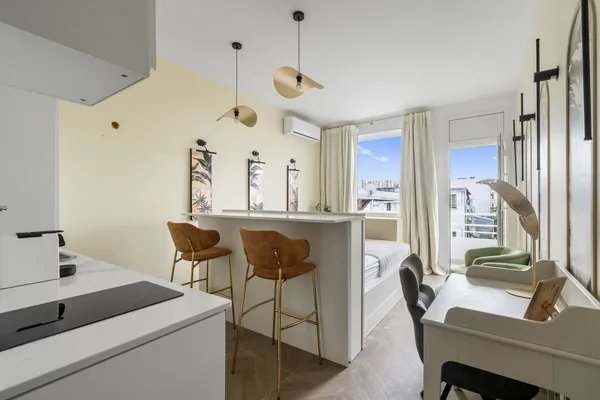
- Studio / one-room flat: as an indication, often between 500 and 750 € per month. Well-located furnished studios (centre, seafront, near the university) push towards the top.
- One-bedroom flat: indicatively 650 to 950 €, depending on condition, floor level, and whether there is air conditioning and parking.
- Two-bedroom flat: generally 850 to 1,300 €, with a marked gap between older properties in the centre and recent ones in the heights or on the outskirts.
- Three-bedroom flat and up / house: from around 1,200 €, and easily beyond 1,800-2,000 € for a recent house with outdoor space in a sought-after residential neighbourhood.
These amounts exclude building service charges, water and electricity — far from negligible items in a tropical climate, especially if you use air conditioning a lot.
Overview by neighbourhood and district
Fort-de-France stretches from the seafront up to fairly distant heights. Location changes everything, both for rent and for day-to-day quality of life.
The town centre and the seafront
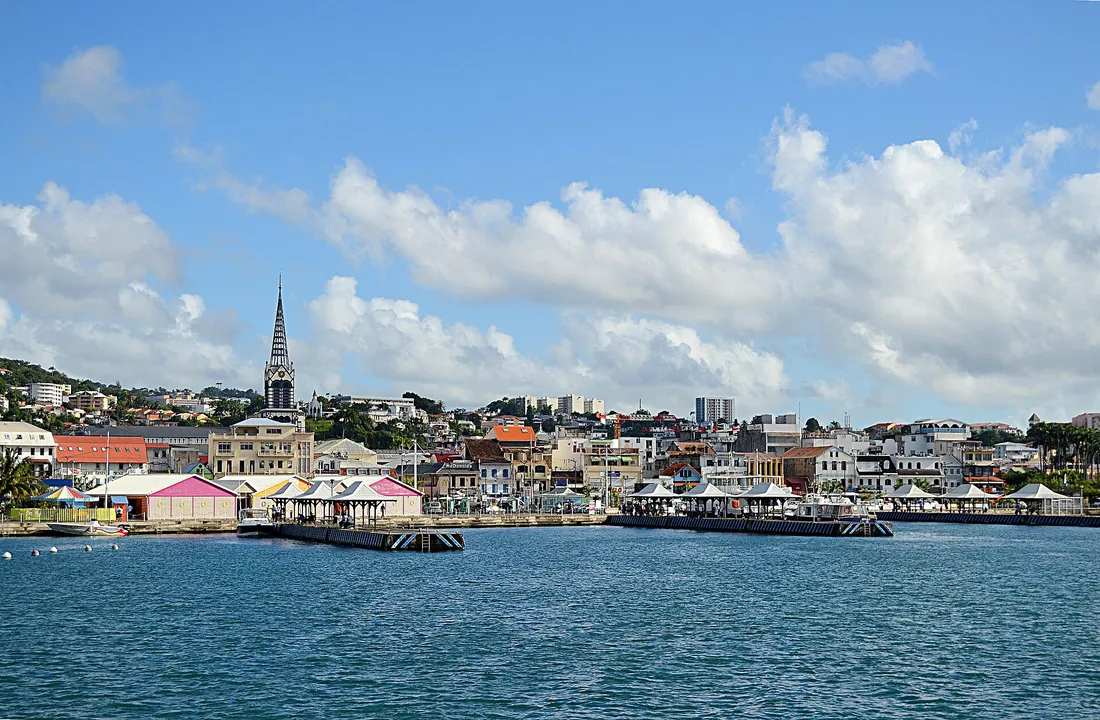
The centre (around La Savane, the covered market and Saint-Louis Cathedral) remains lively, full of shops and well served by transport. You mostly find older buildings there, sometimes in need of renovation, with rents that can stay reasonable for small floor areas. Points to watch: difficult parking, noise, and a buzz that drops off sharply in the evening. Renovated properties with a view over the bay, on the other hand, cost significantly more.
The heights of Fort-de-France (Didier, Redoute, Cluny)
The residential neighbourhoods in the heights — Didier first and foremost, historically one of the most sought-after areas, but also Redoute, Cluny and Tourtet — offer more peace and quiet, greenery and often beautiful views. Rents there are noticeably higher, particularly for houses and recent developments. This is the area to target if you prioritise your living environment and accept having to drive to reach the centre.
The near outskirts and the outer ring
Many newcomers end up looking beyond the municipal boundaries, in the ring around Fort-de-France:
- Schœlcher, adjoining to the west, prized for its university campus, its beaches and its residences; demand is strong and rents are often comparable to, or even higher than, those in the smartest Fort-de-France neighbourhoods.
- Le Lamentin, in the heart of the island, close to the airport and the major commercial and business zones; practical for work, with a more recent housing offer.
- Ducos, Saint-Joseph, Le François: a little further out, generally more affordable, at the cost of longer commutes.
Widening your search perimeter to the outer ring is often the key to finding better value for money, provided you accept the car as a way of life (public transport exists but remains limited).
Charges, security deposit and additional costs
The advertised rent is only part of your real housing budget. Plan for the following items:
- Building service charges: in a residence, they sometimes cover water, maintenance of common areas, even a caretaker; always ask for the amount.
- Electricity: air conditioning can send the bill soaring. It is a genuine budget item in the tropics, especially from April to November.
- Security deposit: typically one month’s rent excluding charges for an unfurnished property (potentially more for furnished lets).
- Agency fees: to be expected if you go through an estate agency.
- Home insurance: mandatory, to be taken out as soon as you move in.
As an indication, plan for starting cash reserves covering several months’ rent (first month’s rent + security deposit + any fees + moving-in costs). Better to arrive with a margin than to find yourself forced to accept the first property that comes along.