Landing in Martinique from mainland France usually means discovering an obvious truth within the first few days: here, a car isn’t a luxury, it’s almost a necessity. The island covers roughly 1,128 km2, but the rugged terrain, the spread of the towns and a still-limited public transport network make life without a vehicle complicated as soon as you move away from Fort-de-France. That raises a question of budget and strategy very quickly: should you buy straight away, settle for a used car, opt for a long-term lease, or rent as you go while you get set up? There’s no single answer. It all depends on how long you’re staying, where you’re settling, your budget and your tolerance for mechanical surprises. This article takes stock, with ballpark figures given purely as a guide, to help you decide with confidence.
Why a car is all but essential in Martinique
Martinique stretches from the mountainous north (around Montagne Pelee, Le Precheur, Grand’Riviere) down to the drier, more touristy south (Sainte-Anne, Le Marin, Sainte-Luce). In between, the central conurbation concentrates Fort-de-France, Le Lamentin, Schoelcher and Ducos.
A few local realities to keep in mind:
- Public transport exists but only covers part of the island. The Mozaik network and the TCSP (dedicated-lane public transport) mainly serve the Fort-de-France-Le Lamentin corridor. As soon as you’re aiming for a town in the far north or deep south, services thin out and timetables become restrictive.
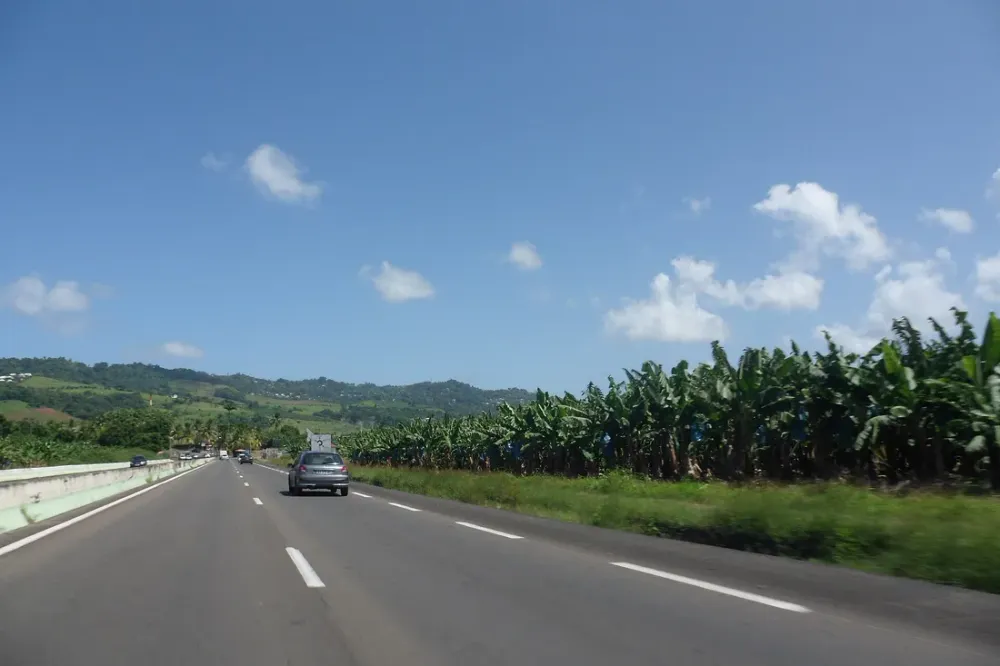
- The terrain stretches distances. A journey that looks short on the map can take a while because of winding roads, especially on the north Caribbean coast (Saint-Pierre, Le Carbet).
- Le Lamentin traffic jams. At peak times, the entrance to Fort-de-France and the Lamentin roundabout are gridlocked. A 20-minute drive can easily double.
- Day-to-day life happens on the outskirts. Retail zones at Genipa (Ducos), Le Lamentin (La Galleria) or Riviere-Salee: without a car, the big shop becomes an expedition.
In practice, if you’re settling anywhere other than central Fort-de-France, plan a mobility solution from the day you arrive.
Short-term rental: the answer for your first few weeks
When you arrive, before even deciding between buying and committing long term, short-term rental offers a comfortable transition. It gives you time to scout neighbourhoods, compare used-car listings and avoid a rushed decision.
Standard tourist rental
The major brands and local rental firms are present at Aime Cesaire airport (Le Lamentin) and in Fort-de-France. As a rough guide, expect somewhere in the region of 30 to 60 EUR per day for a small city car, with rates climbing sharply in the high tourist season (December to April, school holidays). Over several weeks, the bill quickly adds up.
Peer-to-peer rental
Peer-to-peer rental platforms often make it possible to find gentler rates, especially off season. It’s an interesting option for a transitional month, provided you check the insurance and the condition of the vehicle carefully.
The benefit of this phase: you’re not committing to anything while you deal with the real priorities of settling in (housing, school, work, paperwork).
Buying a car: new or used?
If you’re settling for the long haul (several years, or permanently), buying often becomes the most rational choice over time.
The new car market
Dealerships are mainly clustered around the Californie zone and Le Lamentin. New car prices in Martinique are generally higher than in mainland France: shipping costs, local taxation (octroi de mer is added to the price), and a sometimes narrower range. In return, you get the manufacturer’s warranty and a reliable vehicle, a real plus in an environment where the climate (humidity, salt, heat) wears mechanics down.
The used car market
This is the most common choice for new arrivals. The used market is active, with a few realities worth knowing:
- Used prices are often higher than in mainland France for an equivalent model and mileage, because demand is strong and supply limited.
- Rust and corrosion are enemy number one: salty air attacks sills, wheel arches and underbodies. Inspect these areas without fail.
- Models that are reliable and cheap on parts (small Japanese cars, common city cars) resell well and are in demand.
- Be wary of vehicles that have clocked up a lot of mountain-road miles: clutch, brakes and suspension take more of a beating here.
Checklist before buying used
- Check the roadworthiness test (controle technique) is still valid (mandatory for sale)
- Inspect sills, wheel arches and underbody for corrosion
- Check the condition of the air conditioning (essential day to day here)
- Ask for the service history and invoices
- Check that the mileage is consistent with general wear
- Obtain the certificat de situation administrative (proof of no outstanding claims)
- Take a test drive including a hill, to test the clutch
- Check the registration document and the seller’s identity
Long-term leasing (LLD / LOA)
Between buying and tourist rental, long-term leasing is a middle path that’s increasingly offered locally.
The principle: you lease a vehicle (often recent or new) over 12 to 48 months, with a monthly payment that frequently includes servicing, and sometimes insurance or breakdown cover depending on the package.
Points to weigh up:
- Advantage: no big deposit, no resale hassle, a reliable and well-maintained vehicle. Ideal if you don’t know how long you’ll stay or if you want to avoid nasty mechanical surprises.
- Drawback: over time, the total cost often exceeds that of a well-chosen used car. Contracts impose an annual mileage limit, and going over it is charged. Handing the car back requires it to be in good condition.
As a rough guide only, monthly payments on a city-car lease often start at a few hundred euros, and vary widely depending on the model, the term and the services included. Always ask for the total cost over the term of the contract, deposit included, so you can compare with confidence.