Owning a villa right on the water in Sainte-Anne, Saint-François, or Deshaies is a dream that rents out well: in Guadeloupe, beachfront properties command rates 25 to 40% higher than rentals located ten minutes from the beach. But that dream has a flip side: the salt that eats away at hardware, the humidity that stains walls, and the sargassum that can turn a postcard-perfect beach into a source of negative reviews in 48 hours. This is where a beachfront property management service in Guadeloupe makes the difference: it protects your asset and smooths your income across the year. Here is what you really need to know, after several seasons managing coastal villas on both wings of the butterfly-shaped island.
Why beachfront properties require specific rental management in Guadeloupe
A standard rental in Guadeloupe already demands rigor: greeting guests after an 8-hour flight from Paris (a -5h time difference in winter, -6h in summer), tropical cleaning, linens that wear out fast. Facing the sea, three additional constraints come into play and change the economic equation.
Salt and sea spray: accelerated aging
Within 300 meters of the shore, especially on the Atlantic side (Le Moule, Pointe des Châteaux), salt-laden spray attacks anything metallic or electronic:
- Air conditioners: an exposed split unit loses 2 to 3 years of lifespan without regular rinsing of the outdoor units. Replacement: 900 to 1,500 € including installation.
- Locks, hinges, hardware: seizing up within 6 to 12 months without lubrication. A corroded smart lock means a guest stuck at the door at 10 p.m.
- Terrace furniture and railings: only marine-grade 316 stainless steel holds up; exotic wood needs a sealer twice a year, meaning 150 to 250 € of product for 30 m².
A good property manager builds these checks into a monthly technical visit, rather than discovering the failure on the day of an arrival.
Humidity and the risk of mold
Between July and November (the wet season), humidity regularly exceeds 80%. A home closed up for three weeks in September develops a musty smell and black spots on the grout. Our protocol: cross-ventilation at every visit, a programmed dehumidifier in properties vacant for more than 10 days, and washing of textiles just before arrival when the gap is long.
Sargassum: the truly sensitive issue
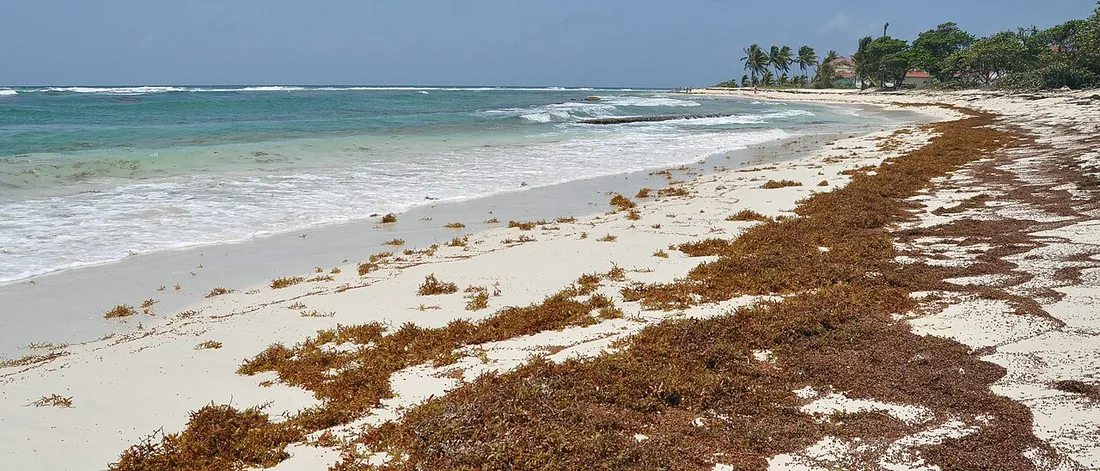
Since 2011, rafts of sargassum seaweed have washed ashore in episodes on the east and southeast coasts of Grande-Terre and on certain coves of Marie-Galante and La Désirade. In practical terms:
- Landings are unpredictable more than a few days out, but tracked by forecast bulletins (Météo-France and local networks) that should be checked every week.
- The smell of hydrogen sulfide appears 48 to 72 hours after landing if the algae are not collected.
- Municipalities clear public beaches with variable delays; on a private direct-access beach, it is up to the owner to act.
What a local property manager changes: honest guest communication before arrival (a proactive message prevents 90% of disputes), a plan B toward La Caravelle in Sainte-Anne, Grande Anse in Deshaies, or the Caribbean coast of Bouillante (very rarely affected, being on the leeward side), and coordination of a cleanup if needed (150 to 400 € depending on volume). On the listing side, we avoid overselling an “immaculate beach all year round”: transparency protects your rating.
Seasonality in Guadeloupe: aligning your calendar to maximize nights booked
Guadeloupe’s seasonality is pronounced but milder than in the Mediterranean: aim for 65 to 75% annual occupancy on a well-managed beachfront property, versus 45 to 55% with remote management.
The real booking calendar
- December to April (dry season): high season. Rates +30 to +50%, minimum stay 5 to 7 nights. Year-end holidays and February (Carnival) book 6 to 9 months in advance.
- May-June: pleasant shoulder season, clientele without children. Favor targeted promotions rather than sharp price cuts.
- July-August: secondary peak driven by the diaspora and families, intermediate rates.
- September to mid-November: the trough (heart of the hurricane season), the ideal window for major work: sealer, paint, AC servicing, bedding.
Three concrete optimization levers
- Weekly dynamic pricing based on Pôle Caraïbes flights, school holidays, and events (Route du Rhum, Carnival). On a 3-bedroom villa in Saint-François renting at 280 €/night in high season, fine calibration brings in 8 to 15% more income per year.
- Variable minimum stays: 7 nights in February, 3 in June, 2 in October to capture local weekends.
- Maintenance scheduled in the troughs: 10 days of unavailability in October cost 5 times less than an AC breakdown in February.
To position your property within its micro-market (Grande-Terre lagoon, leeward coast of Basse-Terre, proximity to the Cousteau reserve at Malendure), our complete guide to Guadeloupe details, town by town, what travelers are looking for.
What a beachfront property manager worthy of the name should include
Beyond the classic trio of listing / cleaning / check-in, demand for a coastal property:
- Monthly coastal technical check: rinsing of outdoor AC units, lubrication of locks and hinges, inspection of seals and mechanical ventilation, testing of beach equipment (kayaks, paddleboards, snorkeling gear).
- Sargassum monitoring and proactive communication of alternative beaches.
- Hurricane protocol (June to November): securing furniture, instructions to occupants, post-alert inspection within 24 hours.
- Short-circuit linen supply: sheets and towels wear out 30% faster (sand, sunscreen); 3 sets per bed minimum.
- Monthly reporting: occupancy, net income, interventions, photos.
On the budget side, full management is billed at between 18 and 25% of rental income for a beachfront property (versus 15 to 20% for a standard property), the difference covering the reinforced maintenance. On a villa generating 45,000 € in annual rents, delegation pays for itself with just 10% additional occupancy — almost always the case compared to managing from mainland France, with 5 or 6 hours of time difference.
The Hostel Toucan approach for beachfront properties
At Hostel Toucan, we manage vacation rentals in the French overseas territories with one simple conviction: a well-informed guest and a well-maintained property are worth more than ten marketing promises. In concrete terms:
- Direct booking with no platform fees: guests book on our site, and you recover the OTA margin (15 to 18%).
- Free cancellation up to 7 days before arrival: decisive for travelers hesitating over uncertainties (sargassum, weather), and excellent for the conversion rate.
- WhatsApp support 7 days a week: seized lock, beach conditions, welcome basket — a quick reply, in the right time zone.
- A local team that knows the difference between an exposed cove in Le Moule and the sheltered lagoon of Sainte-Anne, and adapts the listing accordingly.
Looking for a villa facing the sea? Browse our rentals in Guadeloupe. Own a coastal property in Sainte-Anne, Saint-François, Le Gosier, Deshaies, or Bouillante? Visit the owners page: free, no-obligation income estimate.
FAQ
Does sargassum affect all of Guadeloupe’s beaches?
No. Landings mainly concern the coasts exposed to the east and southeast (Le Moule, Saint-François on the Atlantic side, Pointe des Châteaux). The Caribbean coast of Basse-Terre (Deshaies, Bouillante, Malendure) and the leeward beaches such as La Caravelle in Sainte-Anne are very rarely affected. A local property manager tracks the forecast bulletins and directs guests toward the spared beaches.
How much does property management cost for a beachfront villa in Guadeloupe?
Count on 18 to 25% of rental income for full management, versus 15 to 20% for a standard property. The extra cost funds the reinforced maintenance (AC rinsing, anti-corrosion, sargassum monitoring). With the occupancy gain and dynamic pricing, net income generally exceeds that of remote management.
What is the best time to rent out a beachfront property in Guadeloupe?
High season runs from December to April (dry season), with peaks at year-end and in February. July-August forms a second family peak. The trough from September to mid-November is ideal for scheduling work without sacrificing profitable nights.
Should you close your property during the hurricane season?
No, that would be a shame: it still rents well in July-August and welcomes a local clientele in September-October at adjusted rates. However, a hurricane protocol is essential: securing outdoor furniture, clear instructions to occupants, inspecting the property within 24 hours after each alert — the responsiveness that an on-site team provides.