People come to Martinique for the white sand of Les Salines, agricultural rum and Mount Pelée. They often leave remembering something else: a hummingbird buzzing over breakfast, a grey iguana frozen on a low wall, an electric-blue spider glimpsed on a tree trunk in the forest. Martinique’s endemic wildlife turns up everywhere, as long as you know where to look and at what time. After years of trekking across the island and briefing the travellers we host, here is my hands-on guide to spotting these species in the field, with no wildlife park or overpriced guide.
A useful reminder: “endemic” does not mean “rare” but “found only there, or almost.” Martinique, a volcanic island in the Lesser Antilles, is home to several species found nowhere else in France, or even on the planet. That is what makes the exercise so rewarding.
Understanding Martinique’s endemic wildlife before observing it
Martinique covers 1,128 km² between the Caribbean Sea and the Atlantic, with a mountainous, humid north and a drier south. This geography creates micro-habitats: tropical forest in the North, dry hills in the South, mangroves in the Bay of Génipa, islets off the Atlantic coast. Each environment has its own animal signature.
Three families concentrate the interest for anyone seeking an endemic Antilles bird or a creature found nowhere else:
- Reptiles, with the Lesser Antillean iguana and several lizards (anoles, mabouyas).
- Birds, including the white-breasted thrasher, the bananaquit, the purple-throated carib and the Martinique oriole.
- Emblematic invertebrates, foremost among them the matoutou falaise tarantula, the quiet pride of the northern forests.
Good news: no dangerous species lies in wait for you. There is no deadly venomous snake as in neighbouring Saint Lucia, the fer-de-lance having been eradicated from most frequented areas. Here you can observe with complete peace of mind.
The matoutou falaise, the blue tarantula of the northern forests
This is the island’s secret star. The matoutou falaise (Caribena versicolor) is an arboreal tarantula strictly endemic to Martinique, so much so that it has become a naturalist symbol. As an adult, it sports a greyish-green body and legs of a spectacular metallic blue; as a juvenile, it turns intense blue then pink. No other tarantula in the world displays this palette.
Rest assured straight away: it is harmless to humans, its bite is comparable to a wasp sting and it avoids contact. You never handle it — it is a species protected by decree, whose capture and transport are strictly forbidden.
Where and when to spot it
- Habitat: humid tropical forest in the North (the Mount Pelée area, Pitons du Carbet, the Route de la Trace, Ajoupa-Bouillon). It weaves a silk retreat in bark crevices, bromeliads and trunk cavities.
- Season: all year round, but more active in the wet season. Wandering males are seen more often at year’s end.
- Field tip: look for sheets of white silk on trunks along the trail edge. With a headlamp at night, you can sometimes catch the reflection of its eyes. By day, scan the bark without disturbing anything.
The purple-throated carib and the hillside birds
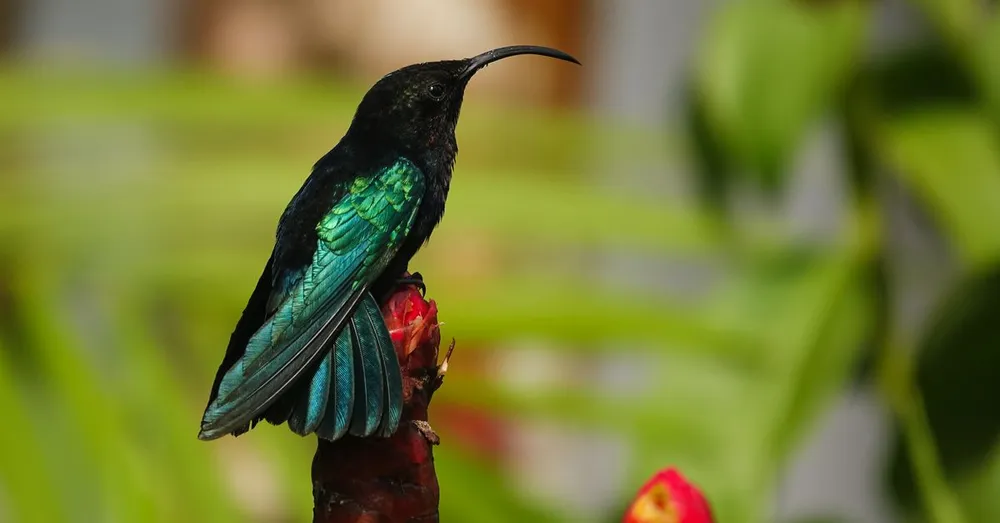
If the tarantula requires attention, the birds come to you. The purple-throated carib (Eulampis jugularis) is one of the most beautiful: dark iridescent green plumage, a brilliant red throat that blazes in the sun. It is not a strict Martinique endemic — it inhabits the Antillean arc — but it is the archetype of the endemic Antilles bird everyone hopes to photograph.
It is confused with the Antillean crested hummingbird (the famous “foufou”) and the green-throated carib, both easy to see near the flowers of heliconia, hibiscus or alpinia.
My best birdwatching spots
- The Balata Garden, near Fort-de-France: a concentrate of hummingbirds and bananaquits drawn by the flowers (entry around €16 for adults, opening around 9am). In the morning, before the crowds, it is unbeatable.
- The Caravelle peninsula (Tartane): the nature reserve is home to the white-breasted thrasher, terns and waders along the mangrove.
- Your own terrace: a sugar-water feeder or simply a flowering garden is enough to bring hummingbirds and bananaquits at dawn.
- The southern hills and the mangrove edges (Bay of Génipa) for herons, egrets and the Martinique oriole, this one truly endemic.
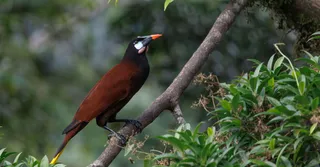
The Martinique oriole (Icterus bonana), black and rufous, is in fact the island’s emblematic bird: classified as vulnerable, it has to be earned, in the wooded areas of the centre and the North.
The Lesser Antillean iguana, an endemic reptile on borrowed time
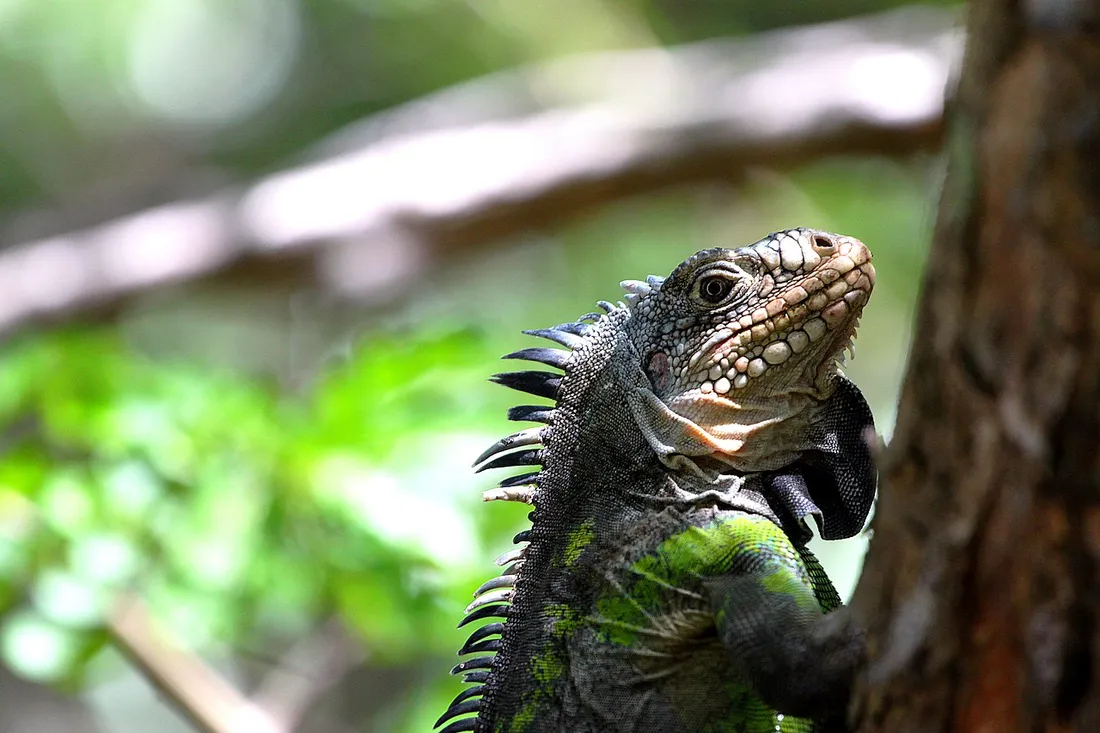
It is impossible to talk about Martinique’s endemic wildlife without the Lesser Antillean iguana (Iguana delicatissima), a large grey-green lizard that can exceed a metre. It is endangered, threatened by the introduced common iguana that hybridises with it and supplants it.
Telling them apart is the whole challenge:
- Lesser Antillean iguana (the endemic to protect): grey to dark green coat, tail without stripes, cheeks with large pale scales.
- Common iguana (the invader): tail ringed with black and a large round scale beneath the eardrum.
Its last solid stronghold is Îlet Chancel, in the Bay of Le Robert, reachable by kayak (€25 to €40 for a guided half-day) or by boat. As it is a heliotherm, aim for a sunny morning: it then basks, motionless, on the low walls and rocks.
Reptiles, crabs and small creatures not to be missed
The micro-fauna holds fine surprises for those who walk with their head down:
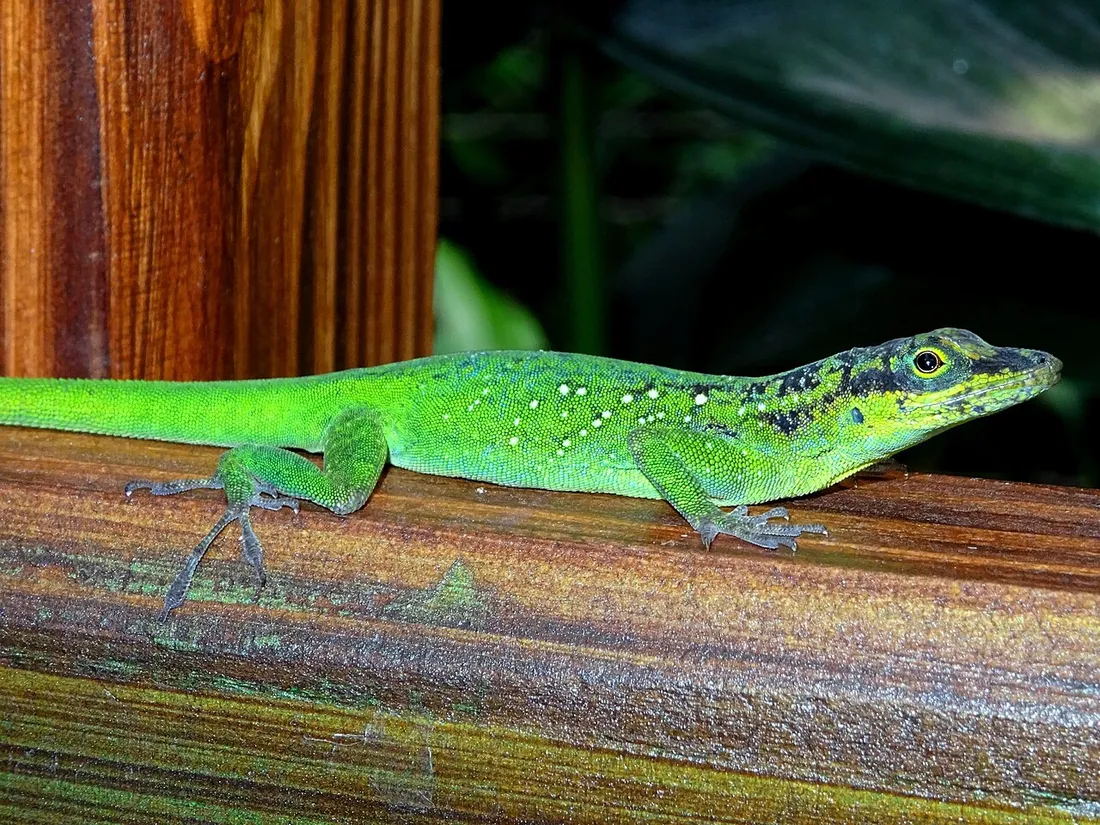
- The Martinique anole (Anolis roquet), a small endemic lizard with variable colours, omnipresent on walls and trunks.
- The land crab (touloulou) and the cirique, stars of the Creole Easter dishes, which emerge in great numbers after the first rains.
Along the coast, the nesting season of sea turtles (May to October) offers another spectacle, to be watched from a distance and at night, without lamp or flash.
Field advice and observation ethics
Observing Martinique’s endemic wildlife is a privilege that imposes a few simple rules, the ones I pass on to every traveller:
- You look, you don’t touch. Photograph with the zoom, never capture, especially the matoutou and the iguana (protected species).
- You don’t feed the wildlife: bread and fruit unbalance their diets.
- You stay on the trails to spare nests and nesting areas.
- Good gear: light binoculars, a headlamp for twilight outings, tropical mosquito repellent, closed shoes, water (1 L minimum).
- Good timing: early morning (6am-9am) for birds and iguanas, late afternoon and night for the matoutou.
On the practical side: a French overseas department, you pay in euros (dialling code +596, time difference -5h in winter / -6h in summer with Paris) and a rental car is strongly recommended to reach the spots in the North and the Atlantic. The best window remains the dry season (Carême), from December to April: passable trails, clear skies, active animals.
Plan your nature safari with Hostel Toucan
To string together Balata at daybreak, Îlet Chancel at a favourable tide and a matoutou hike in the North, it is better to have a well-placed base and a contact who knows the terrain. At Hostel Toucan, we offer handpicked vacation rentals all over Martinique, with direct booking and no platform fees, free cancellation up to 7 days before arrival and WhatsApp assistance 7 days a week to point you to the right time slot, the right nature guide and the best addresses.
To build your itinerary, see our complete guide to Martinique, browse our rental accommodation, and if you own a property on the island, discover our concierge services for owners. Book directly, set off with a free mind, and keep your eyes open: the island’s finest wildlife has to be earned, in silence and with respect.
FAQ
What is the most emblematic species of Martinique’s endemic wildlife?
The matoutou falaise tarantula (Caribena versicolor), with its metallic-blue legs, is strictly endemic to Martinique and exists nowhere else in the world. Among reptiles, the Lesser Antillean iguana is just as symbolic, but endangered. For birds, the Martinique oriole, black and rufous, is the island’s official emblematic bird.
Where can you see hummingbirds easily in Martinique?
The Balata Garden, near Fort-de-France, is the surest spot: purple-throated, crested and green-throated caribs feed on the flowers from opening time (around 9am, entry around €16). A flowering garden or a sugar-water feeder on your rental’s terrace also attracts hummingbirds and bananaquits every morning, effortlessly.
Is the matoutou falaise tarantula dangerous?
No. The matoutou falaise is harmless to humans: it avoids contact and its bite, very rare, is equivalent to a wasp sting. It is a species protected by prefectoral decree: you observe it and photograph it without ever touching, capturing or disturbing it. Its capture and transport are forbidden.
What is the best time to observe wildlife in Martinique?
The dry season, the Carême, from December to April: passable trails, clear skies and animals active under the sun. For times, aim for early morning (6am to 9am) for birds and heliothermic iguanas, and dusk or night, with a headlamp, for the matoutou falaise tarantula in the northern forest.