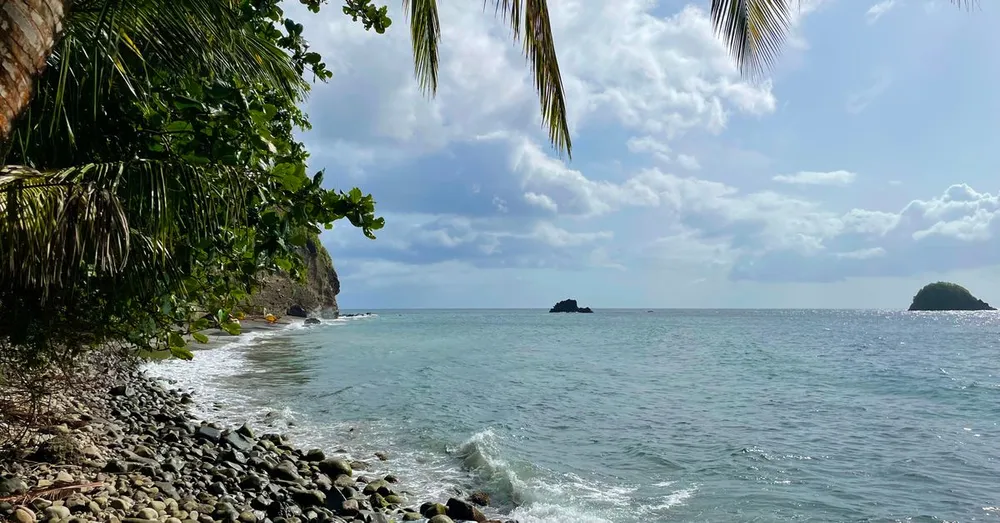
There is a place in Martinique where the road simply stops for good. Not some neighbourhood dead end, no: the true end of the island, where the asphalt surrenders to the mountain and the ocean. That place is Grand-Rivière, the very last commune of the North, clinging to the land between Mount Pelée and the Atlantic. After years of winding down this switchback road for the sheer pleasure of eating grilled fish across from the fishing boats, I can tell you this: Grand-Rivière in Martinique is the island as it was before tourism. An authentic fishing village, a black pebble beach, and the starting point of the most legendary coastal hike of all, towards Le Prêcheur. Here is my field guide so you won’t miss a thing in this tropical end of the world.
Where is Grand-Rivière, the village at the end of the world
Grand-Rivière closes off the north coast of Martinique, at the very end of the road that hugs the Atlantic from Basse-Pointe and Macouba. It is the northernmost commune on the island, wedged onto a narrow strip of land between the foothills of Mount Pelée and the sea. On the Caribbean side, just on the other side of the massif, lies Le Prêcheur: as the crow flies it’s very close, yet no road connects the two. Only a footpath does, on foot alone.
Getting there from Fort-de-France
From the island’s capital, the adventure must be earned. Allow roughly 65 km and 1h30 to 1h45 of driving, not counting the photo stops (and there will be plenty).
- Fort-de-France → La Trinité, then up the Atlantic coast via the N1 and D1 (Sainte-Marie, Marigot, Le Lorrain, Basse-Pointe).
- Basse-Pointe → Grand-Rivière via the D10: a stunning but narrow and very winding road, carved into the cliffside over the final kilometres.
- The village of Grand-Rivière: the road ends here, full stop.
A car is strongly recommended, as everywhere on the island. There are a few network buses, but timetables are sparse and ill-suited to a day of exploring. On these northern bends, drive calmly, sound your horn before blind hairpins, and savour it: the D10 is one of the most beautiful roads in Martinique. To plan your whole island itinerary, our complete guide to Martinique lists the must-sees, from Pelée to the Rum Route.
A fishing village that has stayed authentic
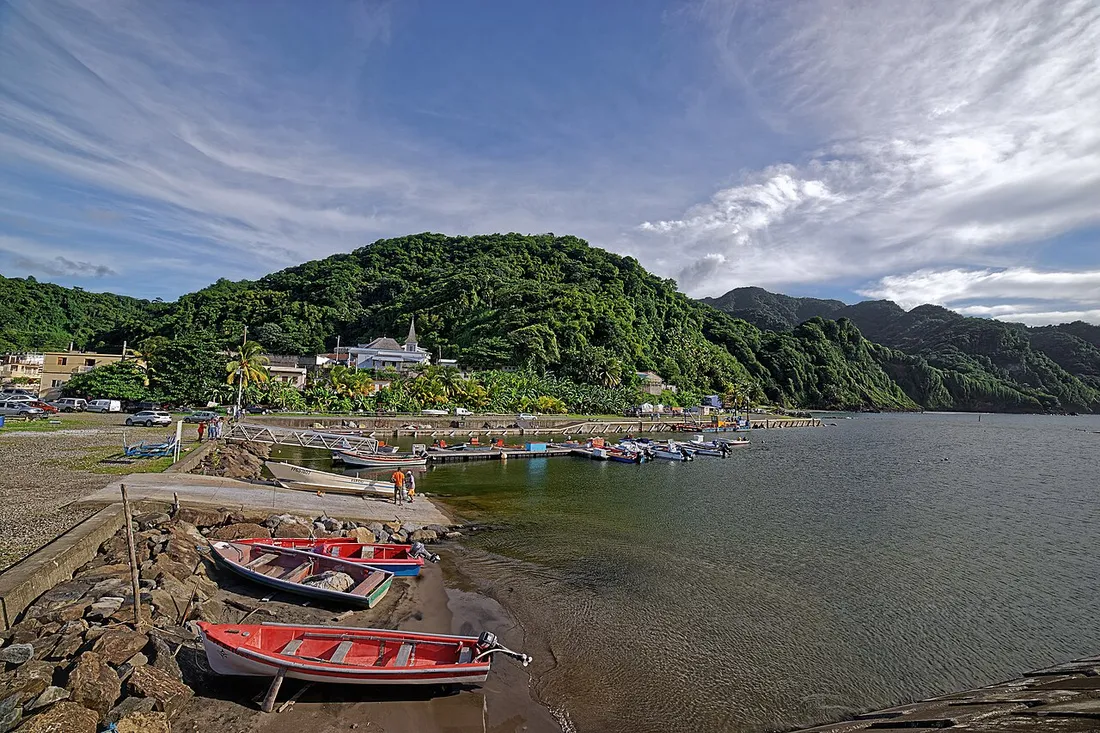
Grand-Rivière is above all a northern fishing village that still lives to the rhythm of the sea. Here there is no sanitised marina or souvenir shops: yoles and gommiers (the traditional boats once carved from a single trunk) hauled up onto the pebbles, lobster traps stacked high, fishermen coming in at dawn and selling their catch on the dock.
A few markers to grasp the soul of the place:
- Population: around 600 inhabitants, making it one of the smallest communes on the island.
- Main activity: coastal fishing, especially deep-sea fishing (tuna, mahi-mahi, marlin) and lobster.
- Atmosphere: a peaceful end of the world, where people come for the quiet, fresh fish and raw nature.
The village centre can be walked in a few minutes: the church, the small town hall, the fish market, and above all the seafront that takes in the wild coastline. Take the time to chat with the fishermen: this is where the most lilting Creole and the saltiest sea stories are passed on.
Eating fish on the dock
It’s impossible to come all this way without lunching facing the ocean. A few small restaurants and lolos (Creole shacks) line the dock and serve the day’s catch. On a typical menu:
- Grilled fish or court-bouillon, salt cod fritters (accras), féroce d’avocat.
- The famous grilled lobster when the season and the catch allow.
- All washed down with a ti-punch made of AOC agricultural rum, the quintessential local aperitif.
Expect to pay 15 to 25 € for a full fish dish, more for lobster, whose price varies with the market (often sold by weight). Book ahead or arrive before 1 pm: the tables facing the sea go fast at weekends.
The black pebble beach
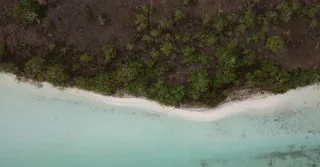
Don’t arrive in Grand-Rivière expecting the golden sand of Les Salines: here the beach is made of black pebbles rolled by the Atlantic and the river that gives the village its name. It’s a typical northern pebble beach, dark, wild, framed by cliffs draped in tropical vegetation. The sight is powerful, almost dramatic when the swell crashes onto the shore.
A few things to know before you lay down your towel:
- Swimming is tricky, even inadvisable: we are on the Atlantic coast, exposed to swell and currents, and the beach is unsupervised. People come here to contemplate, not necessarily to swim.
- The pebbles heat up and shift underfoot: bring water shoes and something comfortable to sit on.
- It’s an exceptional photo spot, especially late in the day when the light grazes the cliffs and lights up the colourful boats.
- No beach facilities at all: no shower, no sun lounger. Raw nature.
For a real swim in the area, you’re better off heading for the more sheltered beaches of the Caribbean coast (Anse Couleuvre, Le Carbet) or the calm waters of the South. Grand-Rivière is the experience of the end of the island, not the postcard beach.
The Grand-Rivière – Le Prêcheur hike, the most legendary of all
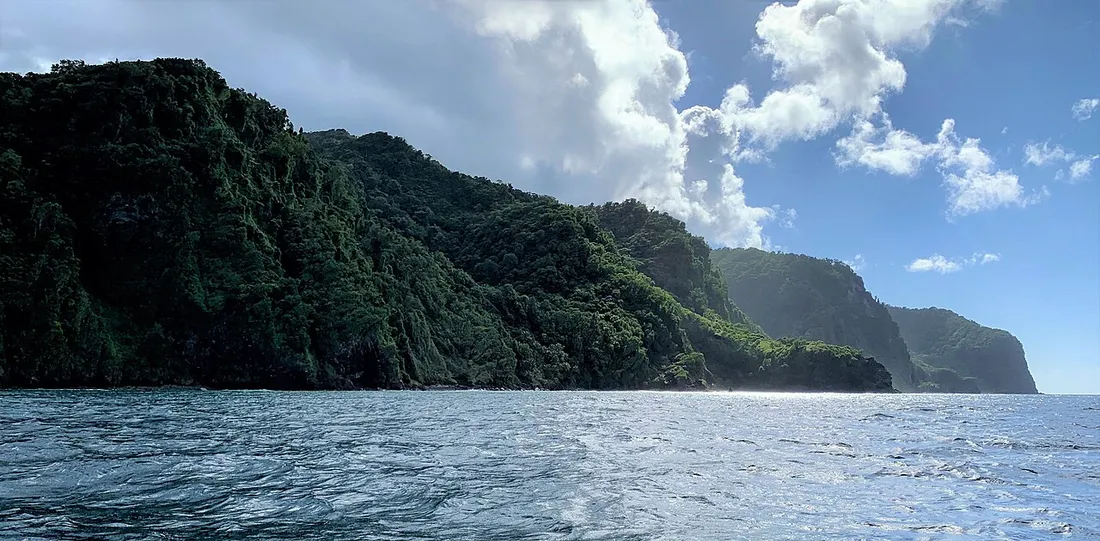
This is THE feat of the North, and the reason many seasoned hikers push all the way out here. The Grand-Rivière – Prêcheur hike links the two flanks of the island via a spectacular coastal path, accessible only on foot, where no road has ever been able to pass. A total immersion in wild Martinique.
The route and the numbers
- Distance: roughly 18 km for the full crossing between the two villages.
- Duration: 5 to 7 hours of actual walking depending on pace and trail conditions.
- Elevation gain: significant and repeated, over 1,000 m cumulative (the path constantly climbs and descends the ravines).
- Difficulty: strenuous, reserved for experienced and well-trained hikers.
The trail alternates between rainforest clinging to the cliffs, crossings of deep ravines, black pebble coves and dizzying ocean viewpoints. You’ll meet more land crabs, hummingbirds and hermit crabs than hikers. It’s one of the last totally unspoiled stretches of coast in the Lesser Antilles.
The right direction of travel and the boat shuttle
Since this is a crossing and not a loop, logistics are the real key:
- Many set off from Le Prêcheur towards Grand-Rivière, to finish at the village and treat themselves to a well-earned meal.
- The most comfortable solution remains the boat shuttle departing from Grand-Rivière, which drops off or picks up hikers by sea and avoids the exhausting round trip on foot. Expect around 25 to 35 € per person each way depending on the operator and season, by reservation. A comfort that radically changes the day.
- Without a shuttle, you’ll need to arrange two vehicles (one at each end, which means a long detour by road), or set out with a mountain guide who handles the logistics.
Safety and gear
This is no stroll. My tried-and-tested recommendations:
- Closed hiking shoes with lugged soles, never flip-flops.
- 2 to 3 L of water per person: there is no resupply along the way.
- A light rain jacket, a cap, mosquito repellent, and something to snack on.
- Set off early (before 8 am): nightfall comes sharply around 6 pm in the tropics, and you don’t want to be caught out on this terrain.
- Turn back in heavy rain: the ravines become dangerous and the trail slippery. Also check that no access restriction is in force on the Prêcheur side, an area exposed to the mountain’s hazards.
The best season is without doubt the Carême, the dry season from December to April: drier trails, clear skies, and a calmer sea for the shuttle.
What else to do in the area
Grand-Rivière is best enjoyed over a full day, paired with the gems of the north coast:
- Macouba and the JM distillery: on the way, a few kilometres off, this distillery nestled in a verdant valley produces a renowned AOC agricultural rum, to be enjoyed in moderation.
- The Céron estate or the river gorges on the Prêcheur side, if you cross over to the Caribbean flank.
- Saint-Pierre and its UNESCO-listed ruins, remnants of the 1902 Pelée eruption, to combine in the day if you pass via the Caribbean coast.
- Birdwatching and endemic wildlife on the heights, kingdom of the Madère hummingbird.
On the practical side, let’s recall the essentials: Martinique is a French overseas department (capital Fort-de-France, about 360,000 inhabitants), where you pay in euros, speak French and Creole, the dialling code is +596 and the time difference is -5h in winter / -6h in summer compared with Paris. You arrive at Aimé Césaire Airport (Le Lamentin), about 1h30 from Grand-Rivière.
Where to stay to explore the North with Hostel Toucan
Let’s be realistic: doing the round trip from the South every morning to reach Grand-Rivière means spending your day in the car. To fully experience the north coast, set down your bags as close as possible, around Saint-Pierre, Le Carbet or Basse-Pointe: you’ll be 30–50 minutes from the end of the island, at the foot of Pelée and the distilleries of the Rum Route.
At Hostel Toucan, we manage holiday rentals and a concierge service designed to discover Martinique like a local. Booking direct means enjoying very concrete benefits:
- Direct booking with no platform fees: you pay the fair price, with no added commission.
- Free cancellation up to 7 days before arrival, ideal when the tropical weather plays up.
- WhatsApp assistance 7 days a week for your last-minute questions, including the state of the northern road and the contact details for the Grand-Rivière shuttles.
Browse our accommodations at /location-martinique and plan the rest of your trip with our guide to Martinique. Do you own a property in the North and want to make the most of it with travellers seeking authenticity? Our concierge offer is detailed at /proprietaires.
Grand-Rivière is not the Martinique of the brochures, and that is precisely what makes it unforgettable. Between the boats on the black pebbles, the grilled fish facing the ocean and the legendary hike towards Le Prêcheur, this tropical end of the world will leave you feeling you’ve touched the authentic island. Write to us to put together your getaway in the North.
FAQ
How do I get to Grand-Rivière from Fort-de-France?
Allow roughly 65 km and 1h30 to 1h45 of driving. From the capital, reach the Atlantic coast via La Trinité, head up through Sainte-Marie, Le Lorrain and Basse-Pointe, then follow the D10 to Grand-Rivière, where the road ends. The final kilometres are narrow and very winding: drive carefully. A car is strongly recommended, as public transport is sparse.
Can you swim on Grand-Rivière beach?
Swimming is tricky, even inadvisable: the black pebble beach faces the Atlantic coast, exposed to swell and currents, and is unsupervised. People come to Grand-Rivière mainly for the setting, the photos and the grilled fish. To swim, favour the more sheltered coves of the Caribbean coast or the calm waters of the island’s South.
Is the Grand-Rivière – Le Prêcheur hike difficult?
Yes, it’s a strenuous hike reserved for experienced walkers: about 18 km for the crossing, 5 to 7 hours of walking and over 1,000 m of cumulative elevation gain across forest and ravine terrain. As no road links the two villages, most hikers use a boat shuttle (around 25 to 35 € per person) to reach the start or avoid the return. Set off early, carry 2 to 3 L of water and turn back in heavy rain.
What is the best time to visit Grand-Rivière?
The dry season, or Carême, from December to April, is ideal: drier trails, clear skies and a calmer sea for the boat shuttle. It’s also the best window for the hike towards Le Prêcheur. Avoid spells of heavy rain, frequent the rest of the year, which make the northern road and the coastal trail riskier.