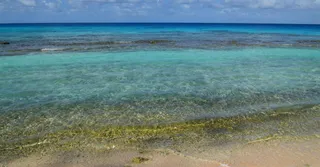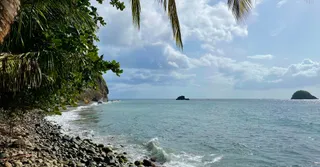
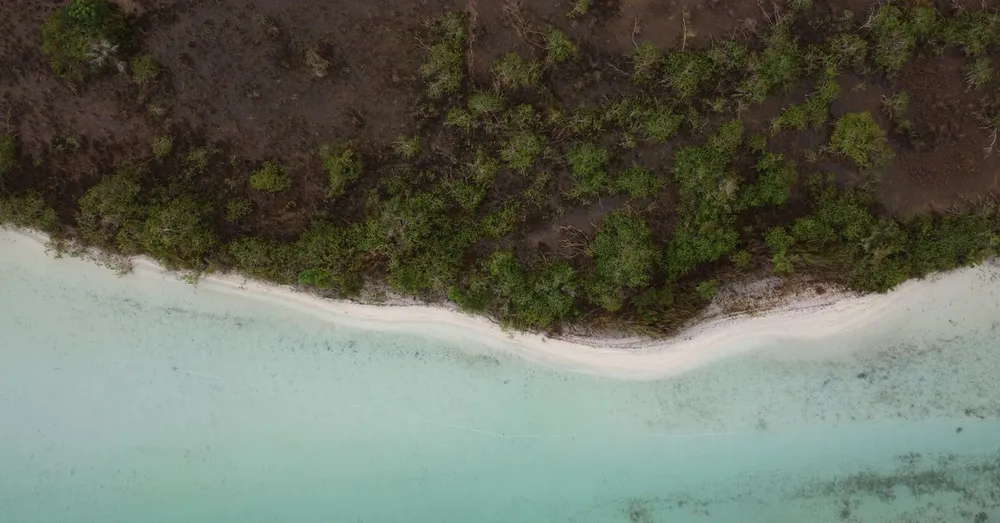
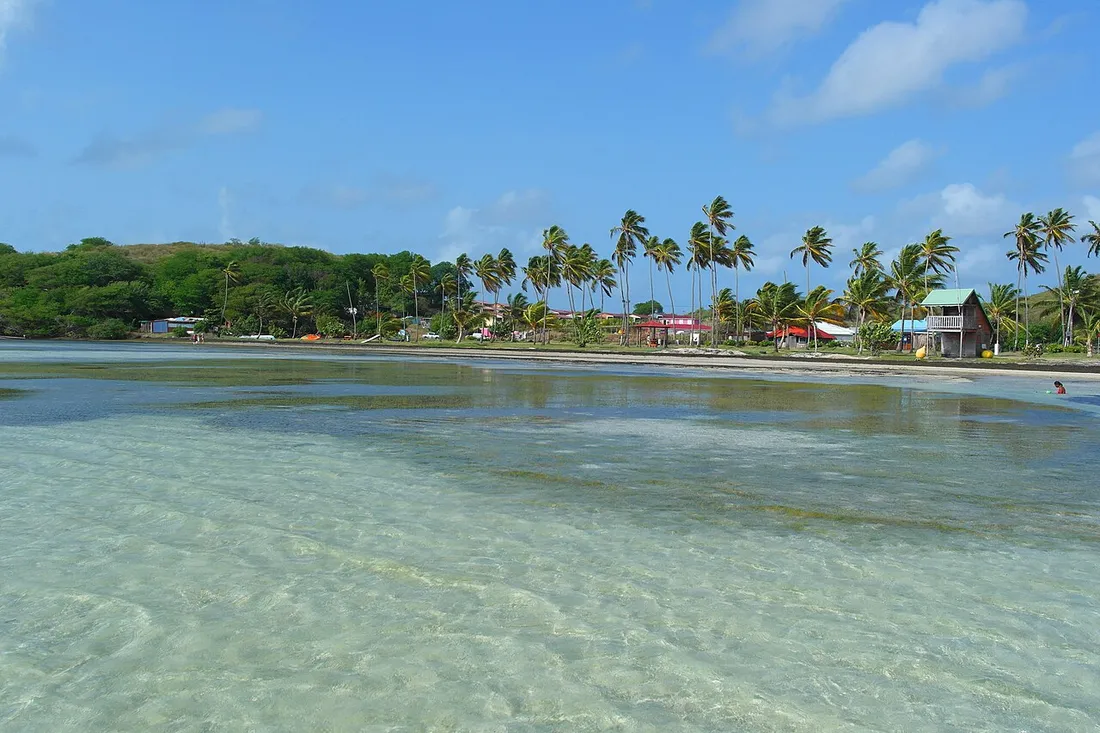
There are still, along the Atlantic coast of Martinique, beaches where all you hear is the wind in the coconut palms and the lapping of the lagoon. Grand Macabou, south of Le Vauclin, is one of them. No beach shack, no sun lounger, no paved car park: just a long ribbon of pale sand, turquoise water held back by the coral reef, and a dry vegetation shared by sea grapes and local poiriers-pays. It is precisely this bareness that makes its worth. After years bringing our travellers here through our concierge service, here is our honest local guide to discovering this Le Vauclin beach the right way, and respecting it.
Why Grand Macabou is a beach apart
Martinique’s Atlantic coast has a poor reputation among those who don’t know it: swell, wind, sargassum. Grand Macabou turns the cliché on its head. A coral reef runs offshore and breaks the swell before it reaches the shore, creating a shallow, calm and warm Macabou lagoon, almost a natural pool. You get the perks of the Caribbean south without the crowds.
What concretely sets the site apart:
- A sheltered lagoon where you can stand for dozens of metres: ideal for paddling, cooling off and keeping an eye on the children, even when the trade wind blows hard.
- A total absence of development: no snack bar, no shower, no equipment rental. You come with your picnic, your shade and your water, and you leave nothing but your footprints.
- Pale sand lined with coconut palms for nearly a kilometre, so you can always find a square of shade and quiet, even on a Lent Sunday.
- Truly preserved nature: the area is managed by the Conservatoire du littoral, which is why no concrete has sprung up here. That is a rare blessing in the Caribbean, and a responsibility for the visitor.
People often speak of the “Macabou” in the plural, since you’ll also find Petit Macabou nearby, more secluded and more exposed to the wind. Grand Macabou remains the more accessible and family-friendly of the two.
Access by the dirt track: what you need to know
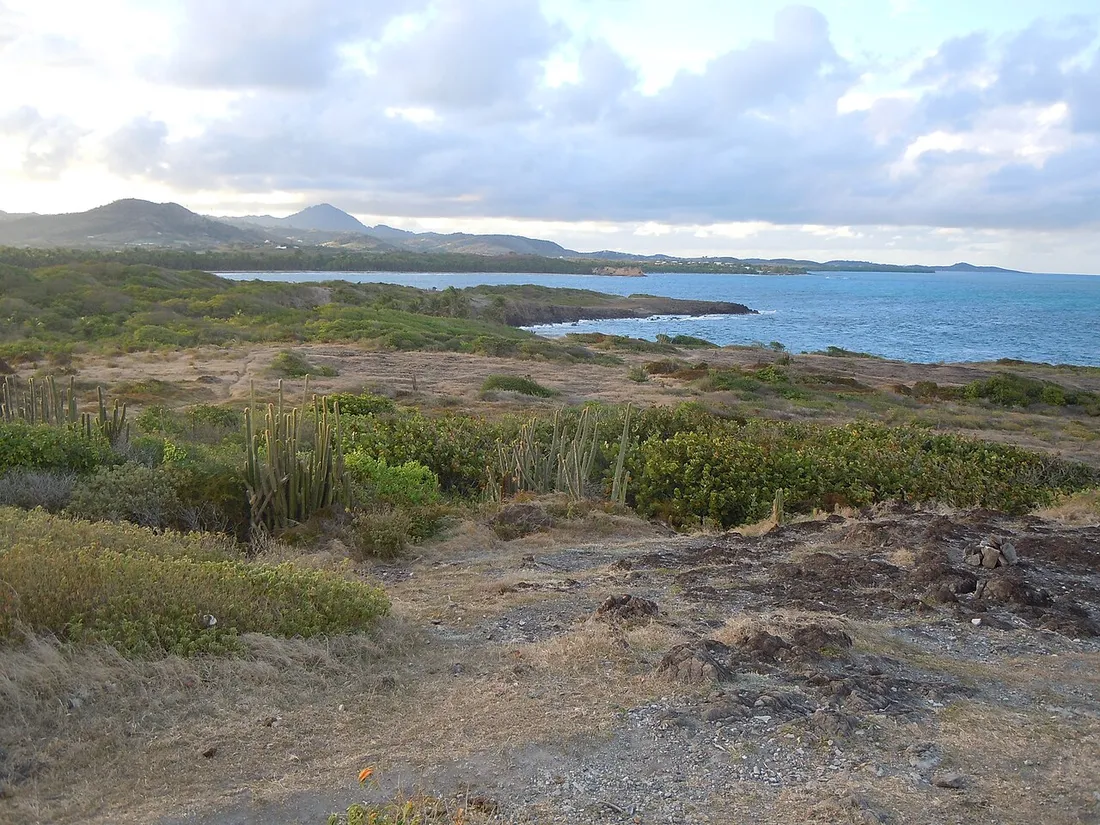
This is the natural filter that protects the spot. You don’t arrive at Grand Macabou by chance, and so much the better. From the town of Le Vauclin, head south (towards Macabou), then leave the paved road for a dirt track of about 1.5 to 2 km that winds through the dry vegetation to an informal parking area at the edge of the beach.
A few concrete points, tested on the ground:
- State of the track: passable in a regular car in dry weather, but bumpy and riddled with potholes. Drive at walking pace. After heavy rainy-season downpours, some sections turn muddy; a slightly higher vehicle is then a comfort.
- Parking: informal, in the shade of the trees, free of charge. No surveillance: never leave any valuables visible inside the vehicle. That is safety rule number one on all the island’s isolated beaches.
- Travel time: count on roughly 45 minutes from Fort-de-France (about forty kilometres), 1 hour from Les Trois-Îlets, and 35 to 40 minutes from Aimé Césaire airport at Le Lamentin.
- A car is essential: no bus line serves the beach, and the final track rules out any drop-off. The freedom to come early, with your own gear, changes everything.
The right time slot to enjoy it
Grand Macabou stays quiet on weekdays, even in high season. At the weekend, especially on Sundays, Vauclin families come to picnic and barbecue under the trees: it’s friendly and authentic, but the parking fills up. Our advice:
- Aim for a weekday morning, between 8 and 11 am: soft light, translucent lagoon, the wind still moderate.
- Avoid Sundays if you’re after silence; prefer Tuesday or Thursday.
- Leave the beach before nightfall (around 6–6:30 pm year-round at these latitudes): the track is unlit and becomes treacherous after dark.
When to come during the year
The dry season, the Carême (Lent), from December to April, is the ideal window: clear skies, turquoise sea, a steady but bearable trade wind. It is also the Carnival period (February–March), when the whole island comes alive. The lagoon, sheltered by its coral reef, keeps a lovely clarity.
On the sargassum front, let’s be transparent: Grand Macabou is on the Atlantic side, so it is affected by seaweed strandings. The lagoon configuration sometimes limits how far the seaweed penetrates, but arrivals remain possible, especially from May to October during the rainy season. Before setting off, the local reflex is to check the sargassum forecast bulletins and, if possible, ask Vauclin residents about the day’s conditions. During Lent, the risk is generally lower.
Snorkeling, kitesurfing and nature: what to do on site
Grand Macabou isn’t just a beach for laying down your towel. The area lends itself to several gentle activities, provided you come equipped, since nothing is for rent on site.
- Snorkeling: the lagoon shelters seagrass beds and shallow coral patches near the reef. You’ll come across parrotfish, triggerfish and sometimes a ray. Mask and snorkel in your bag, and water shoes are welcome (sea urchins and coral heads).
- Kitesurfing and windsurfing: the Le Vauclin coast is one of Martinique’s prime spots for board sports thanks to the steady trade wind. The dedicated spots lie a little further north, around Pointe Faula, but the “wind and lagoon” spirit carries all the way to Macabou.
- Walking and wildlife watching: the dry coastal vegetation (sea-grape savanna, manchineel trees that you must absolutely not touch or shelter under in the rain) is home to birds and crabs. Pretty walks link the neighbouring coves.
- Lazing and picnicking: the shade of the coconut palms and the calm of the lagoon make it a perfect spot for a day with no agenda — the real luxury on holiday.
Essentials to bring: plenty of water (1.5 L per person minimum), a hat, sunscreen, insect repellent for the end of the day, a waterproof bag, and something to carry out all your rubbish.
Respecting a site protected by the Conservatoire du littoral
If Grand Macabou has stayed this wild, it’s thanks to its status as a protected site. The Conservatoire du littoral acquires and preserves remarkable coastal areas to shield them from development. Coming here means accepting a few common-sense rules that guarantee the beach will be just as beautiful for those who follow:
- No rubbish left on site: there is no bin, so you leave with everything, including cigarette butts and picnic leftovers.
- No campfires on the sand or under the trees: the fire risk in the dry season is real.
- Take nothing: no sand, no coral, no live shells. Don’t disturb the wildlife.
- Stay on the existing access routes: no creating new tracks, no wild bivouac, no camping (forbidden).
- Beware of the manchineel: this toxic tree, sometimes marked with a stroke of red paint, must never be used as shelter; its sap badly irritates the skin.
These gestures aren’t administrative constraints: they are the very condition for places like this wild Martinique beach to still exist. To place Grand Macabou within a wider itinerary and discover the island’s other gems, see our complete guide to Martinique.
Extending the discovery around Le Vauclin and the southern Atlantic
Grand Macabou fits into a fine day on the Atlantic coast. Nearby, don’t miss Pointe Faula in Le Vauclin and its vast shallows where you can stand far out, a paradise for kitesurfers and families. Further south, Cap Chevalier and its islet, in Sainte-Anne, offer one of the island’s finest snorkeling lagoons. Hiking lovers can continue along the wild coastline of the Trace des Caps, and those curious about heritage will push on to Le François with its white sandbanks or the Clément distillery. Martinique is best discovered by car, and the southern Atlantic rewards those who venture off the beaten track.
Where to stay for trips to Grand Macabou
The secret to a successful day at Grand Macabou is to arrive before the heat and before the crowds. For that, it’s better to stay in the South or the southern Atlantic — in Le Vauclin, Le François, Le Marin or Sainte-Anne — rather than endure the drive from Fort-de-France every morning. A well-located rental saves you an hour on the road and lets you hit the lagoon by 8 am, coffee in hand.
At Hostel Toucan, we select accommodation across the whole south of the island, in accommodation in Martinique, with a simple promise:
- Direct booking with no platform fees: you pay the fair price, with no hidden commission.
- Free cancellation up to 7 days before arrival, so you can book with peace of mind.
- WhatsApp assistance 7 days a week: need the day’s track conditions, an update on sargassum or a good lolo address in Le Vauclin? We answer like a friend on the spot.
Do you own a property on the Atlantic coast and want to make the most of it with peace of mind? Discover our local concierge offer for owners. Grand Macabou will leave you with that rare memory of a Martinique still intact, where the most beautiful of beaches costs only the respect you give it.
FAQ
How do you get to Grand Macabou beach in Le Vauclin?
You reach Grand Macabou from the town of Le Vauclin heading south, then via a dirt track of about 1.5 to 2 km that leads to an informal parking area at the edge of the beach. The track is passable in a regular car in dry weather, but bumpy: drive at walking pace. Count on roughly 45 minutes from Fort-de-France. No bus line serves the beach, so a car is essential.
Are there any facilities or shops at Grand Macabou?
No, and that’s part of its charm. Grand Macabou is a wild beach managed by the Conservatoire du littoral: no snack bar, no shower, no equipment rental or bin. You need to come self-sufficient, with your water, your picnic, your shade, and carry everything out when you leave.
Is the Grand Macabou lagoon safe for swimming?
Yes, that’s one of its assets. A coral reef offshore breaks the swell and creates a shallow, calm and warm lagoon where you can stand for long distances, which suits families well. Stay alert near the passes in the reef, where currents can exist, wear water shoes against sea urchins and never shelter under a manchineel.
Is there sargassum at Grand Macabou?
The beach is on the Atlantic side, so it is affected by sargassum strandings, especially from May to October. Its lagoon configuration sometimes limits how far it penetrates. In the dry season (December to April), the risk is generally lower. Check the sargassum forecast bulletins before setting off, or ask Vauclin residents about the day’s conditions.