When a future investor reaches out from mainland France, just before signing for a studio in Sainte-Anne or a villa in Les Trois-Îlets, the same sentence always comes up: “People keep mentioning LMNP, but what does it actually mean here in Martinique?” As a resident of the island and a furnished-rental manager, I see many owners confuse the status itself with its tax dimension. Understanding LMNP in Martinique at its core — what it is, who qualifies, how you obtain it and what changes under the tropics — will spare you plenty of mistakes before you even start talking about taxes.
This guide is educational and up to date for 2026. It does not replace the advice of a chartered accountant, the only professional qualified to validate your personal set-up.
What exactly is LMNP?
The non-professional furnished rental status (LMNP) applies to any private individual who rents out a furnished dwelling without making it their main activity. It is neither a company nor a regime you “sign up for”: it is an automatic qualification as soon as you meet two conditions — the dwelling is furnished and you stay below the non-professional thresholds.
The structuring point, identical in Martinique and on the mainland: your rental income is not treated as property income like an unfurnished rental, but as industrial and commercial profits (BIC). This commercial nature changes everything: tax regimes, depreciation, declaration. On the island’s seaside market, where almost the entire supply is short-term furnished rentals (Sainte-Anne, Les Trois-Îlets, Le Diamant, Le François, Tartane), you therefore almost always fall under LMNP.
Furnished or unfurnished: why the distinction is decisive in the Caribbean
A dwelling is only “furnished” in the legal sense if it includes the furniture that lets a tenant live there normally. The regulatory list counts about a dozen items, to be adapted to the tropical climate:
- bedding with a duvet and pillows, plus mosquito nets, genuinely useful here;
- shutters or blackout curtains in the bedrooms;
- a hob, oven or microwave, refrigerator and freezer;
- crockery, utensils and cleaning equipment;
- a table, seating, storage shelves, lighting;
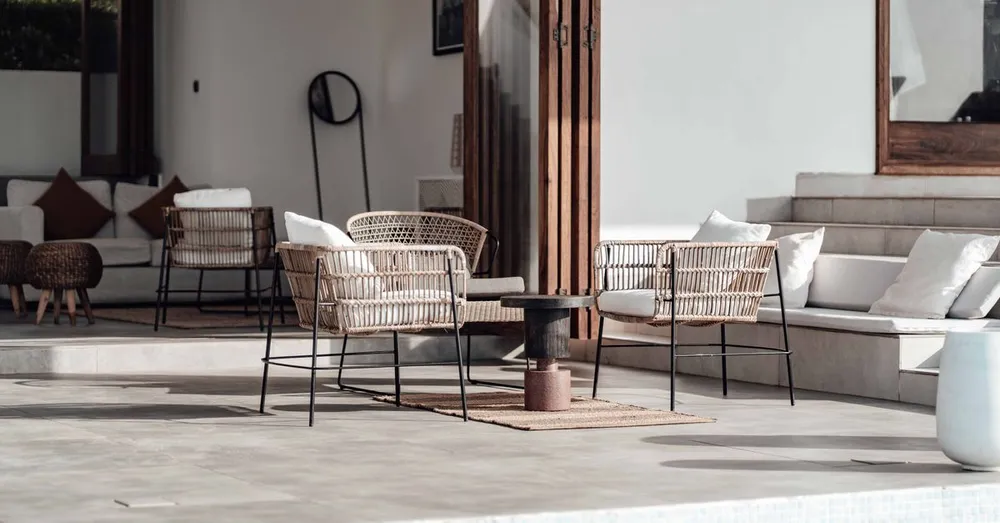
- in practice on the island, you add air conditioning or ceiling fans and salt-resistant outdoor furniture, both expected by guests.
On the Caribbean coast, where unfurnished rentals struggle to compete with the tourist demand of the dry season (Carême), furnished rental naturally prevails — and with it LMNP rather than the property-income regime.
Conditions and thresholds: LMNP, LMP and the overseas case
The “non-professional” part of the overseas non-professional furnished rental status rests on two thresholds, assessed at the level of the tax household. You remain in LMNP as long as:
- your annual rental income does not exceed €23,000, or
- it stays below the household’s other earned income (salaries, pensions, professional BIC or BNC).
If you cross both thresholds at the same time, you switch to professional furnished rental status (LMP), with different rules (social contributions, losses, capital gains). In Martinique, seasonality plays a direct role: an exceptional dry season in Sainte-Anne can bring you closer to the ceiling, while the low cyclone season (June to November) flattens your income. Keep an eye on this cursor every year.
Good to know: there is no separate “overseas LMNP” status. The conditions are national. What differs in the overseas departments are the surrounding parameters — local VAT, operating costs, tax-relief schemes — covered further down.
The steps to get started in LMNP
Becoming an LMNP involves a few simple formalities, all of which can be completed remotely from mainland France:
- declare the start of activity on the single business-formalities portal, which assigns you a SIRET number;
- choose your tax regime (micro-BIC or real, see below);
- file the declaration with the town hall for the tourist furnished rental, with, depending on the municipality, a registration number to display on your listings;
- pay, when the time comes, the CFE (business property tax), often exempted in the first year.
Micro-BIC or real: the two LMNP regimes
Once you are an LMNP, you declare your rental income under one of two BIC regimes. The choice shapes your taxation for several years.
Micro-BIC: simplicity with an allowance
Below the income ceiling, micro-BIC applies automatically. You declare your gross turnover and the tax authority applies a flat-rate allowance covering your expenses, with no supporting documents:
- classified tourist furnished rental: a 50% allowance, income ceiling of €77,700;
- non-classified furnished rental: a 30% allowance, ceiling of €15,000.
The gap is far from trivial. On €20,000 of rental income, a classified property is taxed on only €10,000, against €14,000 for a non-classified one. Having your property classified (an accredited body, €150 to €250 for five years) is one of the most profitable moves on the LMNP journey.
The real regime and overseas LMNP depreciation
Under the real regime, you deduct your actual expenses (loan interest, insurance, property tax, concierge fees, water, electricity) and you apply depreciation of the property and the furniture. This is the status’s most powerful mechanism: an accounting charge that never leaves your cash flow yet reduces your taxable profit, often for ten to fifteen years.
Overseas LMNP depreciation comes fully into its own in Martinique, where costs inflate the depreciable base:
- furniture and appliances made more expensive by the octroi de mer (transport and import duties);
- tropical equipment to be renewed faster (air conditioners, outdoor furniture attacked by salt and sun);
- repair works after the cyclone season and anti-termite treatment.
For a property bought at €200,000 generating €18,000 of rental income, it is not unusual for an LMNP under the real regime to pay zero tax for several years. The trade-off: accounting handled by a chartered accountant (€200 to €600 a year, deductible). The 17.2% social levies and the income-tax scale remain those of mainland France.