
Before booking a villa in Sainte-Anne or a studio in Les Trois-Îlets, a savvy traveller asks two questions: “Is this property properly registered?” and “What is this tourist-tax line on the quote?” The two are connected. The tourist tax in Martinique is only the visible tip of a broader regulatory framework governing furnished tourist rentals in France’s overseas departments and regions (DROM). As a property-management company based on the island, we live these procedures every day, both for our owners and our guests. Here is a clear explanation, updated for 2026 — who pays it, how much, to whom, and what makes a rental truly legal, and therefore reassuring to book.
What is the tourist tax and what is it for?
The tourist tax is a local levy charged to people who spend a paid night in a town where they are not resident. Since Martinique is a French overseas department (DROM), the framework is identical to mainland France: it is governed by the General Code of Territorial Authorities, and each town freely sets its rates within the national brackets.
The principle is simple: the traveller pays, never the owner. The host (hotel, guesthouse, holiday rental) or the booking platform merely collects the amount and then passes it on to the town hall. This revenue funds what makes a stay pleasant: beach upkeep, sargassum removal, tourist signage, tourist offices, events, cleanliness. When you enjoy the clean sand at Les Salines in Sainte-Anne or the trail on the Caravelle peninsula, a fraction of it comes from here.
A West Indian particularity: an additional departmental tax of 10% is added to the town rate. It is automatically built into the amount you see on your invoice, so there is no need to calculate it yourself.
Actual or flat-rate basis: understanding the two systems
There are two calculation methods, and it is the town that chooses which applies on its territory. For Martinican holiday rentals, the “actual” system dominates by a wide margin.
The actual tax (the dominant case on the coast)
This is the system for almost all holiday rentals in Martinique. The tax is calculated per adult and per night, only for liable travellers, according to the property’s classification. Realistic figures for 2026, including the 10% departmental tax, per night and per adult:
- Unclassified furnished rental or one awaiting classification (the vast majority of Airbnb and Booking listings): a percentage of the nightly price per person, usually capped, in practice €0.80 to €2.30.
- Furnished tourist rental classified 1 to 3 stars: around €0.80 to €1.50.
- Rental classified 4 or 5 stars / upmarket hotels: up to €2.30 to €3.00.
For unclassified accommodation, the rate is expressed as a percentage of the nightly cost per person (often around 1 to 5%), with a cap. A concrete example: a studio in Les Trois-Îlets rented at €120 a night for 2 adults, unclassified. Reckon on around €2 per adult per night, i.e. €28 over a week. Another case, a villa in Le Diamant at €180 a night for 2 adults, unclassified at an indexed rate of 4%: once the cap is applied, reckon on around €2.30 per adult per night, i.e. €4.60 per night and €32 over a week — the equivalent of a plate of conch in a beachside lolo. On a budget dominated by the flight to Aimé Césaire airport (Le Lamentin) and car hire (€30 to €50/day, strongly recommended), the tax weighs very little.
The flat-rate tax (rarer)
Here, the tax is calculated on the accommodation capacity, regardless of the actual occupancy rate. It is owed by the host, who usually passes it on in the price. This system remains a minority for the island’s holiday rentals; most of our towns operate on the actual basis.
How much does it really cost? Benchmarks by town
The exact amounts and obligations depend on municipal decisions, but here is the on-the-ground logic in the most touristic towns (always check the exact amount when booking):
- Sainte-Anne (Pointe Marin, Les Salines, Anse Caritan) and Les Trois-Îlets (Pointe du Bout, Anse Mitan, marinas, golf, birthplace of Joséphine de Beauharnais): very strong seaside demand, strict control of declarations, upper bracket for classified rentals.
- Le Diamant (facing the famous Rock) and Les Anses-d’Arlet (Grande Anse, Anse Dufour, Anse Noire with its volcanic sand): mid-range rates, registration number essential.
- Le François (white-sand shallows, Joséphine’s Bathtub): mid-range rates.
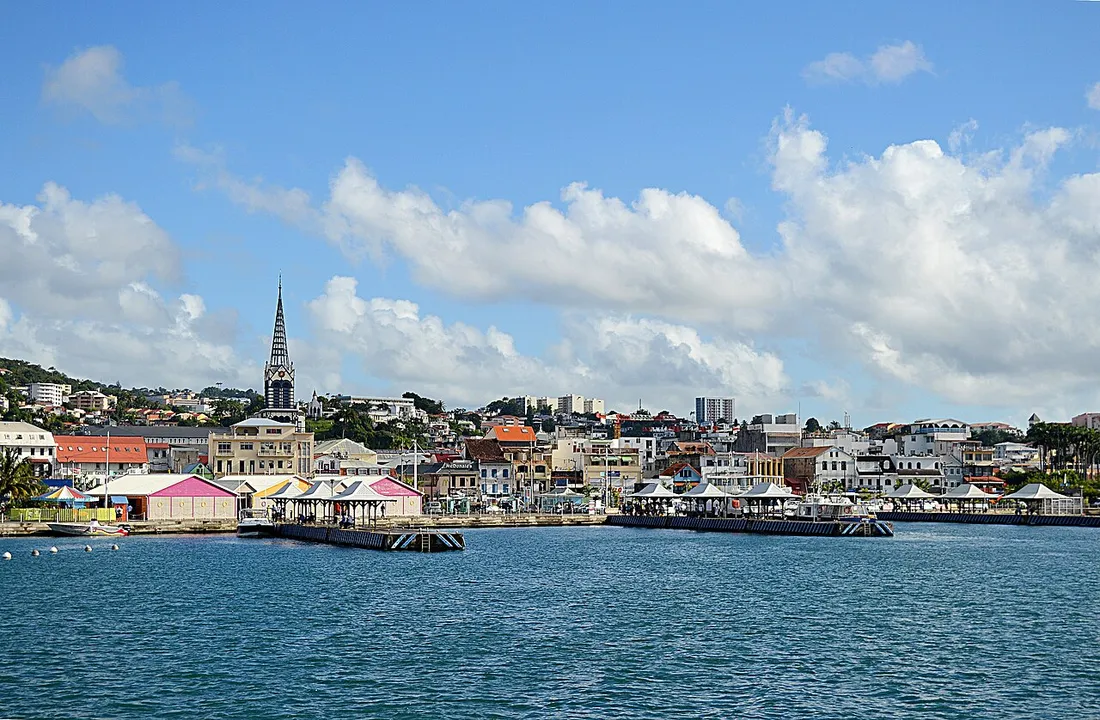
- Fort-de-France (the capital, an island of around 360,000 inhabitants): a business and culture city, rates in the lower-middle range, but be vigilant about the change of use of second homes.
- La Trinité / Tartane (Caravelle peninsula, surf spot) and Saint-Pierre (Mount Pelée, UNESCO-listed ruins): moderate rates, authentic atmosphere.
To give you an overall budget benchmark: for a one-week stay (7 nights) for 2 adults in an unclassified furnished rental, the total tourist tax generally comes to around €15 to €35 for both people. That is the equivalent of a Creole meal for two. In other words, it weighs very little in the budget of a Martinican stay.
Who is exempt from the tourist tax?
Not everyone is liable. The following are exempt as of right:
- minors (under 18);
- holders of a seasonal employment contract working in the town;
- people receiving emergency accommodation or temporary rehousing;
- people occupying premises whose rent is below an amount set by the municipal council.
In short, for a family of two adults and two children in Sainte-Luce or Sainte-Anne, only the two adults pay. Remember to tell your host the make-up of your group if it has not been specified: this avoids being overcharged.
Declaring a furnished tourist rental at the town hall: the heart of the overseas framework
This is where the legality of a rental is decided, and it is what distinguishes a compliant property from a risky listing. Putting a property up for short-term rental in Martinique involves several steps, which we handle for our hosts.
The prior declaration (Cerfa form)
Every furnished tourist rental must be the subject of a declaration at the town hall before being rented out for the first time, via the Cerfa form no. 14004. The town registers the property, its address, its capacity and the landlord’s details. This free step is the foundation of everything else — without it, no legal rental.
The municipal registration number
Several touristic towns have additionally introduced an online declaration issuing a unique registration number (often thirteen characters), which must appear on every listing (Airbnb, Booking, direct website). Without a displayed number, a listing is often removed and a fine remains possible. If a listing shows its registration number, that is a good sign: the property is known and monitored by the town hall. This has become the first reflex before booking, and the first mark of seriousness for the traveller.
Change of use and second homes
The nuance that changes everything depending on your situation:
- Main residence (where you live more than eight months a year): renting as a furnished tourist property is possible within an annual limit, with no change-of-use formality.
- Second home turned into a rental: some towns require a change-of-use authorisation, notably Fort-de-France, the capital, whose regulation is the most extensive on the island. Check with the town hall before investing.
The host register and the obligations that follow
Once the rental is declared, the landlord must then:
- display the rate of the tax and report it on the invoice (nights + liable adults);
- collect the tax whenever no platform handles it, and keep a host register (per stay: people, nights, tax collected);
- pass on the amounts to the town at the set deadlines, often half-yearly;
- apply the exemptions (minors, seasonal workers employed locally, emergency accommodation).
It is this monitoring, time-consuming and easy to neglect, that our team automates. Our owners page details how we manage this machinery from end to end, including the declaration.
Platforms, collection and double billing: what to check
For several years now, collection by Airbnb has been automated for the Martinican towns that have signed an agreement: the platform adds the tax to the payment and pays it directly to the town hall; it appears, itemised, in the booking summary. Booking.com and the other marketplaces proceed in a comparable way depending on local agreements.
The downside, on unclassified rentals: the platform sometimes applies its own percentage while the host also bills an amount — and the traveller pays twice. This is also the classic mistake of the beginner landlord, who confuses the share already collected by Airbnb with the share they must still pay over for their direct bookings, leading to complaints and bad reviews. If you book via an OTA, check that the “tourist tax” line appears only once.
This is one of the advantages of direct booking: a single, transparent amount, calculated according to the property’s actual classification, with no overlapping rates or platform fees.
How to check that a rental is compliant before booking
A few simple reflexes, valid everywhere on the island:
- Look for the registration number on the listing: its presence indicates a property declared at the town hall.
- Read the detail of the invoice: the tax must appear on a separate line, with the number of nights and liable adults.
- Check the classification: an “unclassified” and a “3-star” do not have the same rate.
- Count only the adults (minors are exempt).
- Hunt for the double tax line if you go through a platform.
- Ask if in doubt: a serious host or property manager will explain the calculation to you precisely.
As for the calendar, the best period remains the dry season (the Lent season), from December to April, with carnival in February-March. In high season, rents climb and towns carry out more checks; the tax itself remains calculated identically (except for unclassified rentals indexed on the nightly price). Booking early, and properly, spares you any nasty surprises. Since a recent municipal decision can change a rate from one season to the next, it is always best to check it before high season.
Book a declared furnished rental directly with Hostel Toucan
At Hostel Toucan, we manage declared holiday rentals all along the Martinican coast, from Sainte-Anne to Le Diamant. Every property is compliant: town-hall declaration, registration number, displayed rate, host register, tourist tax collected and paid over as it should be. For owners, we handle the whole chain, declaration and taxation included. For your travels, booking directly with us means:
- no platform fees: you pay the fair price, tourist tax included and clearly itemised, with no risk of double billing;
- free cancellation up to 7 days before arrival;
- 7-day WhatsApp assistance, before and during the stay (dialling code +596; mind the time difference: -5h in winter, -6h in summer compared with Paris).
To prepare your trip, see our complete guide to Martinique and browse our rentals in Martinique. And if you own a property on the island, find out how we handle declaration, tax and finances for owners. Properly understood, the tourist tax is never a nasty surprise: a few euros a night that go, in part, towards the beauty of the island you are coming to discover. A compliant property means peace of mind for everyone.
FAQ
Who pays the tourist tax in Martinique, the traveller or the owner?
The traveller pays the tourist tax, never the owner. The host or the booking platform (Airbnb, Booking) merely collects it at the time of payment, then passes it on to the town. The landlord does not bear the cost, except under the rarer flat-rate system, where it is calculated on the accommodation capacity.
How much does the tourist tax cost for a week in Martinique?
For two adults in an unclassified furnished rental over 7 nights, reckon generally on between €15 and €35 in total for both people. Children under 18 are exempt. The exact amount depends on the town, the property’s classification and, for unclassified rentals, the nightly price.
Do children pay the tourist tax in Martinique?
No. Minors under 18 are exempt as of right. For a family of two adults and two children, only the two adults are liable. Tell your host the make-up of your group to avoid being overcharged.
Do you have to declare a furnished tourist rental at the town hall in Martinique?
Yes. Every furnished tourist rental must be the subject of a prior declaration at the town hall (Cerfa form no. 14004) before the first rental. Several touristic towns additionally require a registration number to be displayed on listings, and a change of use may be required for a second home, notably in Fort-de-France.
Does Airbnb collect the tourist tax in Martinique?
Yes, Airbnb automatically collects the tourist tax for the Martinican towns that have signed an agreement, then pays it directly to the authority. It appears in the booking summary. By booking directly, you benefit from a single, transparent amount, with no risk of double billing.
How do you pass the tourist tax on to the town when you rent directly?
You keep a host register (people, nights, tax collected), apply the rate voted by the town, then pay the amounts over at the set deadlines, generally half-yearly. A local property manager like Hostel Toucan automates the calculation and payments for managed properties.