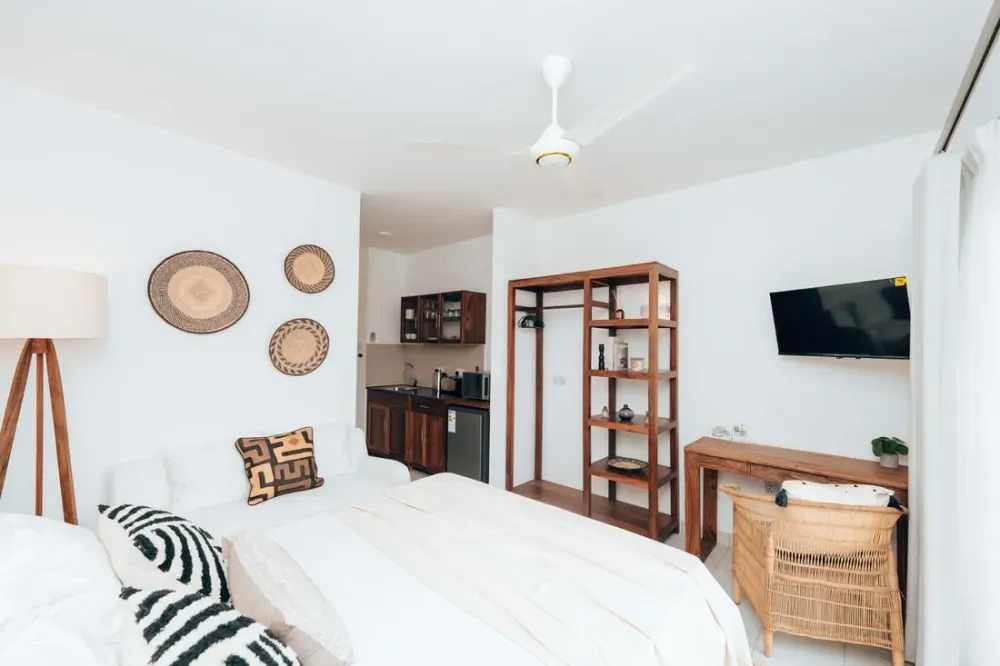
You are running a construction project in French Guiana and you need to house crews for several weeks, sometimes several months. Between slipping deadlines, staff rotations and the administrative constraints of a company, accommodation quickly becomes a headache. A conventional hotel is expensive over the long haul and offers neither a kitchen nor a laundry room. Peer-to-peer holiday rentals, for their part, do not always issue an invoice your accounting department can actually use. That is exactly the gap the para-hotel aparthotel fills: the self-catering comfort of an apartment, with the guarantees of a genuine business provider. This article explains why this formula suits construction projects in French Guiana, what it changes in practical terms for your expense claims and your VAT, and how to frame a long stay without nasty surprises.
Why construction projects in French Guiana set their own accommodation rules
French Guiana is not a territory like any other when it comes to organising team housing. Major projects are concentrated in a handful of hubs: the Cayenne conurbation (with Rémire-Montjoly and Matoury), the Kourou basin around the Guiana Space Centre, and the west around Saint-Laurent-du-Maroni. Between these areas, the distances are real and travel times on the RN1 or RN2 eat into the working day. Housing your teams as close as possible to the site is therefore not a luxury, it is a direct gain in productivity and safety (less fatigue behind the wheel).
On top of that come local realities every site manager knows:
- The rainy season (roughly December to July, with a short dry spell in March) which slows certain works and stretches out assignment durations.
- Pressure on the accommodation supply during periods of intense activity, particularly around launch campaigns in Kourou.
- The equatorial climate, which makes air conditioning, a well-ventilated home and a laundry room virtually indispensable for stays of several weeks.
- Distance from shops in certain communes, which makes a fully equipped kitchen valuable to avoid depending on restaurants.
Accommodation designed for a weekend break does not meet these constraints. A construction project needs stability, self-sufficiency and a clean administrative framework.
The para-hotel aparthotel: the formula that ticks the right boxes
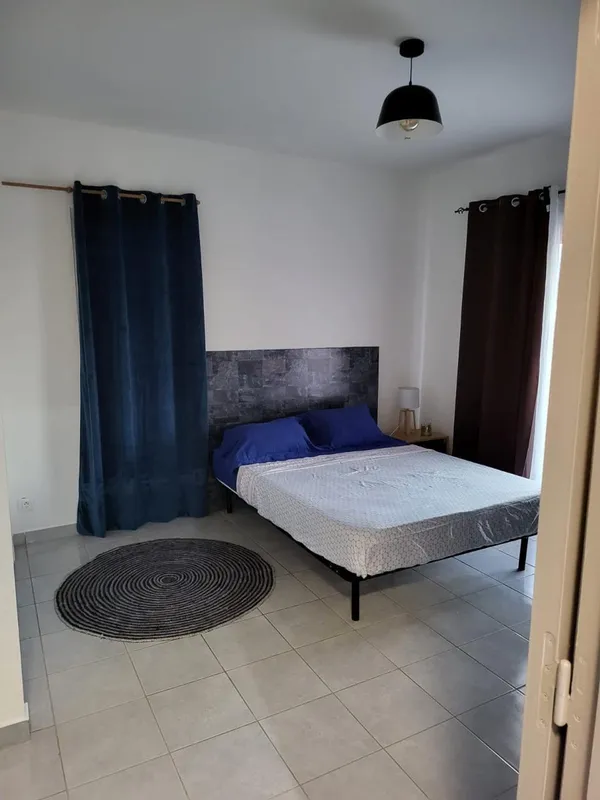
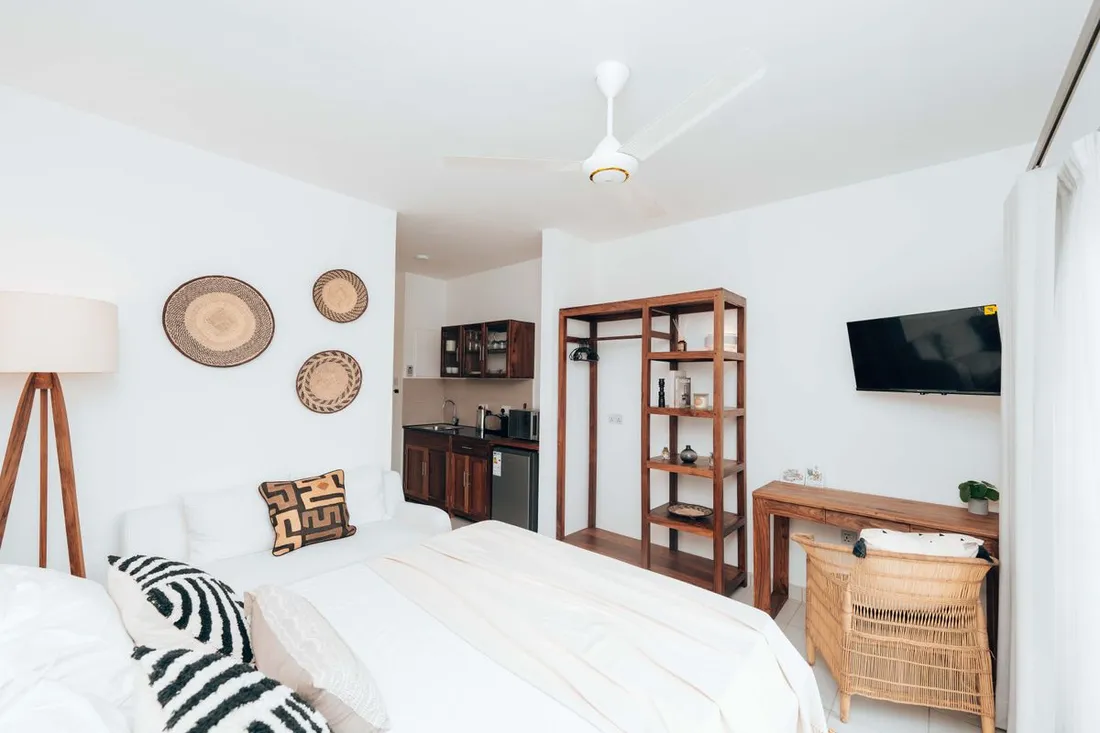
The aparthotel, or tourist residence under the para-hotel regime, combines two worlds. On one side, the apartment: bedroom(s), living room, equipped kitchen, private bathroom, often a laundry room or access to a washing machine. On the other, hotel-style services: linen provided, optional housekeeping, a reception service, and above all professional management able to contract with a company.
The term “para-hotel” has a precise tax meaning. Accommodation is considered para-hotel when it offers, in addition to the overnight stay, at least three of the following four services: breakfast, regular cleaning of the premises, provision of household linen, and reception of guests (even non-physical). This classification is not merely an accountant’s subtlety: it is what opens the door to invoicing with VAT and to straightforward accounting treatment for your company.
What self-sufficiency changes day to day for a crew
Over a long stay, the difference from a hotel quickly becomes obvious. Your teams can:
- Cook on site and keep their meal budget under control.
- Wash their work clothes without depending on a dry cleaner.
- Share a single home between several people (separate bedrooms), which reduces the cost per person.
- Enjoy a real living space to unwind after long days, which matters on assignments lasting several months.
The real differentiator: invoicing that matches your accounting
This is where the essentials play out for a company. Many accommodation solutions are impeccable on comfort but shaky on paperwork. A construction project needs usable documents, not just a platform receipt.
An invoice in the company’s name
A para-hotel provider issues an invoice made out to your company, with its legal name, its SIRET number, the address of the property, the stay dates and a breakdown of services. That document is what makes the expense deductible and what stands up to an accounting audit. Conversely, a booking made in an employee’s personal name on a consumer platform complicates reimbursement and justification.
Compliant expense claims, without friction
When the invoice is issued directly in the company’s name and paid by the company, you skip the expense-claim process for the employee: no personal cash advance over several weeks, no supporting documents to piece back together. If you prefer the employee to pay upfront and be reimbursed, an invoice in the company’s name makes the expense claim clean and acceptable without debate.
Payment by bank transfer
For a long stay, paying by bank transfer (SEPA) rather than by personal card is often standard practice in a company. A para-hotel provider knows how to work this way: quote, purchase order where applicable, invoice, then transfer according to an agreed schedule (for instance a deposit followed by monthly payments). This simplifies cash-flow tracking on the project side.
VAT and tax regime
This is the point administrative managers look at first. Para-hotel accommodation services are, in principle, subject to VAT. In French Guiana, however, there is a major specificity you need to know about, covered right below.
VAT in French Guiana: a rule you need to know
French Guiana is one of the departments where VAT is provisionally not applicable. Unlike Martinique and Guadeloupe (where specific VAT rates apply), French Guiana and Mayotte fall under a regime where VAT is not, to date, charged on transactions.
In practice, for accommodation located in French Guiana, this generally means invoicing without VAT: you pay no VAT, and there is therefore no VAT to reclaim on these local services. This is not a flaw in the para-hotel formula, it is the territory’s tax framework. The benefit for your company remains intact: a clean, clear invoice in the company’s name, fully deductible as an expense.
This point deserves a case-by-case check with your accountant, because your situation (head office in mainland France, an establishment in French Guiana, the exact nature of the services) may have implications. The key takeaway is that a good provider hands you an invoice that complies with the French Guiana regime, with no grey areas.
For guidance: the “no VAT in French Guiana” rule applies to local services. A service invoiced from mainland France, or ancillary services, may follow different rules. Have your accountant validate the arrangement before a long stay begins.
What it costs: benchmarks for building a budget
There is no universal price: everything depends on the commune, the size of the property, the level of service and the season. Here, however, are some methodological benchmarks, to be treated as indicative and confirmed by a quote.
- Duration brings the nightly rate down. Over a stay of several weeks or months, you negotiate a monthly or weekly rate, appreciably better value than the headline nightly price.
- The cost per person drops in shared accommodation. A two- or three-bedroom apartment split between several employees often works out cheaper per head than the same number of hotel rooms.
- Season matters. Around periods of intense activity (launch campaigns in Kourou, events), demand climbs and availability dries up; planning ahead lets you lock in a rate.
- Included services vary. Weekly housekeeping, linen changes, wifi, a parking space, air conditioning: list what is included so you compare like for like.
The right reflex is not to chase the lowest nightly price, but to think in terms of the total cost of the stay: accommodation, meals (a kitchen cuts the restaurant bill), commuting to the site avoided, and administrative time saved thanks to clean invoicing.