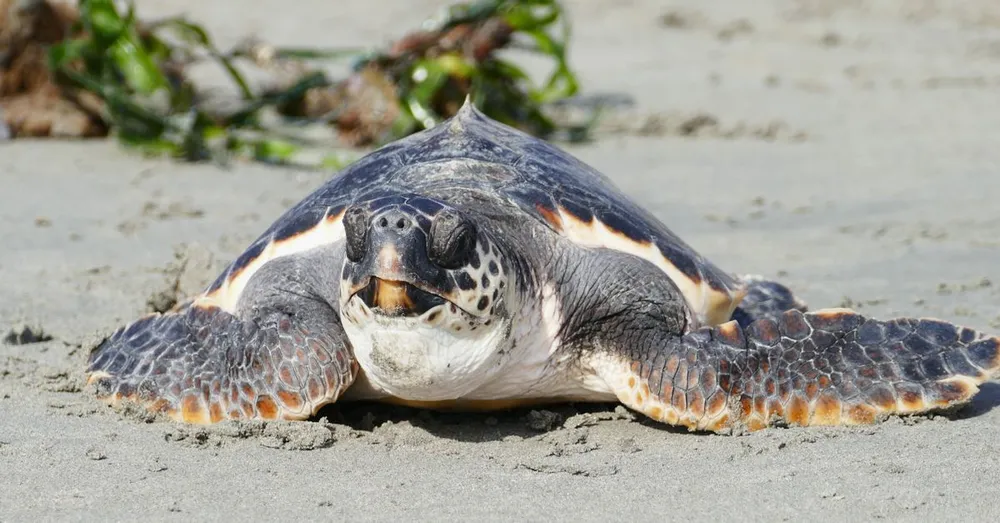
Watching a 400 to 600 kg leatherback turtle emerge from the ocean under the moon, dig her nest for nearly two hours and then return to the sea without a backward glance: French Guiana is one of the very few places in the world where this spectacle can be experienced freely, with no barrier and no entrance ticket. It is also one of the most powerful — and most fragile — that the territory has to offer.
Leatherback turtles in French Guiana concentrate on Les Hattes beach, in Awala-Yalimapo, at the far western edge of the territory, near the mouth of the Maroni. As a French Guiana resident and a regular at this Kali’na Amerindian village, I’ll share the real nesting calendar, the observation rules to respect, and the logistics for organising your night with the giants, in complete respect for the animal and the site.
Why Awala-Yalimapo is a world-class leatherback turtle site
Awala-Yalimapo lies at the far north-west of French Guiana, on the estuary of the Maroni River that marks the border with Suriname. The town, populated mainly by Kali’na Amerindians, is home to Les Hattes beach, one of the most important nesting sites in the world for the leatherback turtle (Dermochelys coriacea), the largest marine reptile on the planet. This beach is part of the Amana National Nature Reserve, created in 1998, which protects nearly 14,800 hectares of coastline between the Maroni and Mana estuaries.
What makes the place unique:
- a dark-sand beach several kilometres long, gently sloping, fed with sediment by the Amazon and the Maroni, ideal for nests;
- a living Kali’na village, with carbets (open shelters), crafts and small eateries: you are among the locals, on land that is inhabited and sacred to them, not in a tourist park;
- free and open access, day and night;
- in season, eco-volunteers and reserve staff on hand to raise awareness and guide visitors.
The leatherback, giant of the oceans
The leatherback can reach 2 metres in length and exceed 600 kg for the largest females. Unlike other sea turtles, its shell has no hard scales but a soft, rubbery skin marked by seven longitudinal ridges that evoke the strings of a lute, hence its French name (tortue luth). A strictly protected species classified as vulnerable, it travels thousands of kilometres across the Atlantic before returning to nest, often on the very beach where it was born. A female lays a nest of 80 to 100 eggs in 1 h 30 to 2 hours and may return several times in the same season, about ten days apart.
Three species frequent the Guianese coast — the leatherback, the green turtle and the olive ridley (more rarely the hawksbill) — but it is the leatherback that gives Les Hattes its fame.
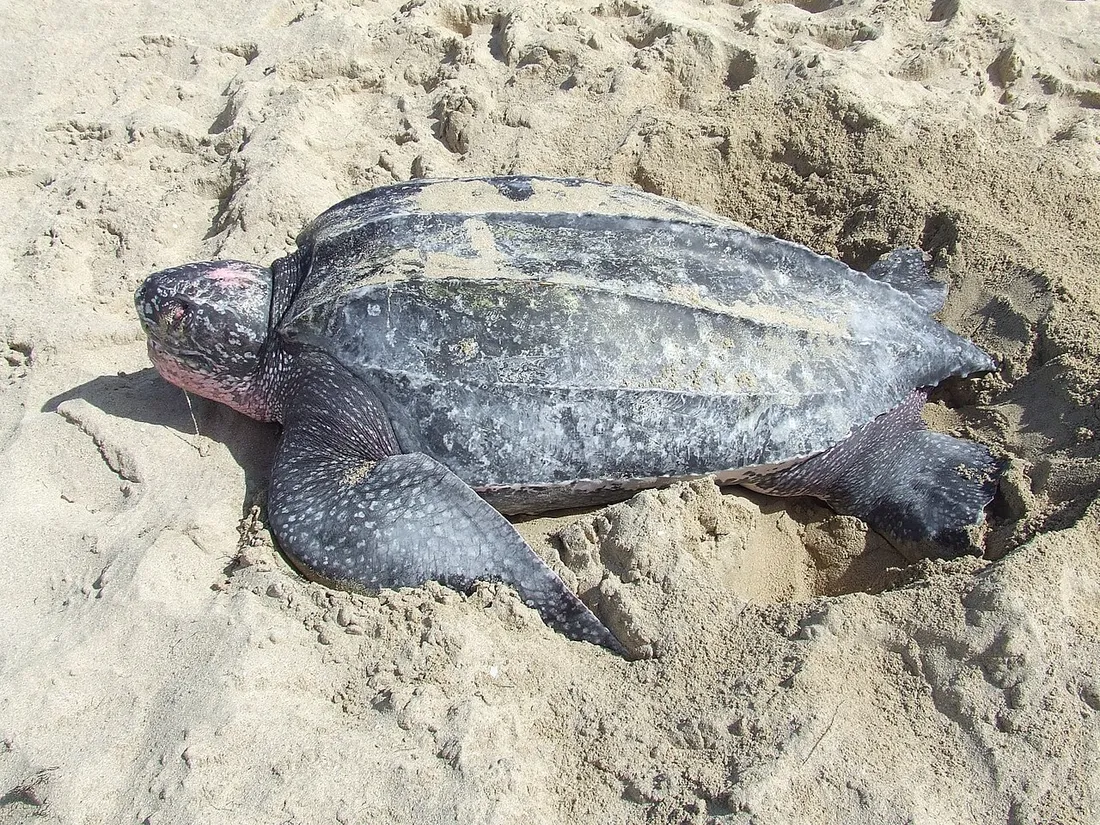
Month-by-month nesting calendar
The main window is short: you need to know it before booking your plane tickets. Here is the rhythm observed in the field.
- March: first leatherback nestings, still spaced out. A few emergences per night, for the patient.
- April to June: peak of leatherback nesting. This is the prime period; it is not uncommon to see several females simultaneously on the same stretch of beach, sometimes several dozen per night on the best evenings.
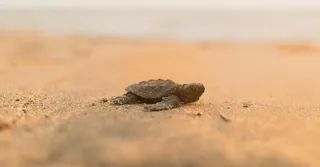
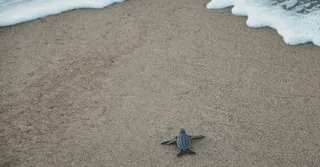
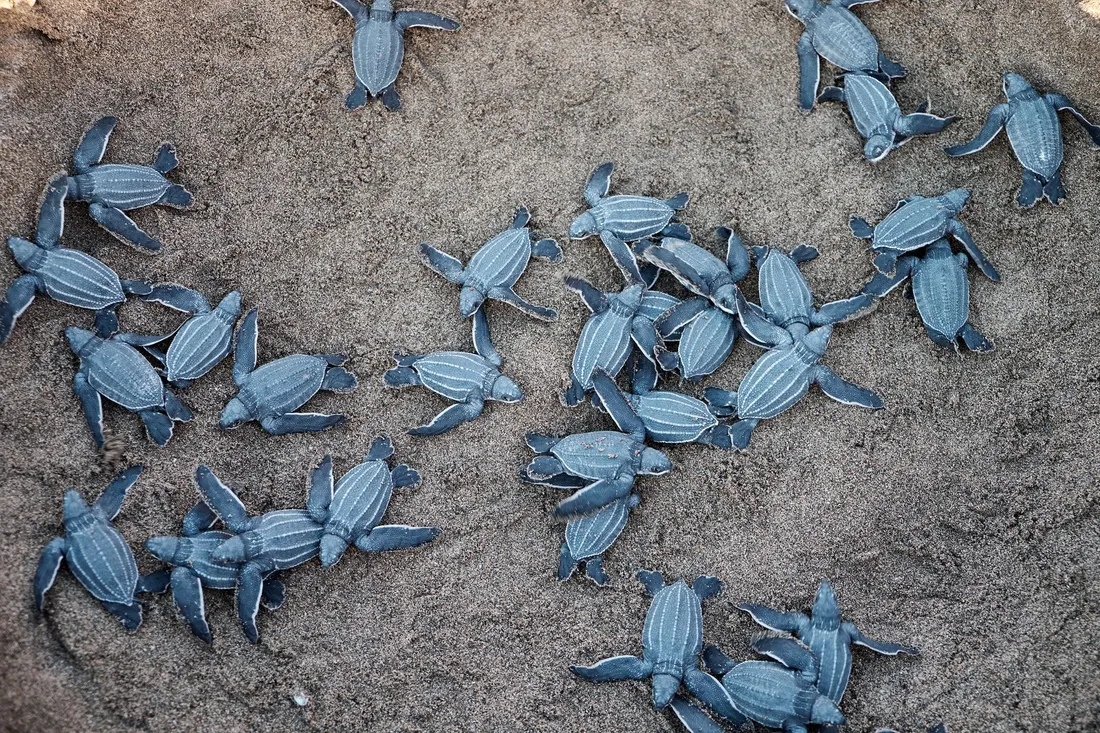
- July: end of leatherback nesting, overlapping with the start of the hatchling emergences from the March-April nests (incubation of around 60 to 70 days). An exceptional period when, on the same night, you can see females laying and newborns heading to the sea.
- August to September: leatherback nestings become rare but hatchings are in full swing. Green and olive ridley turtles take over on the beach.
- October to February: almost nothing on the leatherback side, gone back to the North Atlantic.
In short: to see a large leatherback female nest, aim for April to July (peak in May-June). For baby turtles, June to September is the best window. June and July combine both phenomena, making them the most complete window, all the more so as the Guianese dry season runs from mid-July to mid-November and makes access easier. Also worth noting: the green turtle nests mainly from February to April, and the olive ridley from June to August, more on the beaches of Rémire-Montjoly. Outside the leatherback season, all is not lost.
What time to come and with which tide
Emergences take place at night, most often around high tide, generally between 7:30 pm and midnight, sometimes until 3 or 4 in the morning.
- Check the schedule of nighttime high tide (SHOM or an app such as Marée Info): the ideal window runs from about 2 hours before to 2 hours after.
- Plan to arrive at dusk (around 6:30-7 pm at these latitudes) and be patient. Allow one to three hours on site to maximise your chances.
- Aim for at least two nights on site: even in peak season, a quiet evening is still possible, and sleeping nearby spares you the night drive from Cayenne.
The ethical code of conduct: watching without disturbing
The leatherback turtle is fully protected in France, and a female disturbed during her emergence may turn back without nesting, especially during the phase when she is digging her nest. The hatchlings orient themselves toward the brightest horizon: the slightest lamp disorients them and leads them away from the ocean. Here are the Amana reserve’s rules, to be followed to the letter.
- No white light. Headlamps, flashes, phone screens: all of this disorients turtles and hatchlings. If light is needed, only a red-filter lamp pointed at the ground, and as little as possible.
- No flash photography, no drone. Never, neither on the female nor on the babies. Accept living the moment rather than capturing it.
- Stay behind the turtle, several metres away, out of her field of vision; approach only once nesting has begun, the phase when she enters a kind of trance.
- Silence and slowness. Speak in a low voice, do not run, do not stamp your feet in the sand.
- Do not touch the turtle, the eggs, or the babies, and do not move them toward the water, even to “help” an emergence: the hatchlings must crawl on their own to orient and strengthen themselves.
- Do not block the path between the nest and the sea, do not walk on the upper beach where the nests are buried, and do not plant a parasol during the day: the nests there are invisible.
- No fire, no music, no dogs, no litter, and follow the instructions of the staff and volunteers present. On this Kali’na land, ask before photographing people.
Independent or guided outing?
Independent observation is permitted, but a guided outing adds real value, especially for a first time: you learn to spot the tracks, to read the nesting phases and to position yourself correctly.
- Amana Reserve activities: in high season, free or symbolically priced awareness outings from the Reserve House, which will give you up-to-date info on favourable nights.
- Naturalist guides and local associations (notably the Kwata association): generally 15 to 50 € per adult for a 2-to-3-hour guided night outing, sometimes less for children, often combinable with a pirogue trip on the Maroni.
- Day excursions from Saint-Laurent: penal colony + turtles combo around 80 to 120 € per person, transport included.
How to get there from Cayenne or Saint-Laurent
A car is essential in French Guiana: no public transport serves Awala-Yalimapo in the evening.
- From Cayenne: about 250 km and 3 h 15 to 4 hours of driving via the RN1 to Saint-Laurent-du-Maroni, then the D9 via Mana. Car rental at Félix-Éboué airport (Matoury), from 45 to 70 € per day depending on the season.
- From Saint-Laurent-du-Maroni: about 50 km, or 45 minutes to 1 hour. It is the best base to chain two nights of observation and visit the Camp de la Transportation during the day.
- Fuel: fill up at Saint-Laurent or Mana, there is no station at Awala-Yalimapo. And take care at night on the D9: narrow road, wildlife and cattle cross. The Maroni border zone is subject to frequent road checks, keep your papers within reach.
Do not make the round trip in one night: sleep on site or in Saint-Laurent-du-Maroni to watch the nesting without rushing.
Preparing your night: gear and accommodation
What to pack
- a red-filter lamp (or a red film over your headlamp), used sparingly;
- an effective mosquito repellent, applied before reaching the beach (the mosquitoes are serious at dusk);
- a light long-sleeved garment and a windbreaker or poncho: night squalls arrive quickly;
- shoes that can handle damp sand;
- water, a snack, your papers, and a lot of patience.
Health reminder: the yellow fever vaccine is mandatory to stay in French Guiana, to be anticipated several weeks before departure.
Where to sleep for a front-row seat
Three options depending on your travel style:
- In Awala-Yalimapo itself: carbets and hammocks with locals, from 10 to 25 € a night. Rustic, but a 5-minute walk from the beach.
- In Saint-Laurent-du-Maroni: comfortable lodgings and furnished rentals from 60 to 110 € a night, perfect for radiating out between turtles, penal colony and river. It is the best compromise of comfort, services and proximity.
- On the île de Cayenne (Cayenne, Rémire-Montjoly, Matoury): the ideal base for the rest of the stay, with the bonus of olive ridley and green turtle nestings on the Montjoly beaches in season.
Combining the turtles with the rest of western French Guiana
Awala-Yalimapo fits into a rich itinerary. Nearby or along the way, don’t miss a descent of the Maroni River by pirogue to the Bushinenge and Amerindian villages, the discovery of the Camp de la Transportation at Saint-Laurent, and the Kali’na crafts and basketwork of Awala. Heading back east, the Guiana Space Centre at Kourou offers a free visit and, with a bit of luck, an Ariane 6 or Vega launch. The Îles du Salut, the Kaw marshes and the Cayenne market round out a 10-to-15-day stay. To plan all this, see our complete guide to French Guiana.
Lodging smart for your night outings
Turtle outings happen at night and end late. A comfortable, well-located and flexible accommodation is better, especially if the weather or the tide shifts your evening. At Hostel Toucan, we manage holiday rentals in French Guiana designed for nature travellers, and we live here year-round: we tell you the favourable tides, the contacts of certified guides and the best windows of the week. By booking direct, you avoid platform fees, you benefit from free cancellation up to 7 days before arrival and from 7-day WhatsApp assistance — appreciable when you come back from the beach at 2 in the morning.
Do you own a property in western French Guiana or on the île de Cayenne? Our concierge service for owners can showcase it to this fast-growing responsible-nature clientele.
The leatherback turtle has crossed millions of years of evolution. Seeing her nest under the stars of Les Hattes is a privilege: it is up to us to earn it by staying invisible. Book early, travel light, and leave the beach exactly as you found it.
FAQ
What is the best time to see leatherback turtles in French Guiana?
To watch the large females nest, aim for April to July, with a peak in May-June on Les Hattes beach. For baby turtle emergences, June to September. June and July combine both and coincide with the start of the dry season. Outside this window, the green turtles (February-April) and olive ridleys (June-August) take over.
Do you need a guide, and is observation paid?
Access to the beach is free and open: it is a protected natural space, not a paying park. A guide is not mandatory but strongly recommended for a first time: the reserve’s outings or those of local associations (15 to 50 € per person) increase your chances of seeing a complete nesting and ensure observation that respects the animal and the Kali’na site.
Can you take photos of leatherback turtles at night?
Flash photography is strictly forbidden: the light disorients females and hatchlings. No white lamp is allowed — only a red-filter lamp pointed at the ground is tolerated. The best is to enjoy the moment with the naked eye, with no lit screen, staying behind the animal.
Can you see turtles near Cayenne without going all the way to Awala-Yalimapo?
Yes, the beaches of Rémire-Montjoly host nestings, mostly of olive ridley and green turtles, with a few leatherbacks. Handy for a short stay, but the great spectacle of leatherbacks in numbers plays out at Yalimapo, 3 h 30 to 4 hours’ drive from Cayenne. Book accommodation and car 2 to 3 months ahead between May and July: western French Guiana offers few accommodations and the period coincides with launches from Kourou.