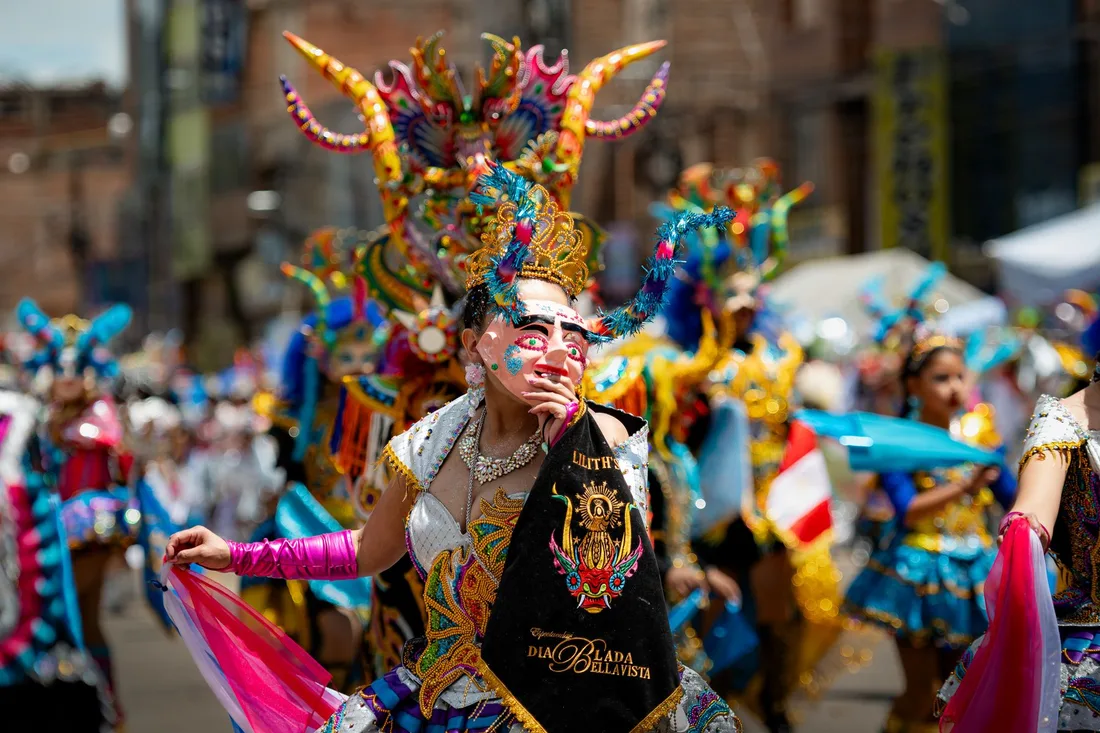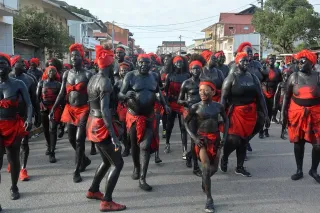
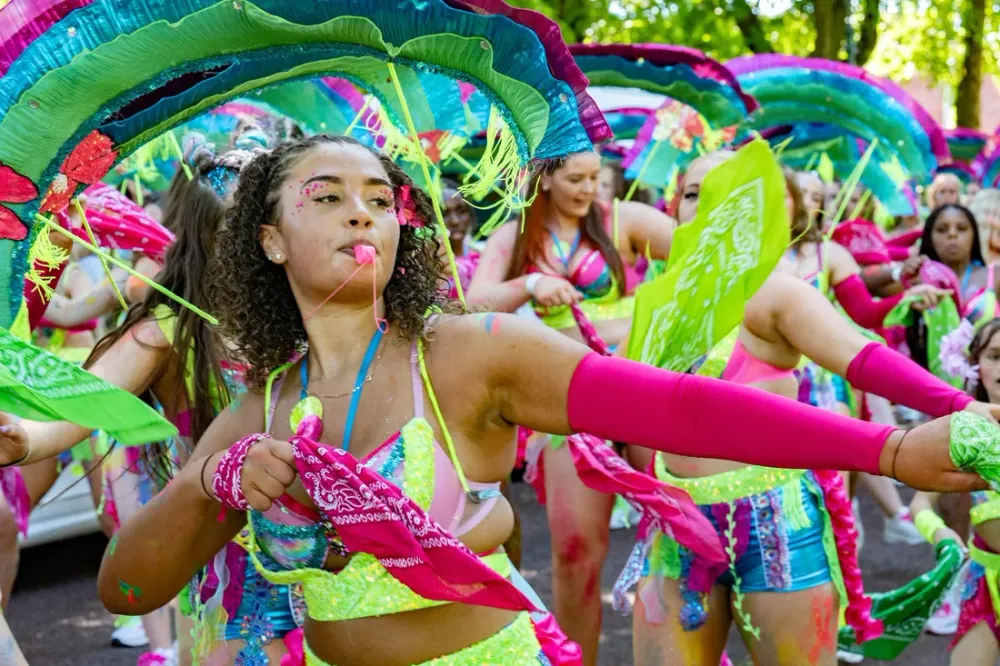
Most visitors come to French Guiana to watch the carnival. Very few realise they can be in it. Yet that is exactly where the difference lies between a nice memory and an experience that stays with you: walking in Cayenne’s Sunday parade yourself, in costume, surrounded by drums, for hours on end. The longest carnival in the world rests on local associations — the carnival groups — and most of them are open to anyone genuinely willing to get involved. Here is how to go about it, what it demands, and what it costs.
Understanding how it works before you knock on the door
Guianese carnival runs from Epiphany, in early January, to Ash Wednesday, in February or March depending on the year. It rests on two distinct worlds that should not be confused.
The masked balls
These are Saturday nights, in the halls known as dancings, where the Touloulou reigns: a woman costumed from head to toe, anonymous, who invites men to dance without ever revealing her identity. These evenings are open to all, with no membership and no rehearsal: you pay your entry, you put on a costume, you walk in. It is the simplest way in for a visitor, and we have devoted a full guide to it: going to a masked ball in French Guiana.
The carnival groups and the parades
This is the other side, daytime and collective. The groups are neighbourhood or municipal associations that spend the whole year preparing their appearance: a theme, made-to-measure costumes, choreography, a music section. They parade every Sunday of the season through the streets of Cayenne, Kourou, Saint-Laurent-du-Maroni, Matoury or Rémire-Montjoly, then during the Jours Gras.
These groups are the ones you can join — and it is a commitment, not a last-minute sign-up.
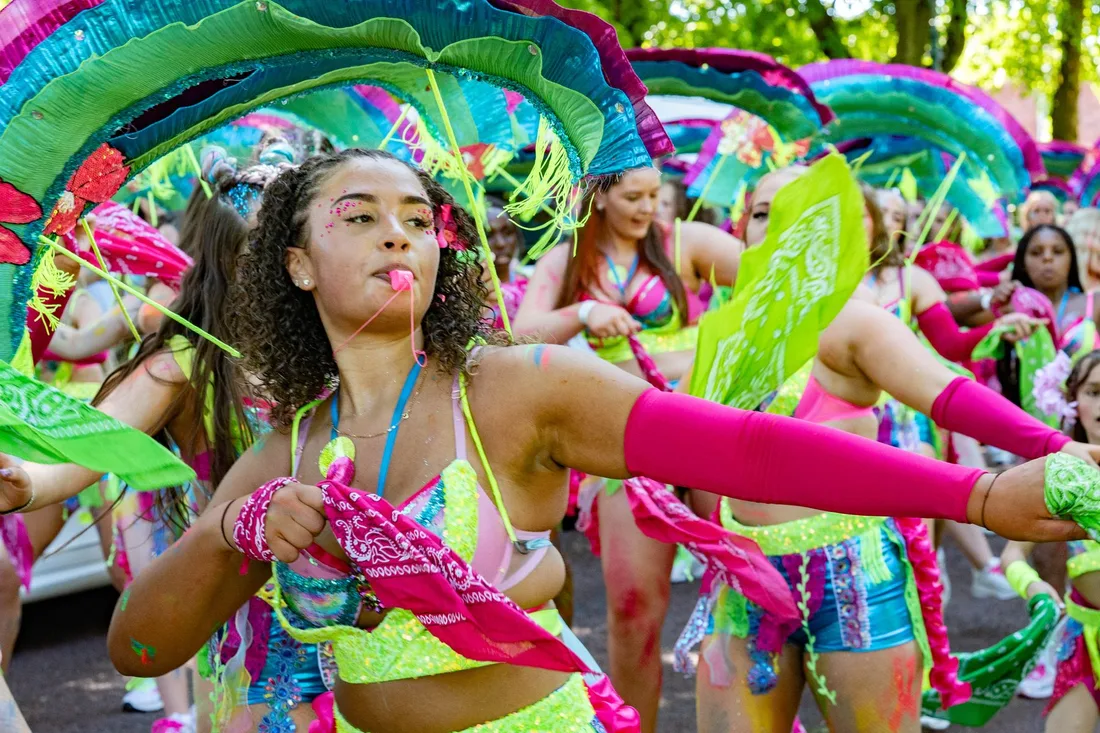
How to join a group when you are not from here
1. Identify the active groups
There is no single desk to go to. What actually works:
- The tourist office and the town hall of the commune where you are staying: they hold the programme and know which associations are active.
- Social media: every group posts its annual theme, its rehearsal dates and its calls for participants there. It is the liveliest channel.
- The ground itself: posters at Cayenne market, announcements on local radio, and word of mouth in the dancings on a Saturday night.
2. Introduce yourself early, and honestly
Contact the group from the autumn onwards, ideally in October or November, for a carnival starting in January. Say clearly who you are, how long you are staying and how much availability you can offer. A group will far rather have a straightforward visitor who turns up to four rehearsals than a participant who lands the day before the parade.
Two realities to accept: some very structured groups limit new entries once the season has started; and there is a difference between parading and accompanying — some groups offer a less demanding place at the back of the procession for newcomers.
3. Go to the rehearsals
This is the heart of it. Rehearsals take place on weekdays and at weekends, in neighbourhood halls or outdoors. You learn the choreography, the rows are set, the music section gets ready. It is also, above all, where you are accepted: a carnival is not a show, it is a collective. Nobody will ask you to be a good dancer — they will ask you to be there.
4. The costume: the real constraint
Each group parades on an annual theme with a unified costume, often made collectively. In practice:
- The group supplies the pattern, sometimes the fabric, and organises sewing workshops.
- You contribute financially, through a membership fee and the cost of the costume.
- Measurements are taken well ahead: turning up two weeks before the parade with no costume ordered means turning up too late.
Also plan on a pair of comfortable, already broken-in closed shoes. A parade lasts several hours, on asphalt, in 30 °C heat and high humidity. That is the detail that ruins the experience for the unprepared.
5. The budget
It varies from group to group and with the year’s theme. Count on the association membership fee, the cost of the costume (the main item, hugely variable depending on complexity), and the extras: drinks, transport, sometimes a contribution towards the float or the sound system. Ask for the total amount at first contact: groups are transparent about this.
The calendar: when to come and parade
The full season runs from January to Ash Wednesday, but not all weekends are equal.
Parade Sundays
Every Sunday of the season, the groups parade through the streets. The first outings in January are more modest; the intensity and the number of participants build steadily up to the Jours Gras weekend. For a first parade, a mid-season Sunday is ideal: the atmosphere is already there, and the pressure is lower than on the Jours Gras.
The Jours Gras, the peak of the season
Four consecutive days, each with its own dress code and meaning:
- Dimanche Gras: the great parade, the longest and most spectacular, with every group taking part.
- Lundi Gras: the day of the burlesque weddings, where roles are reversed — men as the bride, women as the groom. A joyful and very accessible format.
- Mardi Gras: the day of the devils, in red and black, with horns and tridents. A more codified costume.
- Ash Wednesday: the day in black and white, mourning Vaval, king of the carnival, burned at the end of the day. It is the closing ceremony, and one of the most powerful moments of the season.
If you can only come once, aim for those four days. But be aware that this is also when accommodation and rental cars are most stretched.
A note on the weather
Carnival season falls during the rainy season. It is not the driest time of year — the main dry season runs from July to late November — but it is the only possible window. Bring a light waterproof and accept the idea of parading through a downpour: nobody stops for so little.