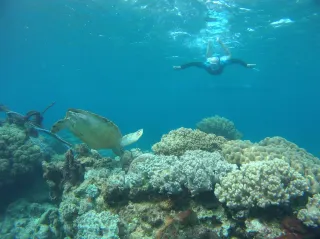
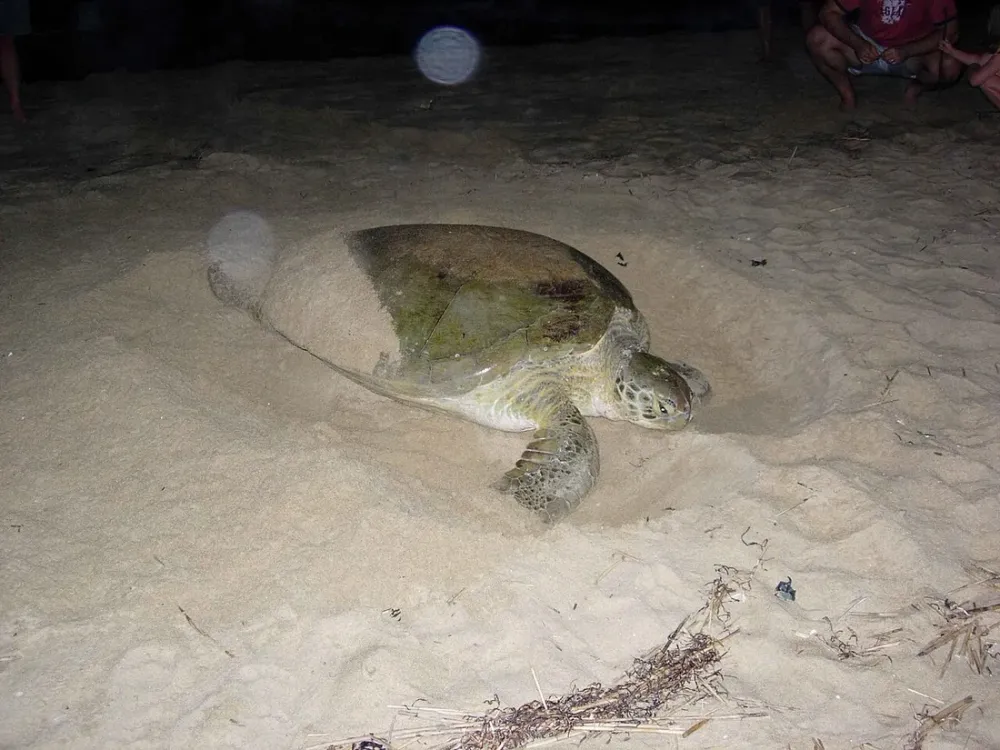
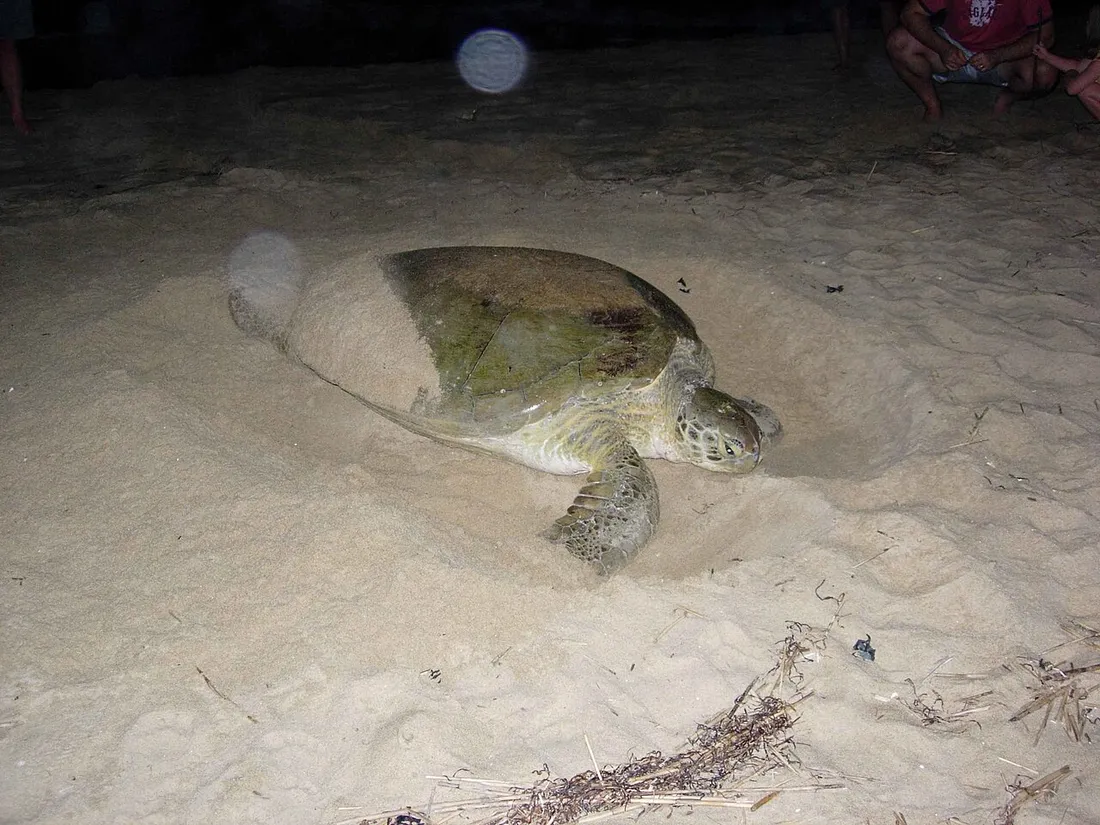
There are few sights in Martinique as moving as a sea turtle hauling herself up the beach after dark to lay her eggs. After years spent guiding our travellers and volunteering on a few monitoring nights, I can promise you this: witnessing a sea turtle nesting in Martinique has to be earned, prepared for, and above all respected. Unlike snorkelling with the turtles that graze the seagrass beds by day, nesting is a fragile moment, governed by law and watched over by a network of passionate volunteers. Here is my field guide to knowing where, when and how to observe this phenomenon without ever harming these protected animals.
Which turtles nest in Martinique
Three sea turtle species frequent the island’s waters and beaches, all fully protected by decree. They are easily confused, so here is how to tell them apart.
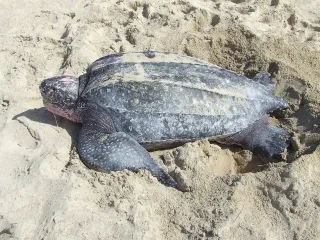
- The leatherback turtle (Dermochelys coriacea): the giant, up to 2 metres and over 500 kg, recognisable by its soft, ridged shell. It is the most spectacular to watch nesting. The search for a leatherback nesting beach mobilises volunteers every year, as the species is in steep decline across the Caribbean.
- The hawksbill turtle (Eretmochelys imbricata): smaller, with a hooked beak, it nests mainly on the quiet beaches of the south and the Caribbean coast.
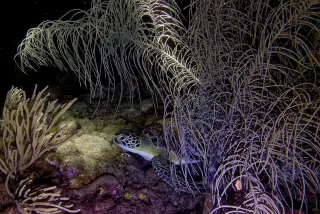
- The green turtle (Chelonia mydas): present at sea all year round, it nests more rarely on the island but remains the champion of the seagrass beds you meet while snorkelling.
Good to know: the same female comes up to lay several times in a season, a few weeks apart, then will not return for two to four years. Hence the value of every single nest.
Nesting season: when does a turtle come to lay
The nesting season runs broadly from March to October, with variations by species:
- Leatherback turtle: mainly from April to July, peaking in May–June.
- Hawksbill and green turtle: rather from June to October.
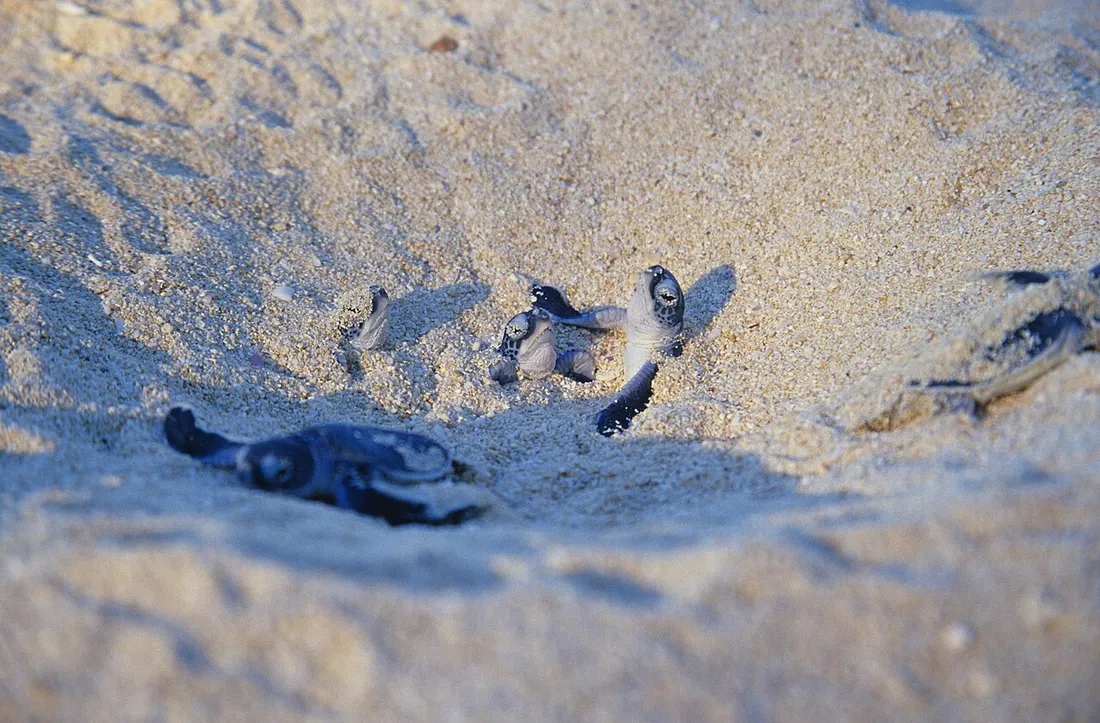
Incubation then lasts around 60 days in the sand: hatchling emergences are therefore concentrated from summer into autumn, sometimes as late as November. In practical terms, if you stay in Martinique between May and September, you fall within the right window, both for a nesting female and for a hatching.
Be aware, however, that this period overlaps with the hurricane season (June to November) and the wet winter. The dry Carême season (December to April), ideal for the rest of the island, is in fact not the best for nesting. This is one of the rare cases where the classic tourist calendar and nature do not coincide.
Where to observe nesting: the beaches to know
Turtles choose beaches with soft sand, little lighting and quiet. Several areas have historically been monitored by volunteers. Out of respect for the guidelines, I deliberately stay general: we do not share the exact location of an active nest.
The Caribbean north and the wild coast
- Grande Anse du Diamant and the southern Caribbean beaches regularly host nesting. Searching for a turtle track at Grande Anse at first light, those wide fan-shaped furrows rising towards the vegetation, is one of the great thrills of a Martinique summer.
- The northern coves (Le Carbet, Le Prêcheur, anse Couleuvre, anse Lévrier) and their black volcanic sand are favourite sites for the leatherback turtle, as they are little visited at night.
The far south and the Atlantic
- Around Sainte-Anne, Sainte-Luce and the preserved southern beaches, hawksbill turtles find discreet coves to nest.
- Some Atlantic beaches, wilder, are also concerned, but the state of the sea there makes observation more uncertain.
My advice: never go turtle-hunting alone on a beach at night. The right move is to go through the volunteer network (see below), which organises supervised monitoring and will guide you without disturbing the animals.
Night observation of a turtle: the golden rules
Night observation of a turtle follows a strict protocol. A female disturbed during her climb may turn back and release her eggs at sea: the nesting is then lost. Here are the non-negotiable gestures, the ones every volunteer will remind you of.
- No white light. Phones, headlamps, photo flashes: all of these disorient the turtle and, later, the newborns that orient themselves by the glow of the sea horizon. If needed, use a low-intensity red light.
- Stay at a distance and behind. Position yourself behind the turtle, never in front of her head, several metres away, and approach only once she has begun nesting (the state in which she no longer turns back).
- Silence and stillness. No noisy group, no abrupt movements, whisper.
- Never touch the animal, do not ride it, do not try to turn it over or to “help” it.
- No litter, no obstacles. Take everything back, do not dig, do not plant a parasol, and avoid fires and music on nesting beaches in season.
- Dogs on a leash, or better left at the accommodation: they can dig up nests and frighten the females.
Legal reminder: disturbing, capturing or harassing a sea turtle, destroying a nest or collecting eggs is an offence punishable by heavy fines and prison sentences. This is not theory: checks do happen. To place this outing within your overall programme, see our complete guide to Martinique.
What if I come across a turtle by chance?
It happens, especially during a night walk. The reflex: switch off all lights, step back, stay discreet and observe from afar. If the turtle is in difficulty (injured, caught in a net, disoriented) or if you find a threatened nest, alert the network rather than intervening yourself.