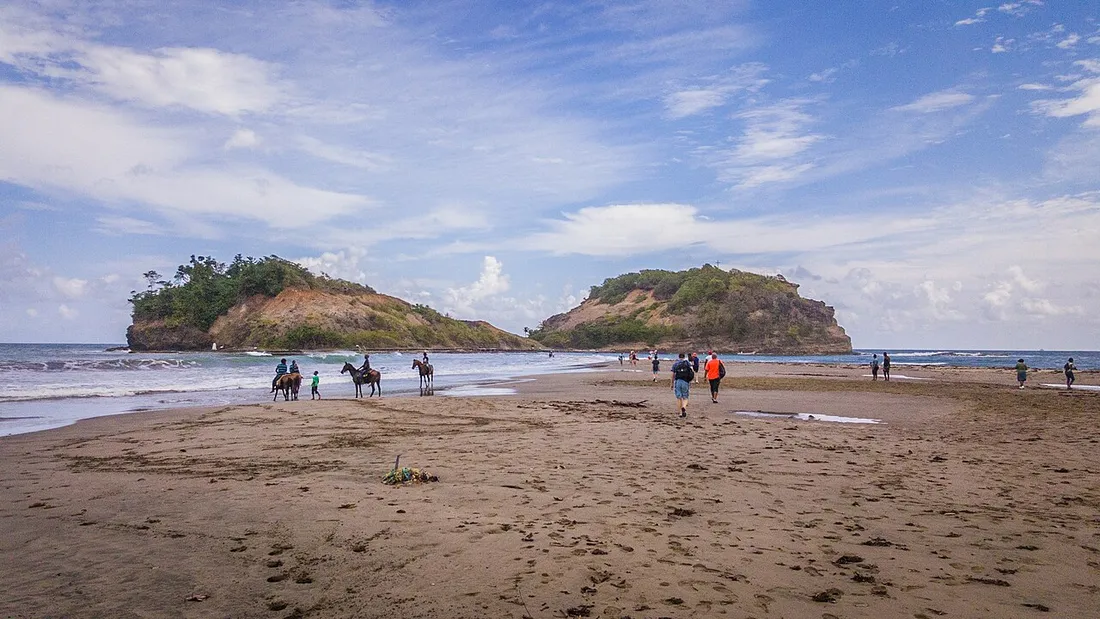
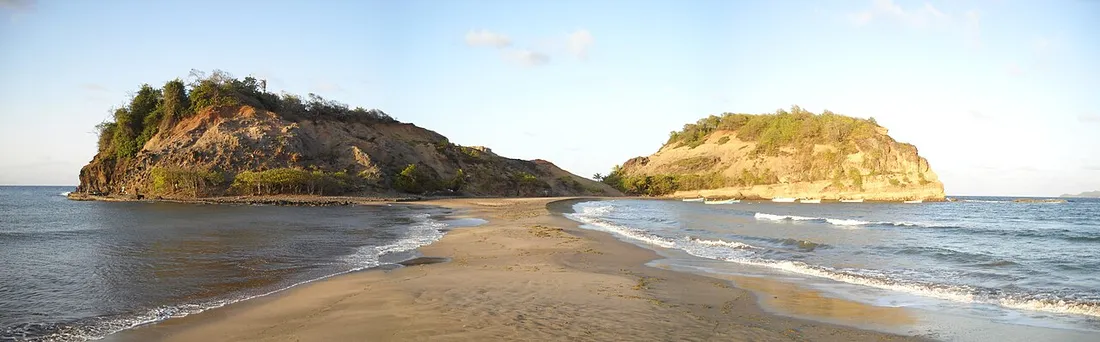
There is a place in Martinique where you walk in the middle of the ocean, water on your right, water on your left, without getting wet above the ankle. This is the Sainte-Marie tombolo, a natural sandbar that rises out of the Atlantic for a few months each year to link the village beach to a small wooded islet. I live on the island and I have crossed it dozens of times; the same thrill every single time. But it is a phenomenon you have to earn: it only appears at certain tides and certain seasons, and getting it wrong can ruin the day, or even turn dangerous.
This guide goes straight to the point: understanding the Sainte-Marie tombolo, reading the tides to walk across, knowing the season when the phenomenon opens up, and doing it safely.
What a tombolo is, and why this one is rare
A tombolo is a tongue of sand that links an island (or islet) to a larger landmass. The mechanism is elegant: Islet Sainte-Marie, sitting about 200 metres off the shore, acts as a screen against the Atlantic swell. Behind this obstacle, the waves diffract, lose their energy and drop the sand they carry. A bank eventually forms between the land and the islet, until it emerges.
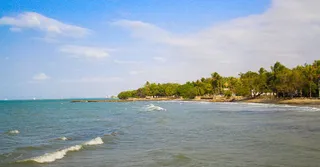
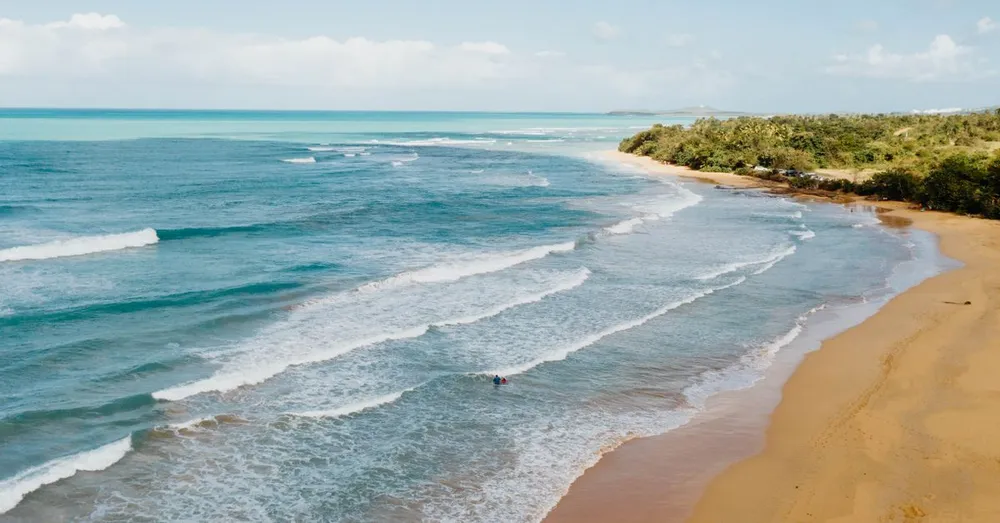
This tombolo phenomenon in Martinique is unique at this scale: it is one of the few tombolos in the Lesser Antilles you can walk across, and the only one on the island you cross dry-footed. You are not walking on a trail, but on a structure the ocean builds and unbuilds with the seasons. This is the north-eastern Atlantic coast, between La Trinité and Le Marigot, so on the windward side, with a sea livelier than the Caribbean.
Above all, this tombolo is intermittent: it only exists dry-footed for part of the year, and only at low tide. The rest of the time, the bank stays submerged and the islet becomes a full island again. It is this intermittence that makes the crossing so special: you have to be there at the right moment.
When the tombolo opens: the Lent window
The basic rule: the tombolo is exposed mostly during the dry season, Lent (le Carême), that is from January to April, sometimes into early May. During this window, the sea is calmer and the swell favours the build-up of sand, which the big tides then expose. In the rainy season (June–November), stronger swells redistribute the sediment and the bar stays underwater.
In other words: aiming for February–March–April maximises your chances of finding the tombolo exposed and walkable. Hoping to cross in the middle of August usually leads to disappointment. And even in peak season, the bar only emerges around low tides, twice a day: it is not a bridge that is open all the time. Since the phenomenon is natural, nothing is guaranteed on any given day: you need to hit both the right season AND the right tide.
Reading the tides to walk across
Low tide at the tombolo is your only way in, and it is what separates a successful crossing from a wasted day. Martinique has low-amplitude tides, but here a few centimetres make all the difference between dry sand and a bank under water. The method:
- Download a free tide app and set it to the nearest reference port (La Trinité or Fort-de-France work as a guide).
- Find the time of the day’s low tide and aim for the highest coefficients of the period: the higher the coefficient, the more sand is exposed. Cross-check with the marine forecast (low swell, moderate wind).
- Arrive 1 to 1.5 hours before low tide to watch the bar emerge, allow 15 to 20 minutes for the crossing, and head back well before the sea covers the bank again.
A small trap for those arriving from mainland Europe: the time difference. Martinique is -5h in winter and -6h in summer relative to Paris. Check that your app displays local Martinique time, otherwise you will be aiming at a low tide several hours off. This is the number-one mistake of newcomers.
Making the crossing a success, and a safe one
The Atlantic is not the Caribbean: the sea is livelier and the current does not forgive carelessness. The crossing is nothing extreme, but it requires preparation. My local guidelines:
- Only cross around low tide, never on an already-rising tide: the bar covers over quickly and the lateral current can be treacherous.
- Wear shoes: the bank is dotted with coral, shells and sea urchins; barefoot, it is a direct trip to the pharmacy.
- Watch the flag and the state of the sea. In a strong swell, give up. As soon as the water starts taking back ground on the bar, head in.
- Bring water and sun protection: there is no shop and no shade on the islet, and the midday sun is fierce. Hold the children by the hand.
Islet Sainte-Marie is also a fragile natural area: do not pick anything, do not disturb the wildlife, take your rubbish back and picnic on the beach side instead. Leave it as wild as you found it.
Building your day around the tide
The tombolo is not something you visit “while passing by”: it is planned around the tide. Check the next day’s low tide the evening before, arrive 1.5 hours early to watch the bar emerge, cross around low tide, then head back to lunch on the beach before the sea rises again. The afternoon easily stretches out nearby: historic distillery, banana house, or the neighbouring Caravelle peninsula. To combine the tombolo with these gems, our complete Martinique guide details the must-sees around.
How to get to Sainte-Marie
- From Fort-de-France: about 35 to 45 minutes (around 45 km) along the coast.
- From Aimé Césaire airport (Le Lamentin): 40 to 50 minutes depending on traffic.
- From the South (Sainte-Anne, Les Trois-Îlets): 1h15 to 1h30.
- A car is strongly recommended: the North Atlantic is poorly served by public transport, and timing your day to the tide means being self-reliant. Fill up before you leave.
Access to the beach and the tombolo is free, with no ticket or barrier.
Staying in the North to catch the right tide
The tombolo is all about timing. The best way not to miss it is to sleep nearby rather than attempting the round trip from the South. By staying in the North Atlantic, you set your days by the current low tides and get another shot over several days if the swell spoils the party.
At Hostel Toucan, a concierge and holiday rental service in Martinique, we select well-located accommodation for exploring Sainte-Marie and the North. By booking direct, you enjoy:
- direct booking with no platform fees, to pay the fair price;
- free cancellation up to 7 days before arrival, peace of mind if the marine forecast changes;
- 7-day WhatsApp support for the best tide windows and the best local addresses.
Browse our accommodation on the Martinique rentals page to find your base. Do you own a property in Sainte-Marie or La Trinité and want to entrust it to local hands? Discover our concierge service for owners.
The Sainte-Marie tombolo is not caught by chance: you need the right season, the right tide and a little patience. But when the bar emerges and you walk between two stretches of ocean towards the islet, you understand why it is one of the most memorable moments of a stay in Martinique.
FAQ
When can you walk across the Sainte-Marie tombolo?
The tombolo is exposed mostly during the dry season, Lent (le Carême), from January to April (sometimes into early May), and only around low tides, ideally with a high coefficient. Aim for February–March–April and a well-marked low tide. In the rainy season (June–November), the bar usually stays submerged.
How do you read the tides to make the crossing a success?
Check a free tide app set to a nearby reference port (La Trinité or Fort-de-France), find the time of low tide and favour the highest coefficients. Arrive 1 to 1.5 hours before and head back before the sea returns. Mind the time difference: make sure to check local time (-5h in winter, -6h in summer relative to Paris).
Is crossing the Sainte-Marie tombolo dangerous?
It is nothing extreme but it calls for caution, the Atlantic coast being rougher than the Caribbean. Only cross around low tide, never on a rising tide. Wear shoes (coral, sea urchins), watch the flag and the sea, bring water and sun protection, and hold the children by the hand. In a strong swell, give up.
Do you have to pay or book to see the Sainte-Marie tombolo?
No. Access to the beach and the tombolo is entirely free, with no ticket or booking: it is a natural phenomenon governed only by the tides. There is, however, no shop and no water point on the islet: bring something to drink and sun protection before you cross.