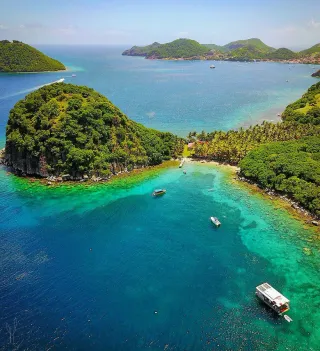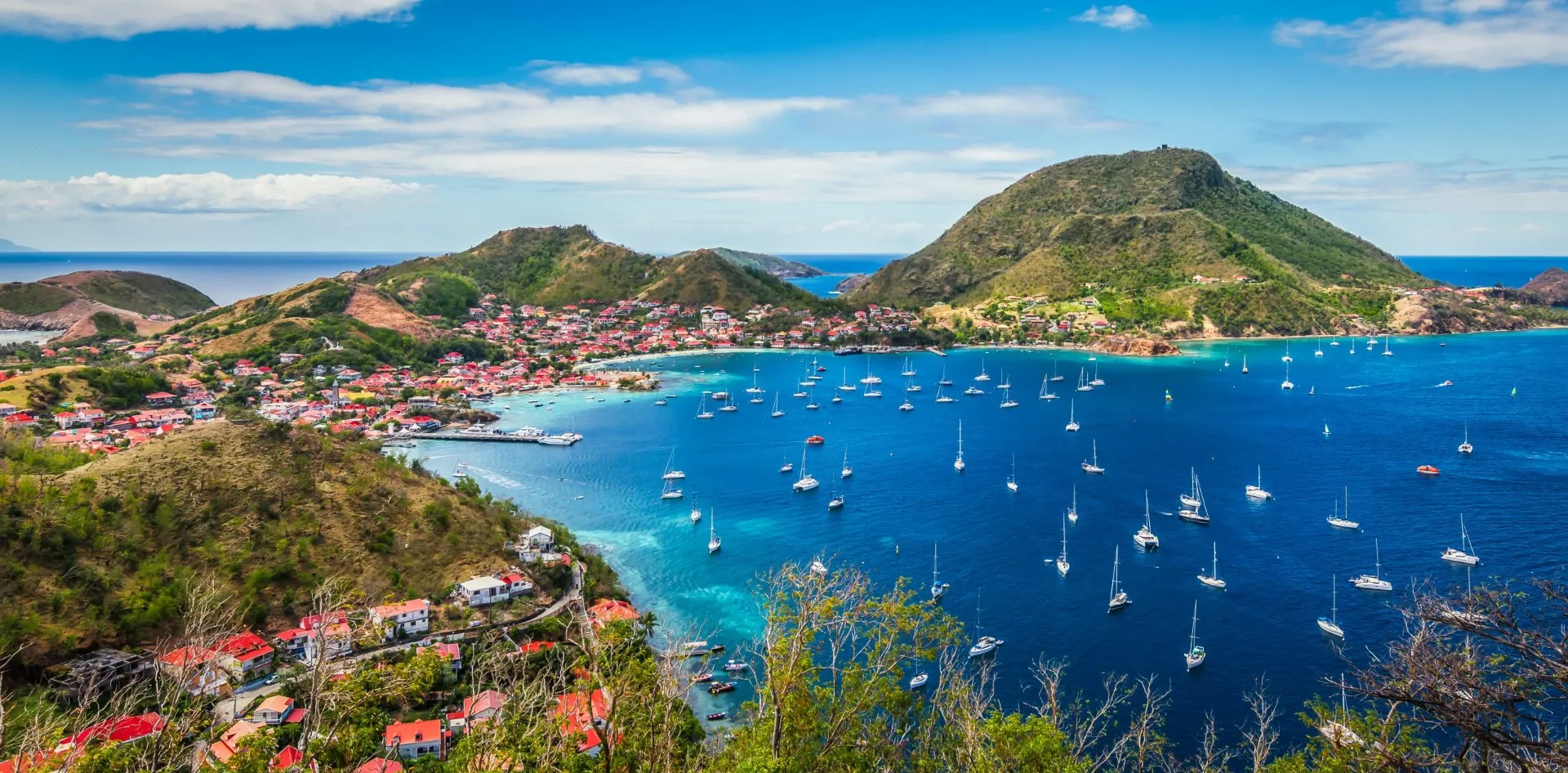
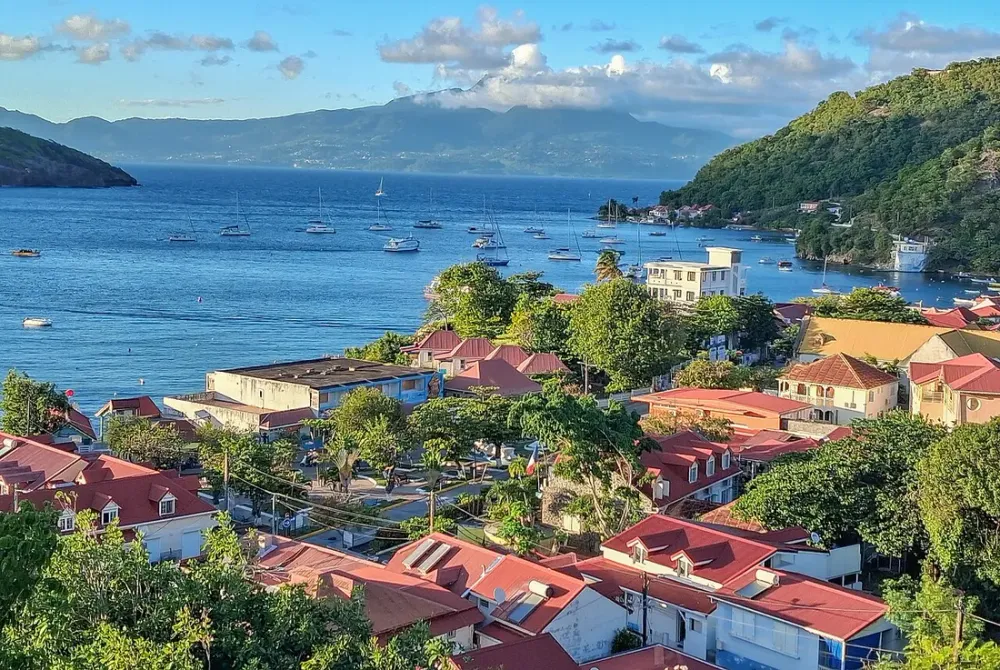
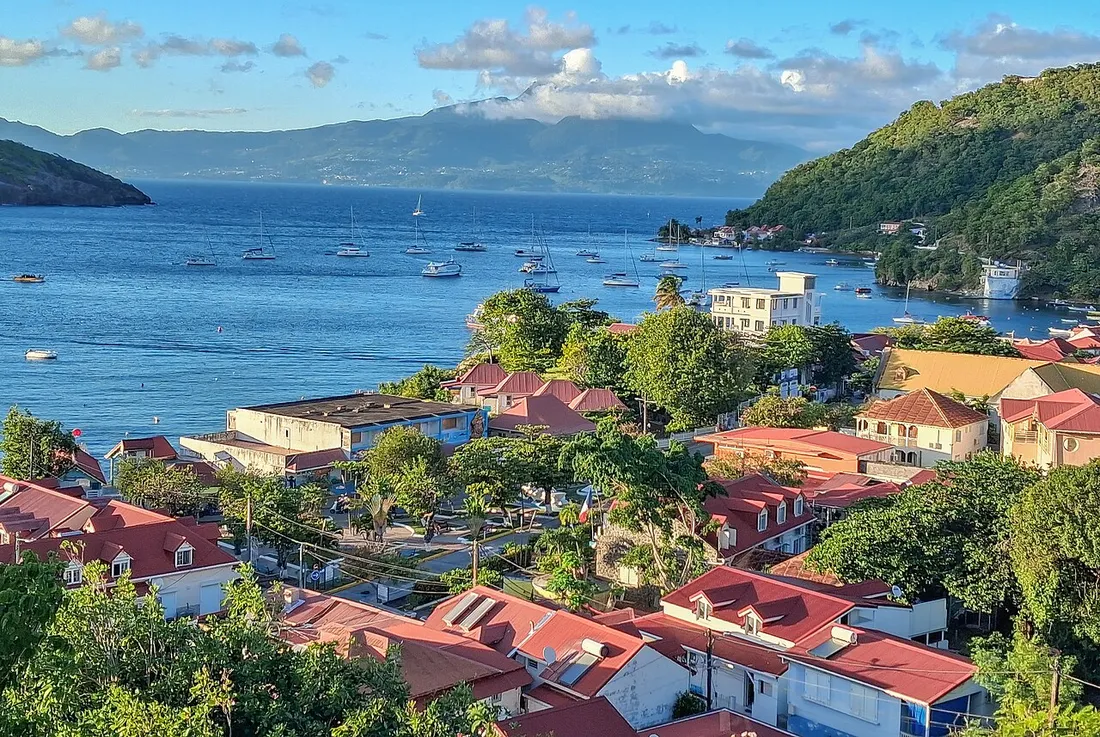
Owning a furnished rental in Terre-de-Haut means betting on one of the most coveted settings in the Caribbean: a bay ranked among the most beautiful in the world, red-roofed Saintois houses and an easygoing way of life found nowhere else in Guadeloupe. But running a vacation rental in Les Saintes is nothing like managing a villa in Grande-Terre: here, there are no cars, land is exceedingly rare, and a heritage framework regulates everything down to the colour of your shutters. Based on the islands and used to the logistics of the southern islands, we share the real playbook — constraints, costs and levers — before you take the plunge.
Why Terre-de-Haut is a market apart
Les Saintes form a small archipelago south of Basse-Terre, of which Terre-de-Haut is the inhabited, touristy island (around 1,500 residents). You can only reach it by boat: about twenty minutes by ferry from Trois-Rivières (23 to 28 euros for an adult round trip) or an hour from Pointe-à-Pitre. This island-within-an-island creates a market that is both highly sought-after and tightly constrained.
Demand, first of all, is strong and spread out:
- Day-trippers who, won over, come back to stay the night — a furnished rental captures precisely this clientele frustrated at having to leave on the last ferry.
- Couples and travellers seeking quiet, willing to pay for a view over the bay or a flower-lined lane.
- Divers and nature lovers, drawn by the Pain de Sucre, Pompierre beach and the protected seabeds.
Supply, meanwhile, is capped by geography: the island is tiny, the building stock is dominated by traditional Saintois houses, and every buildable square metre commands a high price. The result: a decent, well-managed property easily runs at 70-80% annual occupancy, where a Grande-Terre villa tends to aim for 65-75%. To place Les Saintes within the wider Guadeloupean archipelago, our complete guide to Guadeloupe breaks down what travellers are looking for island by island.
Constraint number one: an island (almost) without cars
This is the feature that shapes the entire management approach. Car traffic is strictly limited on Terre-de-Haut: no car rental for tourists, vehicles reserved for residents and professionals, and a village best explored on foot, by bike or by scooter (rental around 25 to 35 euros a day).
In practice, for an owner, this changes everything:
- The welcome doesn’t happen by car. Your travellers arrive at the pier with their luggage and have to reach the property on foot or by baggage shuttle. A rental more than a 10-minute walk uphill from the landing loses bookings — proximity to the village is a major search criterion.
- Cleaning and linen logistics are dictated by the terrain. No car boot to carry sheets and supplies: everything is carried or moved by cargo tricycle. A local team, on the ground on the island, becomes indispensable.
- Works and supplies come by boat. A sofa, a mattress, an air conditioner: every material arrives by barge from Basse-Terre, with a transport surcharge of 15 to 30% and lead times of one to two weeks. You don’t “pop to the hardware store” the way you would in Pointe-à-Pitre.
The right instinct: when buying, choose a property close to the pier and the centre, and plan ahead for every intervention. A broken air conditioner on a Saturday in August can’t be fixed the same day here.
Scarce land and heritage buildings: what the protected bay imposes
The Bay of Les Saintes is a listed site, and the village of Terre-de-Haut has a strong architectural identity protected by planning rules. For an investor, this has two direct consequences.
Buying: few properties, high prices
Buildable land is almost nonexistent and transactions are rare. Price ranges remain high for Guadeloupe:
- A small Saintois house to renovate in the village: often 250,000 to 400,000 euros.
- A house with sea view or garden, ready to rent: 400,000 to 700,000 euros, sometimes more for a bay view.
On top of these prices comes the cost of renovation, inflated by the transport of materials. But scarcity supports value: a property in Les Saintes rarely sells at a loss.
Renovating and furnishing: respecting the framework
Façades, joinery, colours, roofing: any changes visible from public space are regulated. Before any exterior work, you must check with the town hall what falls under a simple declaration or a more thorough review in a protected zone. This framework isn’t just a constraint: it’s what preserves the “postcard” charm that justifies your rate. A rental that respects the Saintois style (wooden shutters, light tones, Creole furniture) rents better than a generic interior.
On the rental formalities side, the rule is the same as across Guadeloupe: declaration at the town hall before the first booking (Cerfa form no. 14004), with a registration number to display on your listings wherever the municipality has activated it — rollout planned for all municipalities by the end of 2026. You also collect the tourist tax from travellers, to pass on to the local authority.