“My villa rents for 300 euros a night, so I make over 100,000 euros a year.” We hear this sentence every single week, and it’s almost always wrong. Between the advertised rate and the income you actually pocket lies a chasm: empty nights, commissions, tropical upkeep and taxes. Calculating the profitability of an Airbnb in Guadeloupe is not a matter of multiplying a price by 365 — it requires a method that starts from real, season-by-season occupancy. Based on the archipelago and managing furnished rentals in Sainte-Anne, Saint-Francois, Le Gosier and Deshaies, here is the framework we use to put a figure on a project without fooling ourselves.
The only formula that matters: from gross revenue to net yield
Before you enter a single number, keep the chain of calculations in mind. The profitability of an Airbnb in Guadeloupe is measured in four tiers, from the most optimistic (at the top) to the most realistic (at the bottom):
- Gross rental revenue = average rate per night x number of nights actually sold.
- Net operating income = gross revenue minus operating costs (commissions, concierge service, cleaning, upkeep, energy, insurance).
- Cash flow = net operating income minus the monthly loan payment and property tax.
- Net yield = (net operating income / total cost of the property) x 100.
The classic mistake is to calculate the yield on gross revenue. But in Guadeloupe, the costs of a tourist rental easily swallow 35 to 45% of receipts: a yield advertised at 9% on gross often drops to around 5% once everything is deducted. The gross yield (annual receipts / purchase price including fees x 100) remains useful for quickly comparing two properties, but never sign on that basis alone.
Step 1: estimate real occupancy, season by season
This is the crux of the matter, and the most overestimated figure. The occupancy rate of a rental in Guadeloupe is anything but uniform across the year: the archipelago lives to the rhythm of the careme (dry season, December to April) and the hivernage (rainy season, June to November). Rather than pulling an annual average out of thin air, think in seasonal blocks.
Here are the ranges we observe for a property that is well photographed, well located and responsive to enquiries:
- December to April (high season, dry season): 80 to 90% occupancy. This is the period of the holidays, Carnival (January-February) and escape from the metropolitan winter. Stays are booked 4 to 9 months in advance.
- May-June (shoulder season): 55 to 65%. Couples, long weekends, intermediate rates.
- July-August (secondary peak): 65 to 75%, driven by the diaspora and families.
- September to mid-November (low point, heart of hurricane season): 30 to 45%. This is the window for works and maintenance.
A realistic annual average: 60 to 70% on a well-managed property, meaning roughly 220 to 255 nights sold. With remote management from mainland France (5 to 6 hours’ time difference, slower responsiveness), expect closer to 45 to 55%. That 15-point difference alone represents several thousand euros a year. For an honest calculation, always divide the nights sold by 365, without excluding nights blocked for maintenance.
Step 2: set the average nightly rate (not the showcase rate)
The rate advertised in high season is not the average annual rate: a rental fetching 300 euros a night in February drops to 180 euros in October. The right figure for the calculation is the season-weighted average rate. Orders of magnitude observed across the archipelago in 2026, for a property with a pool or sea view:
- Studio / one-bedroom (2-3 people) in Le Gosier or Sainte-Anne: 70 to 110 euros a night off-season, 110 to 160 euros in high season.
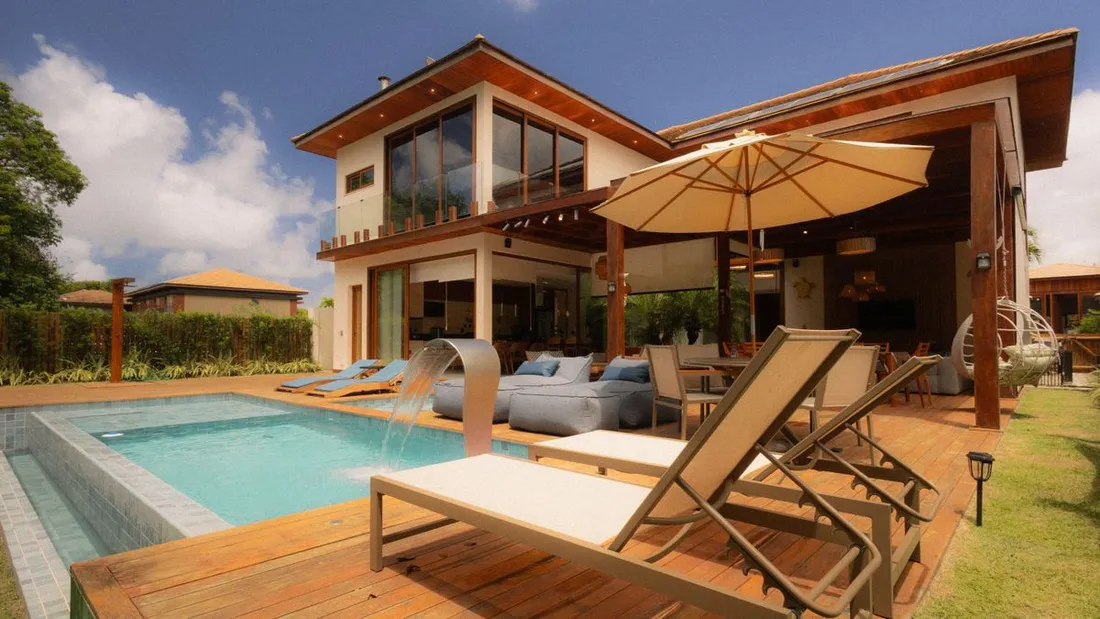
- Three-bedroom villa with pool in Saint-Francois or Sainte-Anne: 180 to 250 euros off-season, 280 to 400 euros in high season.
- Nature bungalow in Deshaies or Bouillante (leeward coast, near the Cousteau Reserve): 90 to 140 euros, with a long-stay clientele.
For the three-bedroom villa, a season-weighted annual average sits around 240 to 270 euros a night. It’s this figure, multiplied by the number of nights sold, that gives gross revenue. To fine-tune by commune and micro-market (the Grande-Terre lagoon, the Caribbean coast of Basse-Terre, proximity to the beaches of Grande Anse in Deshaies or La Caravelle in Sainte-Anne), our complete guide to Guadeloupe details what travellers look for, zone by zone.
Step 3: list every overseas cost (the ones people forget)
This is where optimistic projections fall apart. In a tropical climate and an island context, several line items weigh more heavily than on the mainland. For a villa generating 50,000 euros in gross receipts, here is the typical breakdown over a year:
- Platform commissions (Airbnb, Booking): 15 to 18% of receipts, i.e. 7,500 to 9,000 euros. Zero if you switch to direct booking.
- Concierge / delegated management: 18 to 25% for a coastal property (check-in, cleaning, maintenance, calendar). On 50,000 euros, that’s 9,000 to 12,500 euros.
- Cleaning and laundry: linen wears out 30% faster (sand, sunscreen); budget 3 sets per bed; 2,000 to 3,500 euros a year depending on turnover.
- Energy: air conditioning and the pool drive the bill up; 1,500 to 2,500 euros a year for a villa.
- Tropical upkeep: salt, humidity, garden, pool, wood sealant twice a year, air conditioner servicing. Budget 4,000 to 6,000 euros a year. This is the most underestimated line item.
- Insurance (landlord cover + hurricane guarantee): 600 to 1,200 euros, higher than on the mainland because of the cyclone risk.
- Property tax: varies by commune, often 1,200 to 2,500 euros for a villa.
- Octroi de mer (dock dues): a tax specific to the overseas departments that drives up the cost of imported equipment and furniture (appliances, air conditioners) when fitting out and replacing them. To be factored into your initial investment budget.
In total, the operating costs of a villa commonly reach 35 to 45% of gross receipts, before the loan. For a more simply managed studio, this drops to 28 to 35%, especially without a pool or garden.
Don’t forget the tourist tax (which you collect, not pay)
The tourist tax is owed by the traveller: you collect it and pass it on to the inter-communal authority. It therefore doesn’t eat into your profitability, but it must be managed (a register of nights, payment by deadlines). On direct bookings, it’s up to you to bill it; the platforms collect it automatically.
Step 4: assemble the calculation on a real case
Let’s take a three-bedroom villa with a pool in Sainte-Anne, bought for 580,000 euros including notary fees (a total cost of around 620,000 euros with the furnishings and the octroi de mer on equipment).
Gross receipts:
- 240 nights sold x 245 euros season-weighted average rate = 58,800 euros.
Operating costs (delegated management + platforms scenario):
- Platform commissions (16%): 9,400 euros
- Concierge (20%): 11,760 euros
- Cleaning / laundry: 3,000 euros
- Energy: 2,200 euros
- Tropical upkeep: 5,000 euros
- Insurance: 1,000 euros
- Property tax: 2,000 euros
- Total costs: around 34,360 euros
Net operating income: 58,800 - 34,360 = 24,440 euros.
Net yield: 24,440 / 620,000 = 3.9%. To which you add the effect of depreciation under the régime réel (actual-cost regime), which wipes out all or part of the tax for 10 to 15 years, as well as the appreciation of the property.
Now let’s switch to direct booking (platform commissions removed): net operating income climbs to around 33,840 euros, and the net yield rises to 5.5%. That’s the whole point of the direct model: recovering the 15 to 18% the OTAs take. For a studio at 165,000 euros showing 9.7% gross, the net yield typically lands between 5 and 6.5% after costs, depending on the management approach.
Step 5: check cash flow and the break-even point
Yield is the annual snapshot. Cash flow is what’s left in your account each month once the loan is paid. Back to the villa: if the monthly loan payment comes to 2,600 euros (i.e. 31,200 euros a year), the annual cash flow under delegated management drops to 24,440 - 31,200 = -6,760 euros. Negative. With direct booking: 33,840 - 31,200 = +2,640 euros. Positive, but only just.
At this level of purchase price and loan, the marketing model and the occupancy rate are not details: they are the variables that tip the project from red to green.
The break-even point answers the reverse question: how many nights must you sell to cover your fixed costs? For our villa, annual fixed costs (excluding variable commissions and cleaning) hover around 41,000 euros including the loan. At 245 euros a night net of variable costs (about 175 euros), you need to sell roughly 190 nights to break even, or 52% occupancy. Below that, the property costs money; above it, it makes money.
Concrete levers to improve profitability
After several seasons running properties in the French overseas departments, here is what truly moves the needle:
- Switch to direct booking: 15 to 18% of commissions saved, the number-one lever on net yield.
- Get the tourist rental classified (the star rating): double the micro-BIC tax allowance (50% instead of 30%), better visibility, a gentler flat-rate tourist tax. Classification costs 150 to 250 euros, valid for 5 years.
- Dynamic pricing: adjust the weekly rate according to flights into Pole Caraibes airport, school holidays and events (Carnival, Route du Rhum). Typical gain: 8 to 15% extra revenue.
- Cut empty nights in the low season: minimum stays lowered to 2-3 nights in October to capture local weekends.
- Master tropical upkeep: schedule major works in September-October, when 10 days of unavailability cost five times less than an AC breakdown in February.
The Hostel Toucan approach: profitability with figures, no nasty surprises
At Hostel Toucan, concierge service and seasonal rentals in the French overseas departments, we refuse fanciful projections: before any commitment, we provide a revenue estimate based on comparable properties in your commune, with overseas costs itemised. Concretely, for your travellers:
- Direct booking with no platform fees: the OTA margin stays on your side and improves your net yield.
- Free cancellation up to 7 days before arrival: better conversion rate, travellers reassured against the unexpected (sargassum, weather).
- WhatsApp assistance 7 days a week: a quick reply, in the right time zone, from check-in to the state of the beach.
A traveller looking for somewhere to stay? Browse our accommodation in Guadeloupe. An owner wanting to put a figure on a project in Sainte-Anne, Saint-Francois, Le Gosier, Deshaies or Bouillante? Head to the owners page: a free, honest, no-commitment profitability estimate.
FAQ
What occupancy rate should I aim for to make an Airbnb profitable in Guadeloupe?
A well-managed, well-photographed property reaches 60 to 70% annual occupancy, with peaks of 80 to 90% from December to April (dry season) and a low of 30 to 45% from September to mid-November (hurricane season). With remote management from mainland France, expect closer to 45 to 55%. It’s often falling below 50% that pushes a project into the red.
What net yield can you expect from a seasonal rental in Guadeloupe?
After deducting overseas costs (commissions, concierge service, tropical upkeep, energy, insurance, property tax), the net yield generally sits between 4 and 6.5% depending on the property and the management approach. Direct booking, by removing 15 to 18% in platform commissions, often adds 1.5 to 2 points of yield.
Which costs are most often forgotten in the calculation?
Tropical upkeep (salt, humidity, pool, wood sealant, air conditioner servicing: 4,000 to 6,000 euros a year for a villa) and the octroi de mer on imported furnishings. Next come the energy tied to air conditioning and the pool, and the insurance surcharge linked to the cyclone risk. These items easily make the difference between an advertised yield and a real one.
How do I calculate the break-even point of my rental?
Add up your annual fixed costs (loan, property tax, insurance, basic upkeep), then divide by your net margin per night (average rate minus variable costs such as cleaning and commissions). You get the number of nights to sell to break even. For a villa in Sainte-Anne, this threshold often hovers around 190 nights, or about 52% occupancy.