Are you a civil servant with a posting to French Guiana on the horizon? Good news: an overseas assignment comes with a set of specific financial benefits, including the well-known relocation allowance (the change-of-residence indemnity), a salary uplift and, in some cases, a special allowance. But between the moment you accept the post and the moment the money actually lands, there is a delay — often several weeks. Housing therefore becomes an immediate concern, because the market in French Guiana has its own rules. This guide takes stock, with figures given for guidance only (exact amounts depend on your grade, your family situation and the regulations in force at the time of your transfer), of what you are entitled to and how to find somewhere to live with peace of mind when you arrive.
Financial support for an overseas posting: what are we talking about?
When people mention “the allowance” for a civil servant posted to French Guiana, they often lump together several distinct schemes. It is worth separating them clearly, because they are not triggered at the same time or under the same rules.
The change-of-residence indemnity (the move itself)
This is the scheme closest to what is commonly called the “relocation allowance”. It is designed to cover the costs of moving from mainland France to French Guiana: transporting your furniture, and travel for you and your family. The amount is calculated using scales that take into account distance, household composition and length of service. For French Guiana, the remoteness works in your favour in the calculation.
Key points to remember:
- It is generally paid after you have settled in, on production of supporting documents (tickets, removal company invoice).
- An advance can sometimes be requested from the administration; check with your HR department before you leave.
- Conditions on minimum length of service in your previous post and on the commitment period in the new post apply: leaving early can trigger a repayment.
The salary uplift (the cost-of-living supplement)
In French Guiana, the index-based salary of State civil servants is increased. This uplift is intended to offset the higher cost of living compared with mainland France. It applies month after month, from the moment you take up your duties, and represents a significant share of your net pay. It is often what makes the posting financially attractive over the long run.
The special hardship and installation allowance (IPSI)
Depending on the corps and the administration, a specific allowance may exist for certain first overseas postings, paid in several instalments spread over the length of the stay. Its existence and its terms vary: always check what applies to your corps with your HR manager.
For guidance only, all these schemes combined can represent several thousand euros in the first year, but because payments are staggered, cash flow in the first few weeks remains tight. Hence the importance of planning your housing ahead.
The cash-flow gap: the real challenge of the first few weeks
This is the point many civil servants discover once they are on the ground: the support exists, but it often arrives after the first expenses. On arrival, you generally have to:
- Pay for housing (rent, possibly a security deposit).
- Fund temporary accommodation while you look for permanent housing.
- Equip your home if your furniture has not yet arrived by container.
- Cover day-to-day costs (car, food, setting up utility accounts).
Furniture shipped by container from mainland France takes several weeks to several months to arrive (sea transit, customs clearance, delivery). During that period, furnished accommodation — even temporary — is all but essential. Anticipating this gap saves you the stress of moving into an empty home.
Finding housing in French Guiana: understanding the local market
French Guiana is not a property market “like any other”. Rental demand is strong, particularly from public sector staff (national education, hospitals, gendarmerie, justice, prefecture, local authorities), and the supply of quality housing can be limited at certain times, especially around the August-September start of the school year, when many newly posted staff arrive.
Where to look: the main towns and neighbourhoods
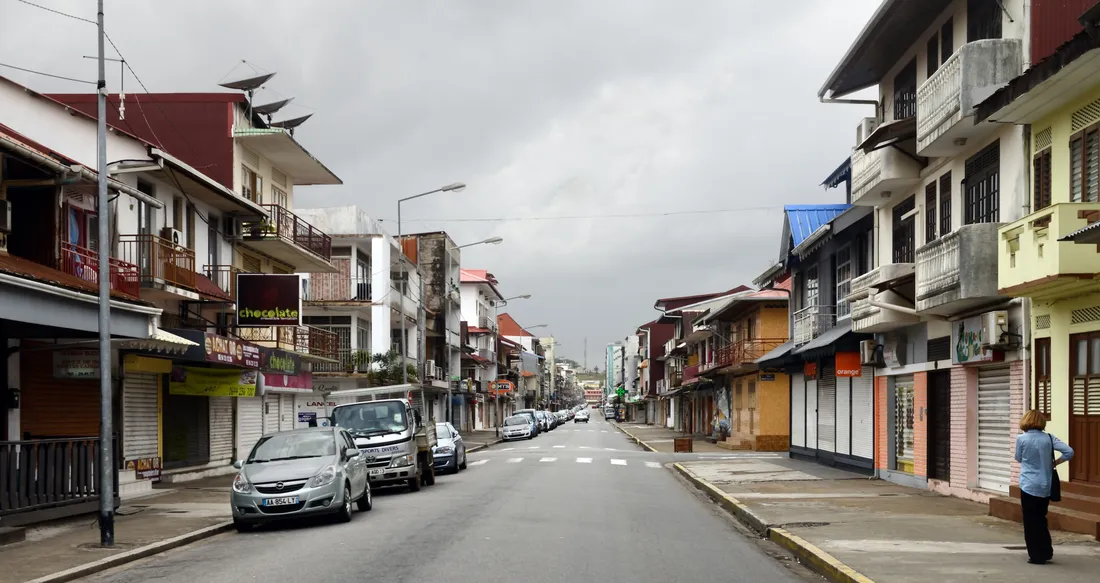
Cayenne, the prefecture, concentrates the administration and a good share of services. Neighbourhoods vary considerably:
- The town centre (around the place des Palmistes and the market): lively, close to services, parking sometimes difficult.
- Montabo: a sought-after residential district, close to the sea and to several schools; popular with families.
- Montjoly (in the commune of Rémire-Montjoly): beaches, recent developments, an appreciated quality of life, but far from the centre.
- Rémire-Montjoly more broadly: a residential commune in high demand, between Cayenne and the ocean.
Matoury, between Cayenne and Félix-Éboué airport, is a fast-growing commune with recent housing estates and a practical location for anyone working in the airport area or travelling a lot.
Kourou, about an hour’s drive from Cayenne, is built around the Guiana Space Centre. Postings linked to the space industry, the armed forces or certain services concentrate demand there.
Saint-Laurent-du-Maroni, in the west, is the territory’s second city. Many staff from national education, health and justice are posted there. The market is specific and the distance from Cayenne (more than two hours’ drive) needs to be factored into your plans.
What costs more than in mainland France
For guidance, several categories of spending are noticeably higher in French Guiana:
- Rents in sought-after areas, because of the tight rental market.
- Food, partly imported.
- Fuel and car maintenance — and a car is all but essential, as public transport is limited.
- Electricity with air conditioning, a major item of consumption in this equatorial climate.
The salary uplift exists precisely to absorb part of these extra costs, but it is better to build your budget with your eyes open.
Temporary accommodation: the way to arrive stress-free
Between landing at the airport and signing a lease, rarely less than a few days go by — often a few weeks. Looking for housing remotely, from mainland France, carries risks (flattering photos, a poorly assessed neighbourhood, scams). The safest strategy is to first arrive in short- or medium-term furnished accommodation, then view properties on the spot before committing.
Temporary furnished accommodation offers several concrete advantages for a transferred civil servant:
- No furniture outlay: you live straight away in a fully equipped home while your container is on its way.
- View before you sign: you assess neighbourhoods for real (noise, commute distances, atmosphere) rather than from photos.
- Flexibility: the length of stay adapts to your administrative calendar, which is often uncertain in the first few weeks.
- A logistics base: a stable address to open a bank account, receive mail and complete the formalities of taking up your post.
At Hostel Toucan, we offer exactly that: furnished accommodation in French Guiana suited to settling-in stays, plus support through our property management service for owners. If your transfer is coming up, getting in touch in advance means we can pin down dates and secure a base for you from the moment you land.