Almost everything written about French Guiana in English is a translation of something written for a French audience — which is fine if you hold a French passport, and quietly misleading if you don’t. Over the years we have welcomed travellers who assumed their Schengen visa covered them, who expected Spanish or Portuguese to be useful because the map shows South America, and who discovered the mandatory yellow fever certificate two weeks before departure. None of that is exotic knowledge; it is simply the part nobody thought to write down for a foreign reader. This guide covers what your trip actually involves — entry status, health, language, money, arrival and home base — before you commit to dates.
Where you are actually going
French Guiana sits on the north-eastern shoulder of South America, between Suriname and Brazil, a few degrees above the equator. It is not an island and it is not a country: it is a French overseas department and region, and therefore an outermost region of the European Union. You will see the euro, the French flag, French road signs and a French postcode, several thousand kilometres from Europe.
A few figures worth carrying in your head, because they shape the whole trip:
- The population is close to 294,000 inhabitants (2023 census figures), for a territory roughly the size of Portugal.
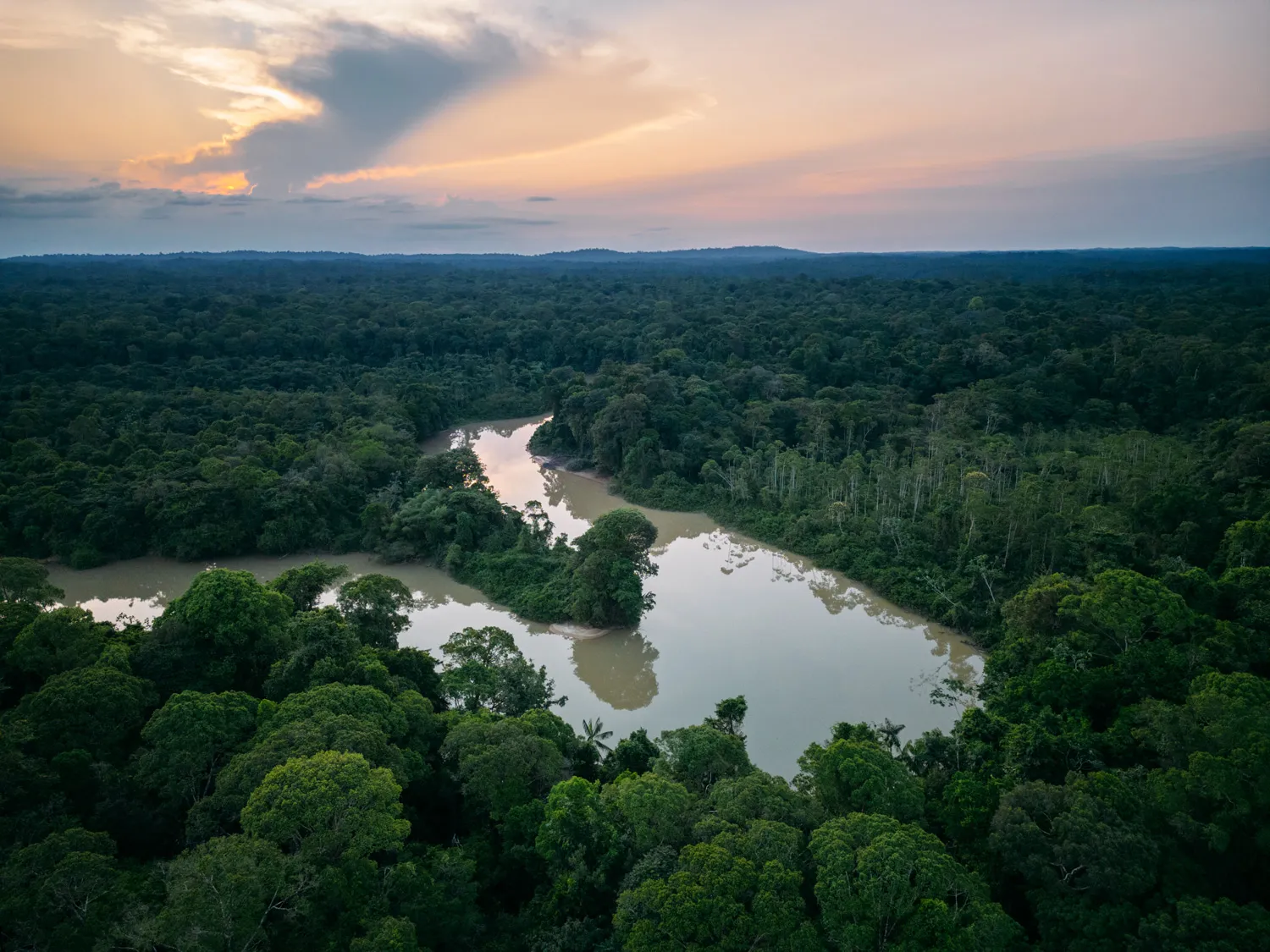
- Around 96% of that territory is forest — some eight million hectares. There is no road network across it.
- Almost everyone lives on a narrow coastal strip, along a single main axis: the RN1 westwards, the RN2 eastwards.
- The dialling code is +594, the currency is the euro, and the time zone is UTC−3 all year, with no daylight saving. That works out at four hours behind Paris in the northern winter and five hours behind in summer — the Caribbean islands are on a different offset, so don’t reuse figures written for Martinique or Guadeloupe.
The practical consequence of the forest statistic is that your itinerary will be linear. You move along the coast, and you go inland by river, with a guide. Our complete travel guide to French Guiana maps out what sits where.
The point most foreign visitors get wrong: this is not the Schengen area
Here is the single most important administrative fact, and the one that no translated article states plainly: French Guiana is part of the European Union but not part of the Schengen area. A Schengen visa is therefore not automatically valid for a trip here — the two regimes are separate, and being admitted to Paris does not settle the question of being admitted to Cayenne.
We deliberately stop there. What documents your particular nationality needs, whether a visa applies, which endorsement is required and how long processing takes are rules that change, sometimes quietly, and getting them wrong at the boarding gate costs you the whole trip. The only source worth trusting is the French embassy or consulate responsible for your country of residence. Check it before you book flights, not after — visa processing times are not something you can compress at the last minute.
One related surprise, whatever your nationality: identity checks are more frequent here than in most of Europe. There are fixed gendarmerie checkpoints on the national roads, and travel documents are checked at Félix-Éboué airport on departure as well as on arrival. Carry your original documents in the car, not a photo on your phone, and the same goes for children.
One vaccine is genuinely mandatory
This is not a recommendation dressed up as a rule. Vaccination against yellow fever is required to enter French Guiana, from the age of one, and the international certificate of vaccination — the yellow card — can be asked for on arrival. The injection has to be given at an approved yellow fever vaccination centre, and it must be done at least 10 days before departure for the certificate to be valid. Since 2016, a single dose counts for life for most adults, so if you were vaccinated for a previous trip to the tropics, dig out the card and check.
Two things trip up travellers coming from outside France. First, appointment lead times at approved centres are measured in weeks, not days, so this belongs at the very start of your planning, alongside the flight. Second, a medical contraindication certificate is issued only by an authorised doctor — you cannot decide on your own that you are exempt. Our detailed article on entry formalities and the yellow fever vaccine goes through the exceptions, the transit cases and the other recommended vaccinations, and it is worth reading before your first appointment. Mosquito-borne illnesses circulate here year-round, so an effective repellent is part of the same conversation with your doctor.
French is the language of service, not a bonus
You are in a French department, and French is what you will be served in — at the car rental desk, at the pharmacy, at the gendarmerie checkpoint, on the phone with an excursion operator. English is spoken in parts of the space sector and by some hotel and tour staff, but it is not something to count on for daily logistics. Neither is Spanish or Portuguese, despite the geography.
Alongside French, you will hear Guianese Creole, Bushinenge languages, Amerindian languages, Hmong, Portuguese and more. That mix is one of the real pleasures of the place, and nobody expects a visitor to navigate it. What people do appreciate is the effort of a greeting in French and a little patience with a rhythm that is slower than northern Europe’s.
Three habits that save foreign travellers a lot of friction: download an offline translation app before you land, keep addresses written down rather than spelled out over the phone, and do as much as possible in writing — a message can be read twice, a phone call in a second language cannot.
That last point is precisely why our team runs on messaging. Booking directly with Hostel Toucan means no platform fees, free cancellation up to 7 days before arrival, and WhatsApp support 7 days a week with people who are on the ground here — so a question about a checkpoint, a late landing or a road closure gets a straight answer from someone who was on that road this week, in writing, and not from a call centre on another continent.
Money: euros, cards and the cash you will still need
The euro is the currency, full stop. If you are coming from the eurozone there is no exchange to plan; if you are not, treat it exactly as you would a trip to France, and tell your bank you are travelling so your card is not blocked on the first transaction.
Cash still matters more than in a European city. Card acceptance is normal in supermarkets, petrol stations and most restaurants on the coast, but market stalls, boatmen and small operators frequently do not take cards, and ATMs thin out fast once you leave the main towns. Withdraw before you head west or inland rather than after.
One more card detail, because it catches people out: a rental car deposit is blocked on a bank card in the driver’s name, and rental agencies apply minimum licence-holding conditions. If you are travelling on a licence issued outside the EU, read our guide to driving in French Guiana as a visitor before you book the car, not at the counter.
Getting there: nearly everything goes through Paris
There is no direct long-haul link from North America, the UK or continental Europe outside France. In practice, reaching French Guiana means a flight to Paris and then a direct service to Félix-Éboué airport, in Matoury, about 8 to 9 hours in the air. There are also connections from the French Caribbean, Martinique and Guadeloupe, which is why some travellers combine the two.
Two things follow from that routing. First, build a comfortable connection in Paris: everything funnels through a single departure point, and a missed link is not a minor inconvenience on this route — airlines also advise arriving well ahead for the document check at Félix-Éboué on the way back. Second, you will very likely land tired, in the evening, into a warm and humid night. Félix-Éboué is 15 to 20 minutes from central Cayenne, so pick a first night close to the airport and keep the ambitious driving for day two.