Heatwaves in Europe: why French Guiana never has one
Published on August 11, 2026 · by Ismael Samuel
Every summer, the same script plays out in Europe: heat warnings turn red, nights no longer drop below 25 °C, poorly insulated flats become unliveable, and everyone hunts for somewhere to breathe. Meanwhile, 7,000 km away, French Guiana sits at 31 °C. Same as yesterday. Same as last month. Same as in February. That is the paradox of an equatorial climate: it is permanently hot, but there is never a heatwave. Here is why, and what it means in practice for a trip.
A heatwave is not simply “being hot”
The confusion comes from the word itself. A heatwave is not defined by an absolute temperature but by a deviation: a period in which daytime and night-time temperatures rise well above local seasonal norms for several consecutive days. It is that abrupt gap that puts the body in difficulty, because it has had no time to adapt.
What makes a European heatwave dangerous comes down to three factors:
The size of the spike: going from 25 to 40 °C in a few days.
No night-time recovery: when the night does not drop below 25 °C, the body never cools down.
The buildings: most European housing is neither designed nor equipped for such temperatures, precisely because they are exceptional.
A climate where it is 31 °C every day of the year meets none of these conditions. There is no spike, because there is no variation. There is no surprise, because everything — architecture, equipment, daily habits — is calibrated for that heat.
The Guianese climate: hot, and disconcertingly steady
French Guiana lies between 2 and 6 degrees north of the equator. At that latitude, day length and sun angle barely change through the year. The result: temperatures are almost identical in January and August.
The figures to remember
Highs sit around 30 to 33 °C during the day, all year.
Lows fall to around 22 to 24 °C at night, all year.
The gap between the warmest and coolest month is on the order of 1 to 2 °C — where Europe swings 20 °C between January and July.
The sun rises around 6am and sets around 6.30pm, with very little variation month to month. There are no long summer evenings and no sixteen-hour winter nights.
In French Guiana, seasons are therefore not counted in degrees but in rainfall. That is the only parameter that genuinely changes.
What replaces the heatwave: humidity
Let us be honest: French Guiana is not an “easy” climate. Relative humidity is very high, often above 80 %, and it slows the evaporation of sweat. At 31 °C with 85 % humidity, it feels heavier than 31 °C of dry heat in southern Europe.
But the difference comes down to three things:
Steadiness. The body adapts within a few days to constant heat. It never adapts to an abrupt spike.
The showers. The atmosphere discharges regularly. A tropical downpour drops the temperature several degrees in minutes.
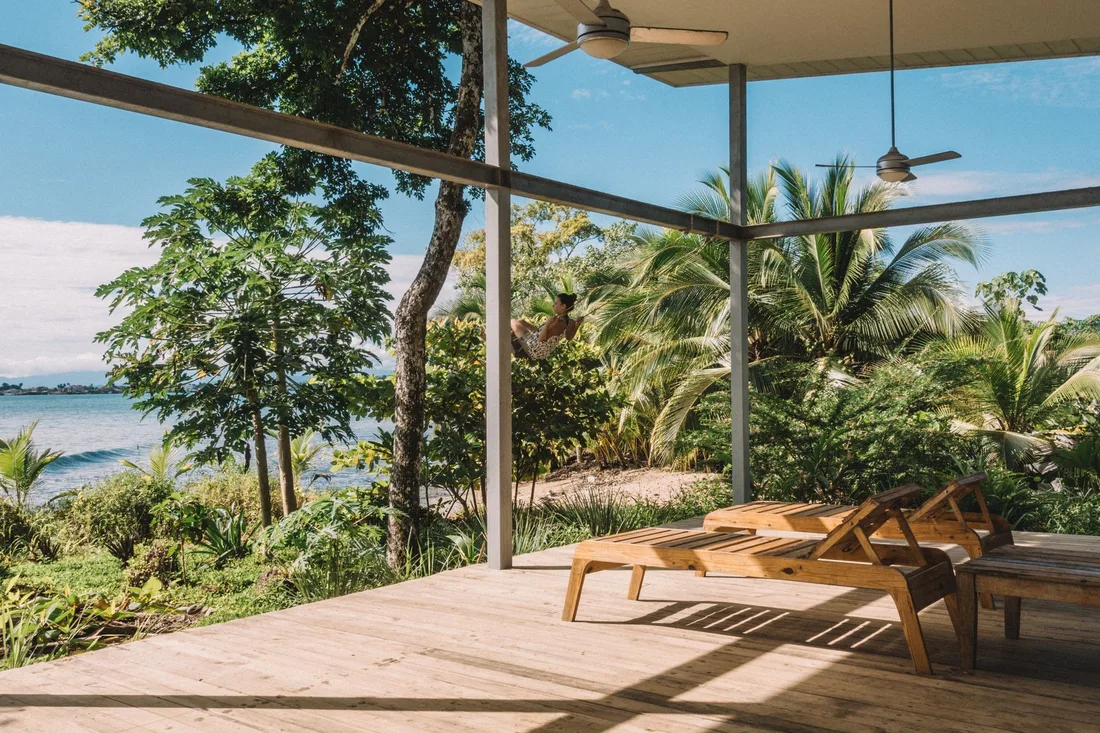
Buildings and habits. Air conditioning in homes, cross-ventilation, shaded terraces, days organised around the cooler hours. Everything is set up for it.
Why July-August is an excellent time to visit
This is the counter-intuitive part, and genuinely good news for anyone fleeing a stifling European summer.
The main Guianese dry season runs from July to late November. In other words, the moment Europe is suffocating corresponds to the start of the best period of the year in French Guiana: mostly clear skies, short showers, passable tracks, accessible creeks, wildlife easier to spot.
Concretely, during your summer holiday:
The beaches and trails of Rémire-Montjoly are walkable, with steady heat that is bearable in the shade.
The creeks and waterfalls along the eastern road — Fourgassié, crique Gabrielle — are at their best for access.
The Îles du Salut can be reached in good sea conditions from Kourou.
Forest outings and pirogue trips are not disrupted by the April-June rains.
One caveat: July-August is still French school holiday season, so flights are more expensive. Our article on flights from Paris to Cayenne covers buying strategy — and points out that mid-September to mid-November offers the best price/weather compromise of the year.
The classic mistake European visitors make is applying a European rhythm near the equator. Here is what locals do.
Schedule activities around the cooler hours. Hikes, markets and excursions early in the morning; a nap or indoor activity between noon and 3pm. With night falling around 6.30pm, an outdoor trip started at 3pm ends in the dark.
Drink far more than you would in Europe, without waiting to feel thirsty. Humidity masks dehydration.
Dress light, loose and covering. Cotton or linen, with thin long sleeves in the evening for mosquitoes.
Use air conditioning sensibly. There is no need to go down to 19 °C: too great a gap with outside is tiring and encourages chills. 24-25 °C at night is plenty.
Do not skip sun protection. Near the equator, the UV index is high even under cloud.
Plan for laundry. Nothing really dries outdoors during the rainy season. Choose accommodation with indoor drying space or a tumble dryer.
This is where the difference lies between an enjoyable stay and an exhausting week. In this climate, accommodation is judged on three criteria, in this order:
Air conditioning that works and is serviced, at minimum in the bedrooms. Non-negotiable for sleeping.
Cross-ventilation and orientation. A flat facing due west with no shading becomes an oven in late afternoon.
Mosquito screens in good condition on every opening, so you can air the place without suffering for it.
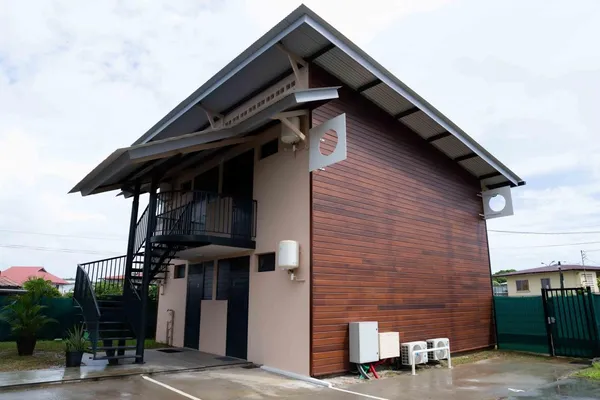
At Hostel Toucan, our accommodation in Cayenne, Rémire-Montjoly, Matoury and Kourou is equipped and maintained for this climate: serviced air conditioning, mosquito screens, shaded areas. Direct booking carries no platform fees, cancellation is free up to 7 days before arrival, and our WhatsApp support answers 7 days a week on Guiana time. Browse our accommodation in French Guiana — and if you are escaping a European summer, consider the September-to-November window instead: the most pleasant, and the cheapest.
Do you own a property in French Guiana? Air conditioning maintenance and damp control directly drive your guest reviews: our property management service takes care of both, with technical follow-up on site.
In summary
French Guiana has no heatwaves because a heatwave is a deviation from the norm, and here the norm does not move: 30 to 33 °C by day, 22 to 24 °C at night, all year, with an annual range of 1 to 2 °C. What changes with the seasons is not temperature but rain. The trade-off is high humidity, which the body adapts to within days and which local buildings offset. And good news for anyone escaping a European summer: the main dry season starts in mid-July — the moment Europe is suffocating is the moment French Guiana is at its best.
FAQ
Is it hotter in French Guiana than during a European heatwave?
No, and often less so. A European heatwave can push past 40 °C, whereas Guianese highs sit around 30 to 33 °C all year. The difference is steadiness: here those temperatures barely vary from month to month, the body adapts within a few days, and buildings are equipped accordingly. On the other hand, relative humidity, often above 80 %, makes it feel heavier than dry heat.
When is the most pleasant time to visit French Guiana?
The main dry season, July to late November. Temperatures do not change, but showers become rarer, tracks and creeks become accessible, and outdoor trips are no longer disrupted. The best price/weather compromise falls between mid-September and mid-November: outside French school holidays, so flights are markedly cheaper than in July-August.
Are there seasons in French Guiana?
Yes, but they are measured in rainfall rather than temperature. The main dry season runs July to late November, the rainy season from December to July with a peak from April to June, and a relative lull known as the “little summer of March”. Day length is near-constant all year, with sunrise around 6am and sunset around 6.30pm: there are no long summer evenings and no endless winter nights.
How do you cope with the heat and humidity arriving from Europe?
Schedule activities around the cooler hours — early morning and late afternoon, bearing in mind night falls around 6.30pm — and avoid exertion between noon and 3pm. Drink more than you would at home, without waiting to feel thirsty, as humidity masks dehydration. Wear light, loose, covering clothing, protect yourself from the sun even under cloud, and set the air conditioning around 24-25 °C at night rather than as low as possible: too great a gap with outside is more tiring than it is refreshing.
Nous utilisons des cookies de mesure d'audience et de publicité pour améliorer votre expérience
et nos campagnes. Vous pouvez accepter ou refuser. Voir notre
politique de confidentialité.