At the very end of the national road, where French Guiana fades into the mouth of the Maroni River, lies one of the most singular beaches on the South American coast. Les Hattes beach, in the municipality of Awala-Yalimapo, is no postcard of white sand fringed with coconut palms: it is a nesting sanctuary, a Kali’na Amerindian territory, and the last point of France before Suriname. For anyone who wants to grasp the soul of French Guiana’s far west, this is where you must come.
Where is Les Hattes beach?
Les Hattes beach sits in the territory of Awala-Yalimapo, the westernmost municipality in French Guiana, at the mouth of the Maroni facing Suriname. You reach it from Saint-Laurent-du-Maroni, the former penal-colony capital, along a paved road of around thirty kilometres.
A few concrete landmarks to picture the journey:
- Cayenne → Saint-Laurent-du-Maroni: about 250 km, allow 3 to 3.5 hours on the RN1.
- Saint-Laurent → Awala-Yalimapo: about 35 km, that is 40 to 50 minutes.
- Félix-Éboué airport (Matoury): the international point of arrival, more than 260 km from the beach.
A car is essential: no regular public transport properly serves this end of the world. Renting a vehicle remains the only reliable way to explore the west at your own pace. Keep the time difference in mind too: French Guiana runs 5 hours behind Paris in winter, 6 hours in summer.
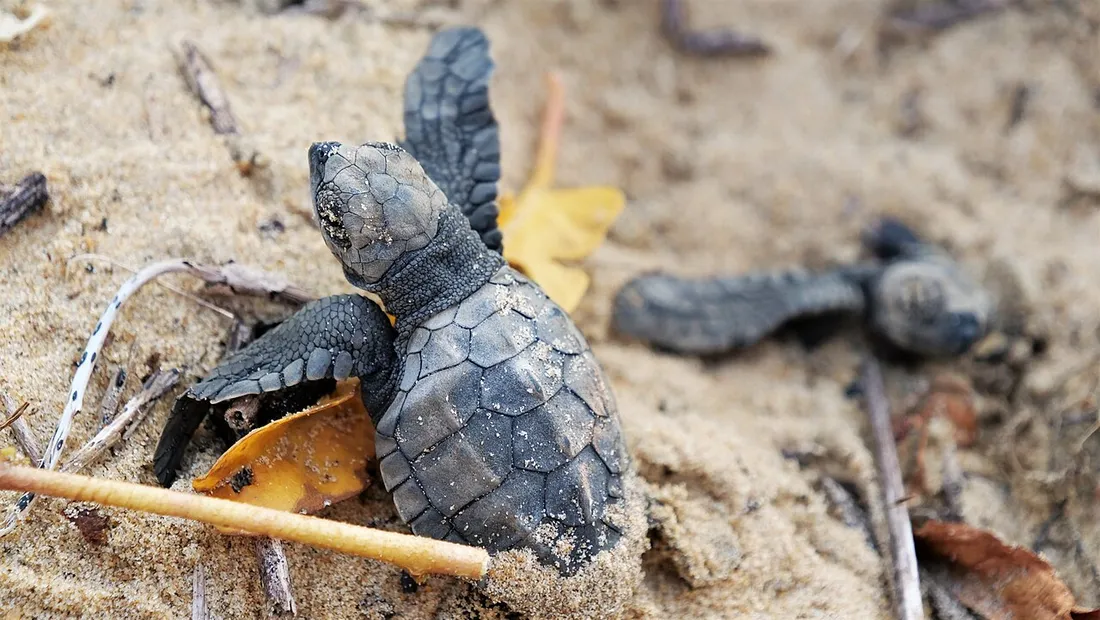
A leatherback turtle nesting sanctuary
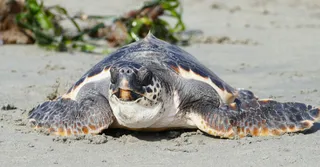
What makes Les Hattes beach known the world over is its population of sea turtles. Awala-Yalimapo is home to one of the most important leatherback turtle nesting sites on the planet. The leatherback, the largest marine reptile in the world, can exceed two metres and weigh more than 500 kg. Watching one haul itself laboriously up the black sand to dig its nest is an experience that stays with you for life.
When can you watch the turtles?
The nesting season runs mainly from April to July, peaking in May and June. Hatchings, on the other hand, are best seen from July to September, when hundreds of baby turtles make their way to the ocean. Three species frequent the site: the leatherback, the green and the olive ridley.
A few golden rules for responsible observation:
- No white lamps or flash: light disorients the females and the hatchlings. Use a red-filter lamp.
- Keep your distance and stay behind the animal, never in front of its head.
- Choose a guided outing with a local association or a Kali’na guide: the experience is richer and the impact lower.
- Tide and timing: turtles nest mostly at night, at high tide. Ask locally about the schedules.
Good to know before you come
Les Hattes beach is part of the Amana Nature Reserve, a protected area. Respecting the site is not optional: take your waste with you, fires are banned outside designated zones, and stay completely discreet at night. This is also why visitor numbers remain low, far from mass tourism.
Awala-Yalimapo, Kali’na Amerindian land
Before being a turtle beach, Awala-Yalimapo is first and foremost a Kali’na village, the Amerindian people of the coast. The municipality, created in 1989, is one of the few territories in French Guiana where Amerindian culture remains alive in daily life: the Kali’na language, craftsmanship, basketry, and a cuisine built on cassava and fish.
As you wander, you will come across:
- Traditional carbets (open shelters) of wood and palm, opening onto the sea.
- Artisans working basketry and beads.
- The local museum and ecomuseum, to understand Kali’na history and the ecosystem of the river mouth.
It is this rare blend — protected nature, Amerindian culture and an international border — that gives the far west its identity. Here you are light-years from Caribbean clichés: French Guiana is lived, not consumed.
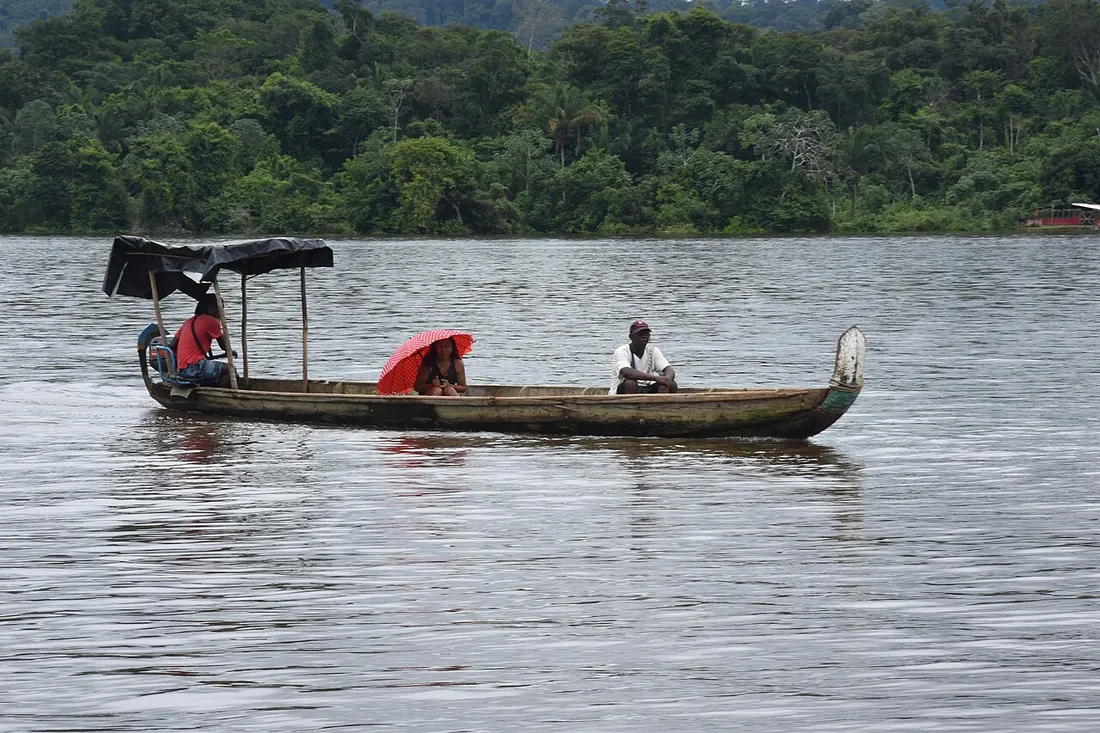
The Amerindian route and the crossing to Suriname
From the beach, your gaze reaches the other bank of the Maroni: Suriname, the former Dutch Guiana. The river mouth has always been a space of movement for Amerindian and Bushinenge peoples (descendants of the Maroons), long before modern borders.
Crossing the Maroni by pirogue
The crossing to Suriname is traditionally made by pirogue, from Saint-Laurent-du-Maroni to Albina on the Surinamese bank. It is one of the most authentic experiences in French Guiana: boarding a long motorised pirogue and gliding over the brown water between the two countries.
A few essential practical points:
- Formalities: an official crossing exists, and checks have been tightened. Carry a valid passport; check the entry conditions for Suriname (visa or e-card depending on nationality) before you leave.
- Yellow fever vaccine: compulsory for French Guiana, strongly recommended for the region. Check your records.
- Currency: you move from the euro to the Surinamese dollar; bring cash.
- Language: you shift from French/Creole to Dutch and Sranan Tongo.
The formal crossing remains for well-prepared travellers. For most visitors, gazing at Suriname from the French Guianese bank, at Les Hattes beach or from Saint-Laurent, is enough to grasp the unique border dimension of the place.
Planning your visit to the far west
The west of French Guiana is not discovered in a single day. Here is a realistic itinerary over two to three days:
- Day 1: road from Cayenne to Saint-Laurent-du-Maroni, visit the Camp de la Transportation (former penal colony) at the end of the day.
- Day 2: pirogue on the Maroni in the morning, then road to Awala-Yalimapo, settling in and night-time turtle watching.
- Day 3: beach morning and Kali’na culture, then the road back east.
Which season to choose?
The dry season, from mid-July to mid-November, offers the best road conditions and comfort. But for the turtles, the ideal compromise falls around June-July, at the turn of the seasons: the end of leatherback nesting and the start of hatchings, with weather that is still acceptable.
Logistics tips
- Fill up the tank in Saint-Laurent: fuel stations grow scarce towards the west.
- Water, insect repellent, hat: the river mouth is exposed and mosquitoes are active at dusk.
- Book your accommodation in advance: supply is limited and demand rises in high season.
Where to stay as a base for Les Hattes beach?
Saint-Laurent-du-Maroni makes the best rear base for exploring the far west without giving up comfort. At Hostel Toucan, we support travellers who want to live French Guiana authentically, not merely see it. Our seasonal rentals let you set down your bags near the river and range out towards Awala-Yalimapo, the turtles and the Maroni.
By booking direct, you enjoy several concrete advantages:
- Direct booking with no platform fees: you pay the fair price.
- Free cancellation up to 7 days before arrival, for peace of mind.
- WhatsApp assistance 7 days a week: advice on tide times, the name of a Kali’na guide, a last-minute question? We answer.
To prepare your whole trip, see our complete guide to French Guiana, browse our accommodation in French Guiana, and if you own a property in the west, discover how we handle your concierge service for owners.
Les Hattes beach is not a destination you tick off: it is a place you feel, between the black sand, the centuries-old turtles and the Surinamese horizon. French Guiana’s far west rewards those who take their time. Over to you.
FAQ
What is the best time to see the turtles at Les Hattes beach?
Leatherback nesting concentrates from April to July, peaking in May and June. Hatchings are best seen from July to September. To combine observation with decent weather, aim for June-July, at the turn of French Guiana’s dry season.
How do you get to Les Hattes beach from Cayenne?
Allow about 250 km and 3 to 3.5 hours from Cayenne to Saint-Laurent-du-Maroni on the RN1, then 35 km (40-50 min) to Awala-Yalimapo. A car is essential: no regular public transport properly serves the far west.
Can you cross into Suriname from Awala-Yalimapo?
The official crossing to Suriname is made by pirogue from Saint-Laurent-du-Maroni to Albina. It requires a valid passport and, depending on your nationality, a visa or an e-card. Check the up-to-date entry conditions before you leave, and bring Surinamese dollars.
Are health precautions needed to visit Les Hattes beach?
Yes. The yellow fever vaccine is compulsory for French Guiana. Bring an effective insect repellent, especially at dusk at the mouth of the Maroni, along with water and sun protection.