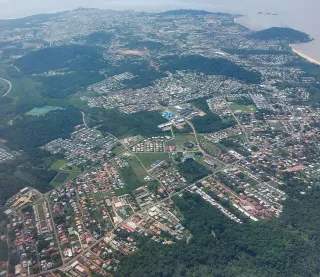

Settling in Guadeloupe after a job transfer or a life project overseas raises one central question very quickly: which town should you unpack your bags in? Around the bay of the Petit Cul-de-sac Marin, three hubs concentrate most of the activity of Grande-Terre and Basse-Terre: Pointe-à-Pitre, the historic and administrative city; Baie-Mahault, the economic engine; and Le Gosier, the seaside and residential town. Together with Les Abymes, these three communes form the heart of the Pointe-à-Pitre metropolitan area (Cap Excellence), home to a large share of the archipelago’s population.
Choosing between them is not just a matter of charm: it determines your daily commute, your housing budget, how close you are to schools and shops, and your quality of life in the broadest sense. This article compares the three destinations factually to help you decide, keeping in mind that the best strategy on arrival is often to rent temporary accommodation long enough to get a feel for the ground before committing.
Understanding the geography of the metropolitan area
Before comparing, you need to picture the map. “Mainland” Guadeloupe is shaped like a butterfly whose two wings, Grande-Terre and Basse-Terre, meet at Pointe-à-Pitre, linked by bridges over the Rivière Salée. It is around this hinge that activity is concentrated.
- Pointe-à-Pitre: the central commune, on Grande-Terre, with the port, the old town, the hospital and government offices.
- Baie-Mahault: just across the water, on Basse-Terre, home to the Jarry business zone, the largest in the Caribbean.
- Le Gosier: east of Pointe-à-Pitre, on the south coast of Grande-Terre, geared towards tourism, beaches and residential living.
Pôle Caraïbes airport is located in Les Abymes/Pointe-à-Pitre, which puts all three communes a short distance from flights to mainland France. Distances as the crow flies are small, but real travel times depend heavily on traffic, which is particularly heavy at rush hour around Jarry and on the roads leading into Pointe-à-Pitre.

Pointe-à-Pitre: the historic and administrative heart
Pointe-à-Pitre remains the archipelago’s reference city. It is home to the Guadeloupe teaching hospital (CHU, the main healthcare site), numerous government offices, the commercial and cruise port, and a city centre marked by Creole architecture, the covered market and the Place de la Victoire.
Who is it for?
The city suits those who want to be as close as possible to public services and to urban and cultural life, and who prefer a lifestyle where a car is not systematically required for everyday errands. Healthcare professionals attached to the CHU, civil servants and people who enjoy urban buzz will feel at home here.
Points to watch
The old centre shows strong contrasts: some streets have been renovated, others less so. Parking can be tricky and, as in any city centre, it is best to visit the exact neighbourhood at different times of day before committing. Rents are often more moderate than on the Gosier seafront, but this varies a great deal depending on the condition and location of the property. As a rough indication only, expect more affordable rent levels than in Le Gosier for a comparable home, though this is by no means a rule.
Baie-Mahault: the economic engine
If your job is the number one criterion, Baie-Mahault deserves your full attention. The commune hosts Jarry, a vast commercial, industrial and logistics zone that concentrates a very large share of the archipelago’s private-sector jobs: retail, import-export, construction, services and company headquarters.
Who is it for?
- People transferred or recruited into the private sector whose workplace is in or around Jarry.
- Families looking for newer residential neighbourhoods, with housing developments and detached houses more common than in central Pointe-à-Pitre.
- Those who want everything close by: hypermarkets, DIY stores, car dealerships and restaurants.
Points to watch
The flip side of this dynamism is traffic. Access roads to Jarry and the bridges to Pointe-à-Pitre can be gridlocked at peak times. Living in Baie-Mahault to work in Jarry keeps these journeys short; conversely, living there while working in eastern Grande-Terre (Le Gosier, Sainte-Anne) can significantly lengthen your commute. Always test your actual home-to-work journey, at the times you will really be travelling.
Le Gosier: seaside setting and residential living
Le Gosier is the “art de vivre” commune of the trio. Guadeloupe’s historic resort town, it lines up beaches, a marina, restaurants, hotels and sea-view residences. It is often the first instinct of newcomers seduced by the island’s postcard image.
Who is it for?
- Those who want to live near the beaches and enjoy a seaside atmosphere every day.
- People whose job is in Pointe-à-Pitre or eastern Grande-Terre.
- Anyone looking for a pleasant residential setting with a well-developed leisure and dining scene.
Points to watch
Attractiveness comes at a price: as a rough indication, Le Gosier is among the communes where rents and purchase prices are among the highest in the metropolitan area, especially for properties near the coast. Rental demand is strong, which can make the search harder on arrival. Finally, if you work in Jarry, plan for crossing the whole metropolitan area morning and evening.
Quick comparison: which area for which profile?
No commune is “better” in absolute terms; it all depends on your situation. Here are some benchmarks to guide your choice.
- You work in Jarry (private sector, logistics, retail): Baie-Mahault first, to cut down on commuting.
- You depend on the CHU or government offices: Pointe-à-Pitre or a neighbouring commune.
- You want beaches and a seaside setting, with work on the Grande-Terre side: Le Gosier.
- You have children and are aiming for newer housing developments: Baie-Mahault, and possibly Les Abymes as well.
- You want to limit car use day to day: central Pointe-à-Pitre.
- You prefer residential quiet with quick access to shops: the suburban districts of Baie-Mahault or Le Gosier.
Bear in mind that commune boundaries are porous: many households live in one commune and work in another. The real criterion is not the name of the town, but the actual travel time between your home and your anchor points (work, school, healthcare).