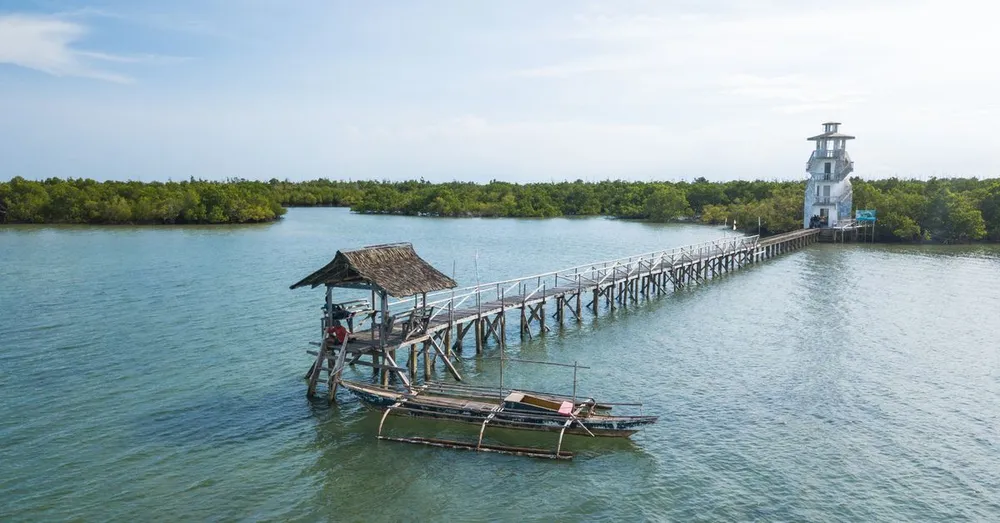
There are two ways to look at the Caravelle Peninsula. You can see it as just another fine hike, something to tick off between two beaches in the South. Or you can take the time to appreciate it for what it really is: one of the last great protected natural areas in Martinique, where mangrove, dry savanna and Atlantic coastline meet within a few kilometres. We who live here much prefer to share this second way of seeing it.
A finger of land jutting into the Atlantic on the island’s northeast, the Caravelle is one of those places you like to keep to yourself. Away from the turquoise beaches of the South, it shows a wilder face: cliffs battered by the swell, a silent mangrove, savanna swept by the trade winds, a lighthouse planted facing the ocean and the history-laden remains of Château Dubuc. This guide is not a technical sheet on elevation gain: it is an invitation to discover what this strip of land truly shelters, with the village of Tartane as your gateway and the Caravelle reserve, which offers what is arguably the most accessible mangrove in Martinique on foot.
The Caravelle Nature Reserve, a concentrate of wild Martinique
The peninsula extends the town of La Trinité, on the northeast Atlantic coast. At its tip lies a regional nature reserve of around 400 hectares, protected since 1976. On such a small area, the Caravelle Peninsula brings together habitats that, elsewhere on the island, are separated by hours of driving:
- a sheltered mangrove along the Baie du Trésor, on the leeward side;
- a dry forest and a cactus savanna, unique in Martinique;
- an Atlantic coastline battered by the swell, made of cliffs and rocky plateaus;
- a historic lighthouse perched about a hundred metres above the ocean.
Cut off from the humid highlands by the trade winds, the peninsula receives far less rain than the Caribbean north: vegetation adapted to drought, ochre soils, sharp light. You are a few kilometres from the rainforest, and yet it feels like another country.
Where the peninsula is and how to get there
You reach the Caravelle via the D2, which runs through the fishing village of Tartane, a hotspot of Martinican surfing, then climbs up to the reserve car park at the tip of the peninsula, near the Maison de la réserve (reserve visitor centre).
A few practical landmarks:
- From Fort-de-France: about 50 km, allow 1 hour to 1 hour 15 of driving.
- From Aimé Césaire airport (Le Lamentin): about 45 minutes.
- From rentals in the South (Sainte-Anne, Les Trois-Îlets): 1 hour 15 to 1 hour 30.
A car is strongly recommended: the roads of the North are winding and public transport to this remote point is rare. The reserve car park is free but fills up quickly; setting off before 9 a.m. guarantees you a spot and the cool of the morning, precious under the tropical sun.
Local tip: fill up on fuel and water in Tartane or La Trinité before heading up. There are no shops once you are on the trail.
The Caravelle trail: two loops to choose from
The reserve offers two waymarked routes from the same car park.
The long loop (about 3 h 30)
This is the full route, 8 to 9 km for 3 to 3 h 30 of walking depending on your pace. It runs along the mangrove, climbs up to the Caravelle lighthouse, crosses the dry savanna then descends along the Atlantic coast with its spectacular cliffs and inaccessible coves. The elevation gain is moderate but the terrain is uneven: bring good walking shoes, no flip-flops.
The short loop (about 1 h 15)
More accessible, about 2.5 km for 1 hour to 1 h 15, it heads straight to the lighthouse and a first viewpoint, ideal with children or in strong heat. It is also the right option if you combine the visit with the Dubuc ruins and the beach in the same day.
Our local advice: take the short loop for the panorama, then come back to stroll along the mangrove. You will spot far more wildlife by staying still for ten minutes at the edge of the bay than by clocking up the kilometres.
To slip into your bag, whichever loop you choose:
- 1.5 L of water per person minimum (no water points along the route);
- hat, sunglasses and sunscreen (the savanna offers almost no shade);
- some insect repellent for the mangrove section;
- a snack, and if possible binoculars for the wildlife.
The Caravelle lighthouse: the signature panorama
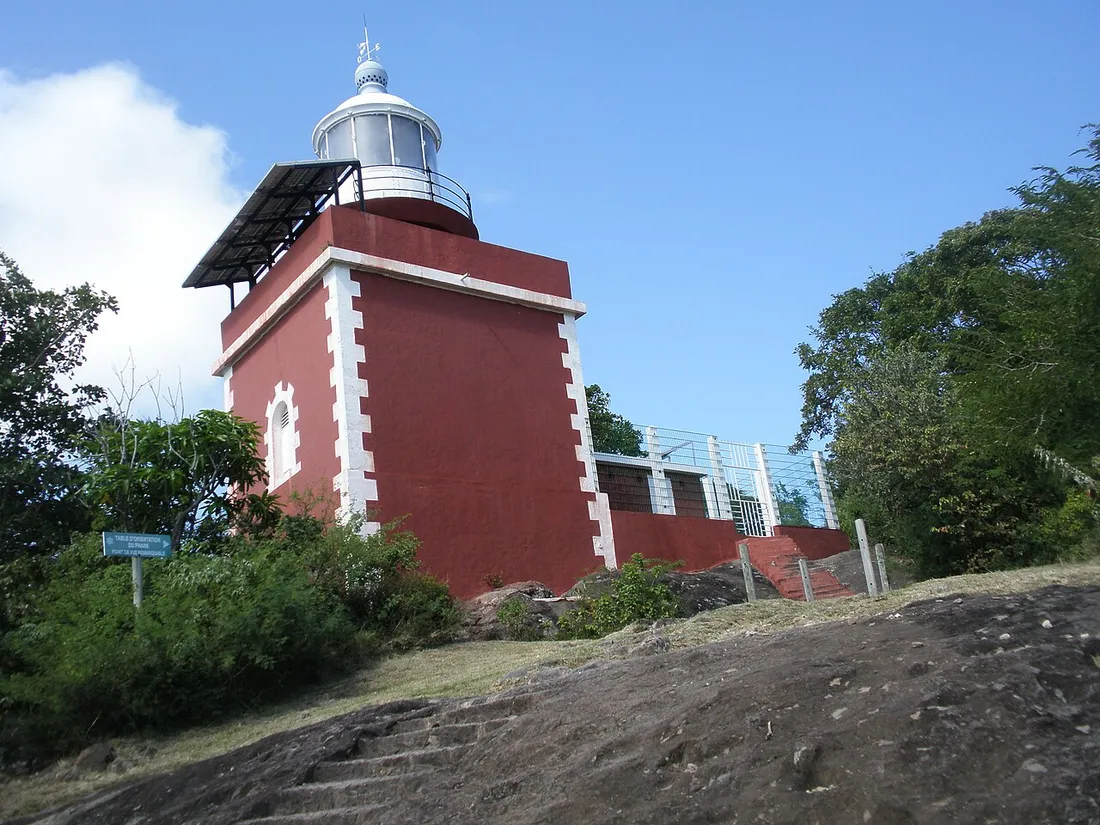
Built in 1862, the Caravelle lighthouse stands about 130 metres above the ocean. It is the high point of the walk and its finest viewpoint. On a clear day, your gaze takes in the whole Atlantic coast: the Baie du Galion to the south, the indented peninsula below, and in the distance the silhouette of Montagne Pelée.
The lighthouse itself usually cannot be visited (technical site), but the esplanade around it offers a 360° panorama that alone justifies the climb. This is where we recommend taking a real break: the trade winds blow strong here and refreshingly cool you down after the effort.
The ruins of Château Dubuc: a dive into history
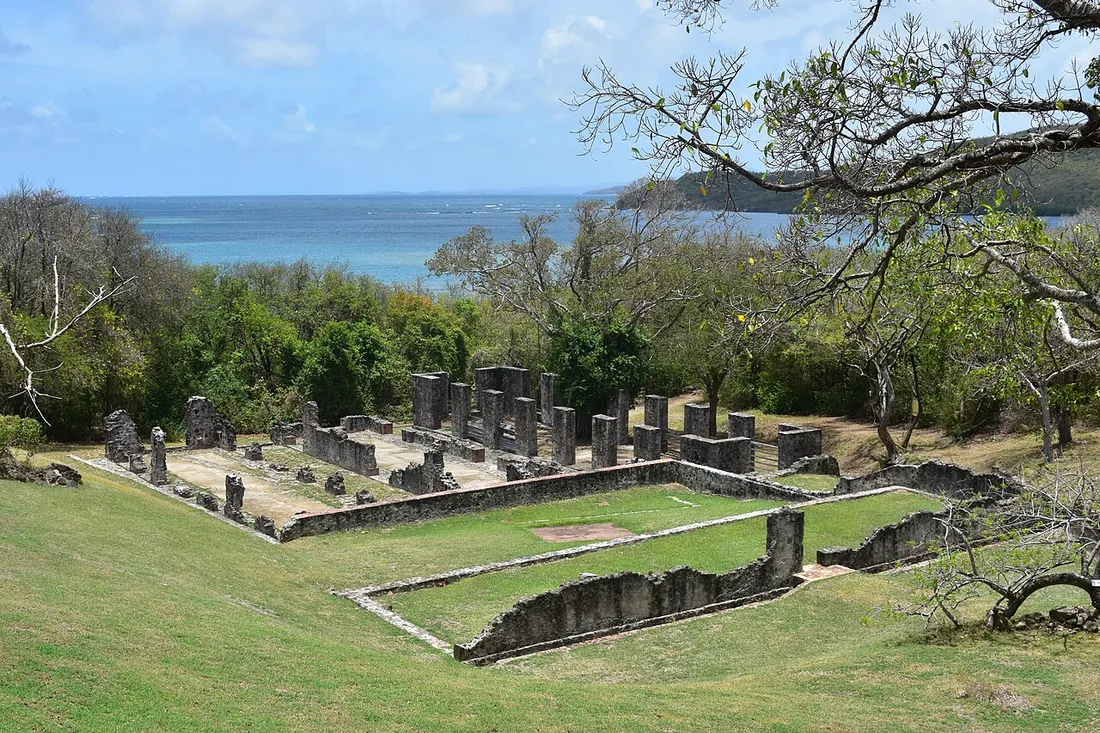
A few minutes from the car park, on the sheltered slope facing the Baie du Trésor, the ruins of Château Dubuc tell a whole chapter of Martinican history. This former sugar plantation of the Dubuc family, prosperous in the 18th century, combined cane growing, livestock and maritime trade — including, according to local history, the activities of wreckers and slave trading.
The site, listed as a Historic Monument, is explored on foot:
- remains of the master’s house, the vats and the mill;
- former dungeons and working buildings;
- a small museum presenting objects and explanations about life on the plantation.
Allow 45 minutes to 1 hour for the visit. Admission is paid, around €4 to €6 per adult, free for the youngest; opening hours are generally in the morning and early afternoon, so it is best to check before you set off. It is a stop that adds depth to the day: you are not just contemplating a landscape, you are reading a page of Martinique’s past.
The mangrove of the Baie du Trésor: the living heart of the peninsula
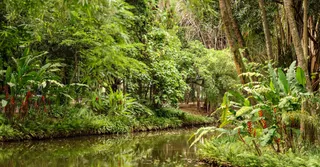
If we had to keep just one habitat, it would be the mangrove. The trail runs along a stretch of the Baie du Trésor, a sheltered body of water where the mangroves take root, with no kayak or guide needed: you simply walk along the shore and keep your eyes open.
The mangrove is not a backdrop, it is a biological factory. Standing on their stilt roots, the mangroves play a decisive role:
- they serve as a nursery for the fish, crabs and shrimp that grow up sheltered among the roots;
- they filter the waters flowing down from the land and protect the coast from erosion;
- they store enormous amounts of carbon, far more than a conventional forest.
Three species grow side by side: the red mangrove with its arched roots plunging into the water, the black mangrove bristling with pneumatophores, and the white mangrove of the back-mangrove. Stop where the trail brushes the calm water: at low tide, the exposed mud teems with life.
The coastal wildlife to watch: keep your eyes peeled
This is the whole point of approaching the Caravelle reserve as a naturalist rather than an athlete: at a slow pace, the wildlife lets itself be caught off guard. What you might come across, and where:
- Near the mangrove and on the mud: the fiddler crab, whose male waves its oversized claw (stay still, they come out by the dozen), the more discreet land crab and the hermit crab on the rocky shore.
- On the dry savanna and the rocks: the iguana basking on the stones in mid-morning, the anole lizards with their colourful dewlap, and sometimes the manicou (the local opossum) or the mongoose, more elusive.
- In the sky and the trees: the purple-throated carib hummingbird, the island’s winged emblem, the bananaquit, herons and egrets in the Baie du Trésor, and offshore the silhouette of a frigatebird.
The flora completes the picture: lignum vitae, local pear trees and cacti make up a savanna unique in Martinique. Stay on the waymarked trails: this is a protected area, and it is this collective respect that keeps the site so unspoiled. One rule sums up the ethic of the place: you look, you photograph, but you don’t touch, you don’t pick, you don’t feed.
When to come and how to plan your day
The dry season, the Carême, from December to April, remains the best period: dry trails, clear skies, open panoramas from the lighthouse and discreet mosquitoes. In the wet season, some sections near the mangrove become muddy and slippery. In any case, set off early: before 9 a.m. you have a parking spot, the cool air and much more active wildlife. The time difference on arrival (-5 h in winter, -6 h in summer compared to Paris) actually makes that early start easy.
A typical day:
- 9 a.m.: drive up to the reserve car park, then the short loop to the lighthouse (Atlantic panorama and Montagne Pelée in the distance).
- 10:30 a.m.: a relaxed walk back along the mangrove, binoculars in hand.
- 12:30 p.m.: lunch with your feet in the water in Tartane (grilled fish, accras, ti-punch).
- 2 p.m.: visit the ruins of Château Dubuc.
- 4 p.m.: a swim or a surf discovery session at Anse Bonneville, the village’s spot.
If you are staying nearby, the peninsula also lends itself to a simple half-day: that is the whole point of staying in the La Trinité / Tartane area rather than doing the round trip from the South.
Stay in Tartane or La Trinité rather than doing the round trip
We say it to every traveller: sleeping on site transforms the experience. Instead of enduring three hours of driving in the day, you hit the trail at dawn and string together wildlife watching, surfing and lazing about, far from the crowds of the South.
At Hostel Toucan, we manage holiday rentals well located to explore the North-Atlantic and the Caravelle reserve like a regular. By booking direct, you enjoy:
- direct booking with no platform fees, to pay the fair price;
- free cancellation up to 7 days before arrival;
- WhatsApp support 7 days a week for our on-the-ground tips and the best spots in Tartane.
Browse our accommodation on the Martinique rental page and plan the rest of your stay with our complete guide to Martinique. Do you own a property in the La Trinité area? Entrust it to local hands with our concierge service for owners.
The Caravelle Peninsula is earned on foot, but savoured with the eye. A mangrove, a savanna, a lighthouse, ruins and discreet wildlife that only awaits your patience: this is raw and generous Martinique, within reach of Tartane. Put on good shoes, set off early, and let the Atlantic do the rest.
FAQ
How long does it take to walk the Caravelle Peninsula trail?
The long loop is 8 to 9 km and takes 3 to 3 h 30 of walking. The short loop, more accessible, is about 2.5 km for 1 hour to 1 h 15. Bring good shoes, at least 1.5 L of water per person and sun protection, as the savanna offers little shade. Stock up on water and fuel in Tartane: there are no shops on the peninsula.
Do you need a guide to see the mangrove of the Caravelle Peninsula?
No. Unlike the mangrove of the Baie de Génipa, which is explored by kayak, the one in the Baie du Trésor is walked alongside on foot from the reserve trail, with no guide or equipment. Stop near the calm water, at low tide, and watch the wildlife of the mangroves.
Can you visit the ruins of Château Dubuc and do the trail on the same day?
Absolutely. The Dubuc ruins are a few minutes from the reserve car park and the visit lasts 45 min to 1 hour. By doing the short loop in the morning and Dubuc in the afternoon, you combine hiking, history and a swim in Tartane in a single day.
Is the Caravelle trail suitable for families with children?
Yes, thanks to the short loop of about 2.5 km (1 hour to 1 h 15) that leads to the lighthouse with a moderate elevation gain. It is the ideal option with children, especially combined with a wildlife-watching break along the mangrove. Set off in the morning, take enough water, a hat and good shoes, as the savanna offers little shade.
What is the best time to visit the Caravelle Peninsula?
The dry season, the Carême from December to April, offers the best conditions: dry trails, clear skies, sharp panoramas from the lighthouse and discreet mosquitoes. Set off early in the morning, before 9 a.m.: the cool air and the low-angled light make the wildlife (crabs, iguanas, birds) much more active and easy to spot.