I’ve lived in French Guiana for several years, and if there’s one piece of advice I repeat to every traveller who writes to me before landing at Félix-Éboué, it’s this: book your car before your return ticket, not after. Renting a car in French Guiana isn’t a comfort option like in the West Indies — it’s the very condition of your trip: no train, rare intercity buses, and 290,000 inhabitants spread across a territory the size of Portugal. Without a vehicle, you’ll be stuck between your accommodation and the Place des Palmistes. But renting here has its rules: roads that vary wildly between the RN1 and the RN2, insurance clauses that exclude precisely what you intend to do, and a limited fleet that empties out with every Ariane 6 launch.
Why a car is essential in French Guiana
A few distances from Cayenne to set the scene:
- Kourou and the Guiana Space Centre: 60 km, about 50 minutes via the RN1
- Saint-Laurent-du-Maroni (Camp de la Transportation, departure point for pirogues on the Maroni): 250 km, allow 3 to 3.5 hours
- Awala-Yalimapo (leatherback turtles, April to July): 270 km, nearly 4 hours
- Cacao, the Hmong village and its Sunday market: 75 km including a winding road, 1 h 15
- Roura and the landing stage for the Kaw marshes: 80 km including 35 km of degraded mountain road
- Saint-Georges-de-l’Oyapock, on the Brazilian border: 190 km via the RN2, about 2 h 30
The shared taxis (“taxicos”) leave when they’re full, and there’s almost no service after 6 p.m. For the headline outings described in our complete guide to French Guiana — a rocket launch at Kourou, the Salvation Islands, a pirogue trip on the Kaw — a car is the only way to be on time.
Renting a car in French Guiana: real budget and where to book
The supply is concentrated at Félix-Éboué airport (Matoury) and in Cayenne: international brands (Europcar, Avis, Hertz, Sixt) and local rental companies that are often cheaper but have older fleets.
Prices observed in 2026, unlimited mileage included:
- City car (Clio, 208): €35 to €50 per day, around €280 a week
- Compact SUV (Duster, Captur): €55 to €75 per day
- 4x4 pick-up (Hilux, L200): €90 to €130 per day, often unavailable at the last minute
- Fuel: around €1.85/L for unleaded (regulated price, the same everywhere)
Three calendar pitfalls to know about:
- Rocket launches: with every Ariane 6 or Vega launch from Kourou, the fleets empty out within 48 hours. Check the launch schedule and book 4 to 6 weeks ahead.
- The dry season (July to late November): this is the high tourist season, and prices climb 15 to 25%.
- Carnival (January–February): on the “vidé” weekends, some agencies close and vehicle returns are pushed back.
Book online with free cancellation, and photograph the odometer and fuel level at both pick-up and return: disputes over a missing full tank are our travellers’ number one complaint.
RN1 and RN2: the real state of French Guiana’s roads
French Guiana has only two national roads, and they’re nothing alike.
The RN1, from Cayenne to Saint-Laurent-du-Maroni
This is the backbone of the coastline: 250 km of generally decent tarmac, but a single lane in each direction, with no lighting outside built-up areas. The real dangers of the RN1 in French Guiana aren’t the potholes:
- Equatorial rain: in the rainy season (January to June), sheets of water cut visibility to 20 metres in a matter of seconds. You pull over, hazard lights on, and wait ten minutes.
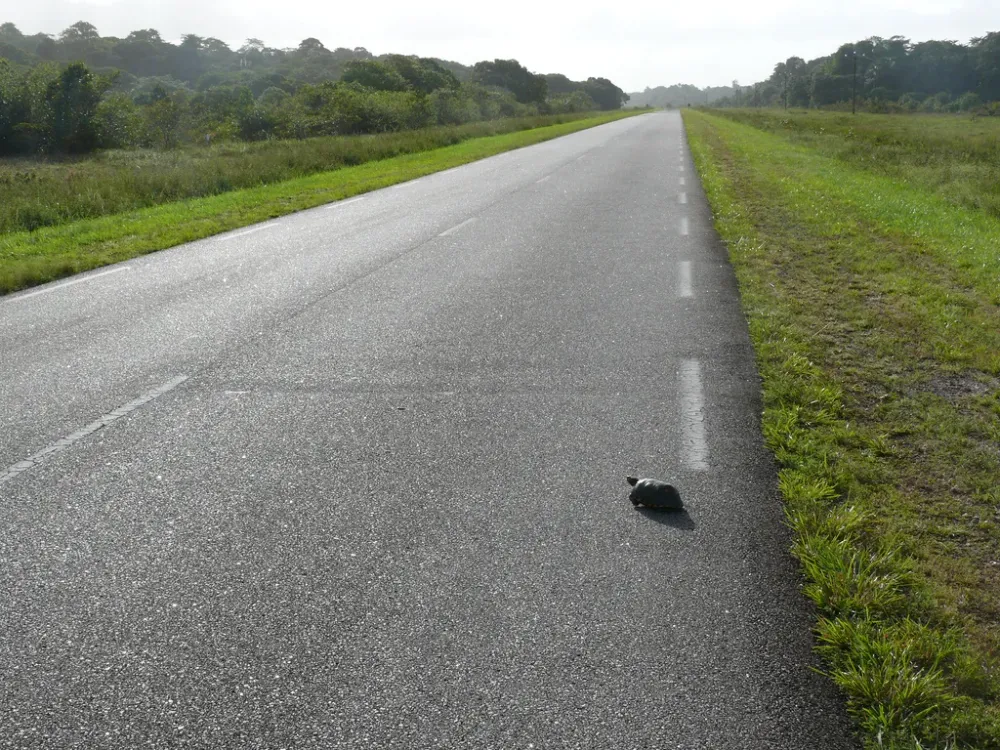
- Wildlife: stray dogs near the villages, and at night, armadillos, iguanas or deer crossing. The local rule: avoid driving at night outside built-up areas.
- The PAF checkpoint at Iracoubo: a permanent border police checkpoint between Sinnamary and Iracoubo. Keep your ID, driving licence and rental contract within reach.
The RN2, from Cayenne to Saint-Georges-de-l’Oyapock
The RN2 to Saint-Georges, fully paved since the 2000s, crosses 190 km of almost unbroken forest after Roura. Magnificent and deserted: past Régina, you sometimes drive for 45 minutes without passing a soul. Practical consequences:
- Fill up in Cayenne or Régina: no reliable petrol station between Régina and Saint-Georges.
- No mobile signal on long stretches: download your offline maps before setting off.
- PAF checkpoint at Bélizon on the RN2, same principle as at Iracoubo.
- The road surface breaks up in patches after heavy rain: a cautious 80 km/h beats the permitted 90.
And beyond the tarmac: the tracks
Kaw beyond the river crossing, the Saint-Élie track, certain carbet access routes or the Coralie track: it’s laterite, slippery as wet soap in the rainy season. This is exactly where the question of a 4x4 in French Guiana arises — and where your rental contract becomes crucial.