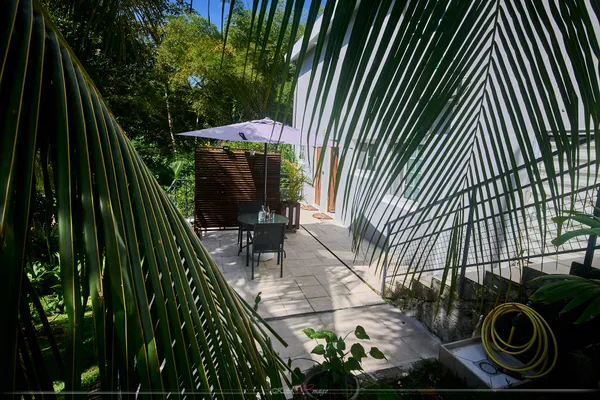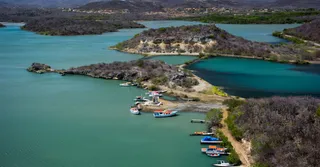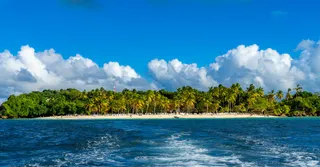
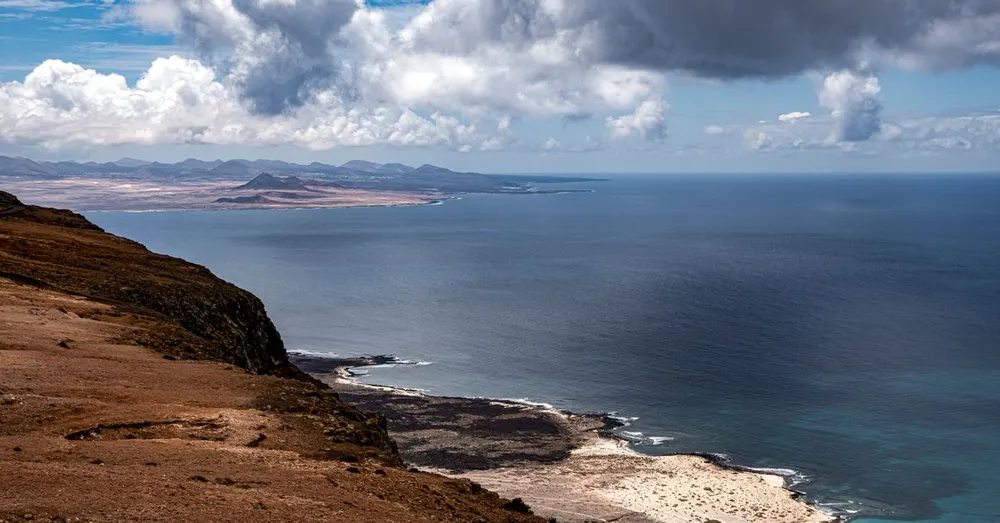
We picture Martinique like a postcard: palm trees, turquoise lagoons, dripping tropical rainforest. Then you set foot on the Savane des Pétrifications, at the far south-east of the island, and the scenery goes haywire. Not a single tree, a cracked red soil, candle cacti, fossilised trunks lying in the dust. It is Martinique’s one and only arid landscape, a mineral desert that most visitors never notice. I regularly take travellers there, surprised to find a Caribbean Wild West twenty minutes from Les Salines: here is how to discover it without turning the walk into a heatstroke.
What exactly is the Savane des Pétrifications?
The Savane des Pétrifications is a semi-desert plateau in the town of Sainte-Anne, at the very tip of the peninsula that closes off Martinique’s Grand Sud. The name comes from the pieces of petrified wood found on the ground, remnants of vegetation fossilised millions of years ago, when silica replaced the matter of the trunks: fragments as hard as stone, ochre and grey in colour.
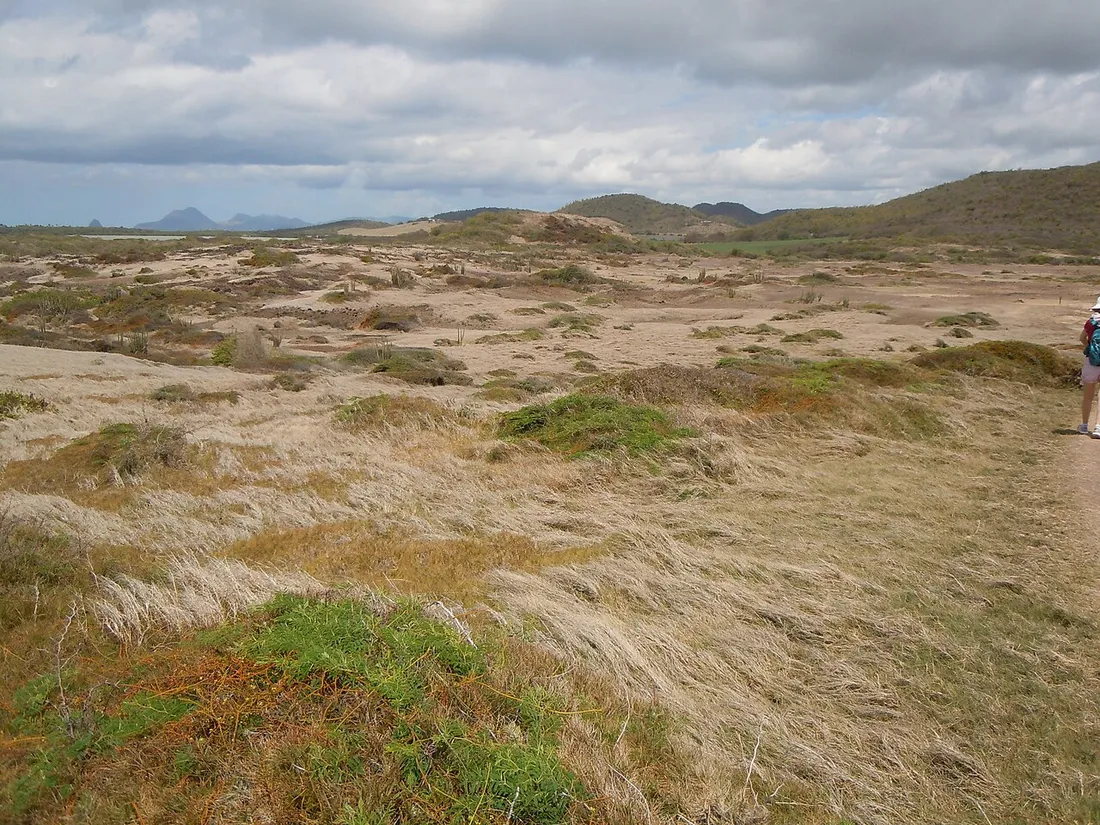
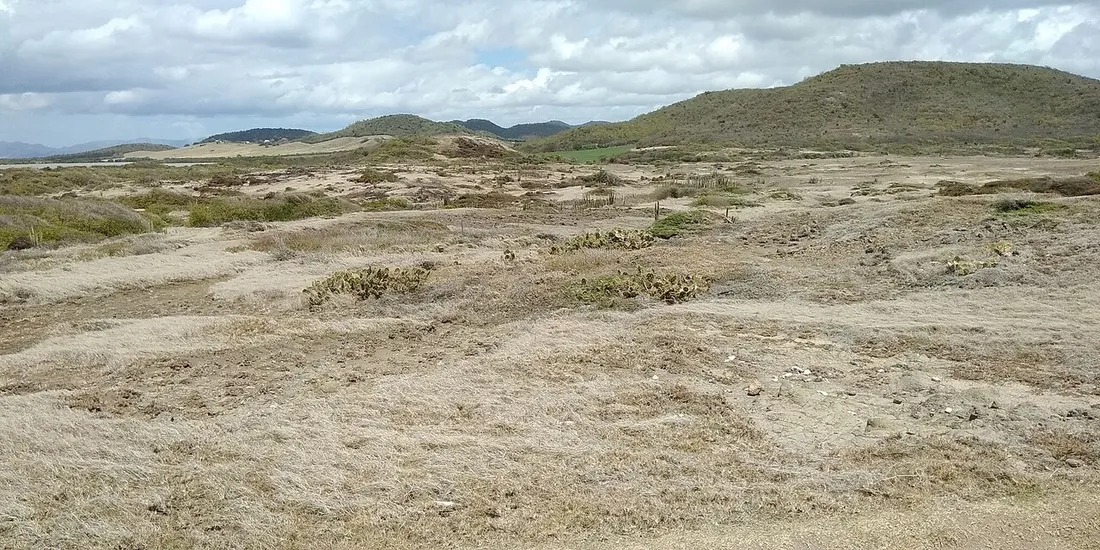
But the real spectacle is the whole arid landscape: a reddish lateritic soil, low vegetation of candle cacti and thorny bushes, shaped by the trade winds. A few landmarks to place the spot:
- Location: south-eastern tip of Sainte-Anne, beyond the Salines beach.
- Status: protected natural area, largely owned by the Conservatoire du littoral.
- Area: a compact sector of a few hundred hectares, explored on foot.
- Distinctive feature: the only micro-desert in the territory, due to a dry, windy microclimate.
In less than half an hour’s drive from the crowded beaches of the South, you tip into another, almost lunar world, freely accessible all year round.
Why a desert in the tropics?
How can such a desert exist in the tropics? It all comes down to local factors: the headland takes the trade winds head-on, the salt-laden spray scorches young seedlings, and with no canopy to act as a screen, evaporation runs wild over a laterite that holds water poorly. The result is one of the most photogenic arid landscapes in the Lesser Antilles.
The petrified wood, for its part, bears witness to an ancient mineralised forest, proof that the climate here has changed profoundly. Scattered shards can be found, but the Conservatoire’s golden rule is non-negotiable: look, photograph, take nothing.
Cap Macré and Table du Diable: the sites not to miss
The Savane is not just a uniform plateau: you string together several settings, each worth a photo stop.
Cap Macré, a balcony over the Atlantic
Cap Macré is one of the emblematic headlands of this wild coastline. Battered by the Atlantic swell, it offers an open view of the sea and the neighbouring points, with small coves below where the rock plunges into choppy water. You reach it by road from Le Marin, and the contrast is striking between the deep blue of the ocean and the burnt ochre of the savane.
Table du Diable, the curiosity of the plateau
Deeper into the mineral desert, the Table du Diable is a rock formation that intrigues: a flat slab set like an altar in the middle of the low vegetation, around which a few local legends are woven. It serves as a landmark for walkers, the surrounding ground being strewn with cacti and fossilised wood. Look at it at the start or end of the day: these are the hours when the arid landscape reveals its finest colours.
Between the capes, the trail skirts the Étang des Salines, a wetland where herons and egrets nest: a striking contrast between the water-soaked world of the coast and the dryness of the plateau.
Preparing your hike well: the serious part
Let’s be clear: the Savane des Pétrifications is superb but merciless without preparation. There is no shade, no water source, no shop, and the real dangers are not the terrain but the sun and dehydration. My field instructions:
- Hydration: at least 1.5 litres of water per person for a short loop, 2.5 to 3 litres for a multi-hour exploration. No fountain in the sector.
- Smart timing: set off at dawn (6:30 - 8 a.m.) or in the late afternoon (from 3:30 p.m.); the 11 a.m. - 3 p.m. window is to be avoided.
- Sun protection: hat, sunglasses, factor 50 cream reapplied, and an anti-UV t-shirt for the long exposed sections.
- Closed shoes: trail trainers rather than flip-flops, the ground is rocky and sharp.
- Plant vigilance: beware of the manchineel trees along the beach edge, whose sap and green fruit are toxic; never shelter under one during a shower.
As for duration: for the overview, about 1 h 15 to 1 h 30 of walking out to the heart of the savane (4 to 5 km round trip); for the extended loop with Cap Macré and Table du Diable, allow 3 to 4 hours over 8 to 10 km. The rocky ground slows the pace, count on 35 to 45 minutes per kilometre.
The best period is the Carême, the dry season from December to April: clear skies and crisp light. It is also the high tourist season and that of the carnival (February-March), so book your accommodation ahead.
How to get there and where to stay
The main access is from Sainte-Anne, at the end of the road to Les Salines: you leave the car at the car park of the big beach, then continue on foot heading east. A second gateway exists via Le Marin, on the road leading towards Cap Macré. A car is strongly recommended (allow 45 minutes from Aimé Césaire airport, in Le Lamentin), as is an offline map, because the waymarking fades in places.
To reach the Savane at daybreak without swallowing miles of road, drop your bags in the Grand Sud, between Sainte-Anne, Le Marin and Le Diamant. You will be less than 30 minutes from the trailheads and from the island’s finest beaches: Les Salines, Anse Dufour, Anse Noire with its black sand, or the Grande Anse des Anses-d’Arlet.
At Hostel Toucan, we manage holiday rentals in the South designed for active travellers. Booking direct changes everything:
- Direct booking with no platform fees: the fair price, with no added commission.
- Free cancellation up to 7 days before arrival, very useful when the tropical weather changes its mind.
- WhatsApp assistance 7 days a week for your last-minute questions, from the best time slot to the day’s conditions.
Discover our accommodations at /location-martinique and build your programme with our complete guide to Martinique. Do you own a property in the South and would like to make it pay off without the management burden? Our local concierge service is detailed at /proprietaires.
Extending the discovery in southern Martinique
The Savane is ideally enjoyed over a half-day, then combined with the other gems of the area: a swim at Les Salines, a meal facing the pontoons of Le Marin (the Caribbean’s sailing capital), a distillery on the Route des Rhums to taste the AOC agricultural rum of La Mauny or Trois-Rivières, or a morning of snorkelling at Anse Dufour and Anse Noire.
One last word: Martinique is a French overseas department (capital Fort-de-France), you pay in euros and the time difference with Paris is -5 h in winter, -6 h in summer. For the Savane, aim for the Carême and the cool hours, take plenty of water and leave the petrified wood where you find it. Well prepared, this little desert remains one of the most disorienting landscapes on the whole island. Write to us to set your morning according to the weather: we know the terrain.
FAQ
Is the Savane des Pétrifications difficult to walk?
No, the terrain is flat and without vertiginous passages: the difficulty comes from sun exposure and the total absence of a water source, not from the relief. Setting off early, with 1.5 to 3 litres of water depending on the distance, closed shoes and good sun protection, the walk remains accessible to beginners as well as motivated families.
Can you collect petrified wood on site?
No. The site is a protected natural area, largely managed by the Conservatoire du littoral, and removing petrified wood, like any natural element, is forbidden there. Photograph the fragments, observe them on the spot, but leave them to preserve the richness of the place and allow the next visitors to enjoy it in turn.
How do you access the Savane des Pétrifications and Cap Macré?
The main departure is at the end of the road to Les Salines, in Sainte-Anne, where you leave the car before continuing on foot heading east. To reach Cap Macré more directly, take the road that leads to it from Le Marin. In both cases, a car is strongly recommended, as public transport serves the Grand Sud poorly.
What is the best time to visit this Martinican desert?
The Carême, the dry season from December to April, offers the best conditions: clear skies, ideal light and firm ground. Whatever the season, favour early morning or late afternoon and flee the 11 a.m. - 3 p.m. window, because the plateau, without the slightest shade, becomes a real furnace in the middle of the day.