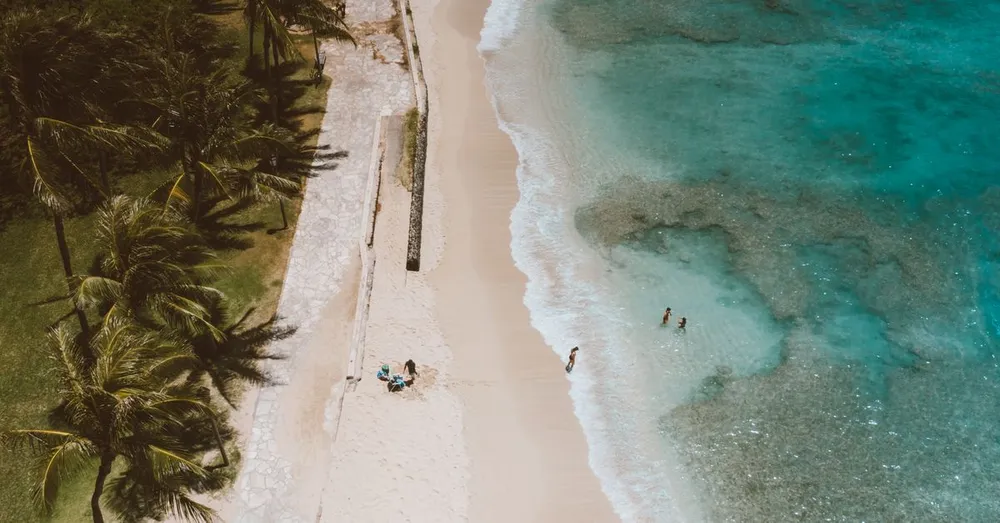
Seen from above, Guadeloupe finally takes on the shape it’s famous for: a butterfly resting on the Caribbean Sea. At 1,000 feet of altitude, you suddenly grasp the geography of the archipelago in a way no road map ever truly conveys: the sharp boundary between flat, turquoise, limestone Grande-Terre and dark, volcanic Basse-Terre carpeted in tropical forest. After several years organizing stays here and personally flying in most of the aircraft on the island, here is a concrete guide to choosing your microlight or paragliding flight, with no nasty surprises.
Why see Guadeloupe from the sky
The archipelago is a French overseas region (DROM) of around 380,000 inhabitants, spread across several islands. On the ground, you string together winding roads and the traffic jams of Pointe-à-Pitre, the economic hub. From the sky, everything lines up: in twenty minutes you connect what takes two hours by car.
The flight reveals perspectives that are impossible to get any other way:
- The dome of la Soufrière (1,467 m), often capped with clouds, and its sulfurous fumaroles.
- The shades of blue of the Réserve Cousteau at Malendure, with the Pigeon islets set on the reef.
- The Carbet waterfalls tumbling down the National Park forest.
- The slender tip of Pointe des Châteaux and the arc of Petite-Terre offshore.
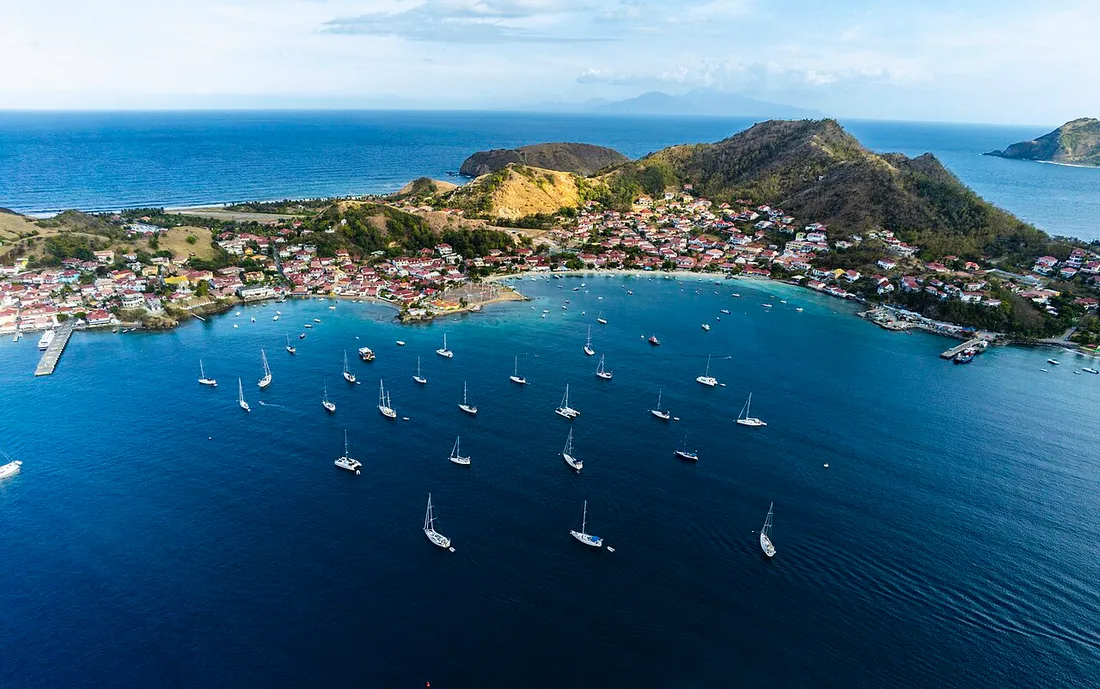
- Les Saintes, whose Terre-de-Haut bay is ranked among the most beautiful in the world.
It’s a BOFU experience par excellence: you’re no longer wondering whether you want to fly, but with whom and on which circuit.
Microlight or paragliding: which experience for which profile
The two disciplines offer entirely different things, and the confusion costs dearly in disappointed expectations.
The microlight flight: covering ground
The microlight (fixed-wing or weight-shift) is motorized and piloted by an instructor. It’s the top option for covering long distances and stringing together several sites in a single flight. You generally take off from an airfield (Saint-François, Le Moule or Baie-Mahault area depending on the operator) and pick a tailor-made circuit.
- Duration: from 20 minutes (introduction) to 1 hr 30 (grand archipelago tour).
- Flight altitude: 300 to 500 m, ideal for photography.
- Comfort: bucket seat, helmet with intercom to talk with the pilot.
- Weather: sensitive to wind, but flies under partly cloudy skies.
Paragliding: pure sensation
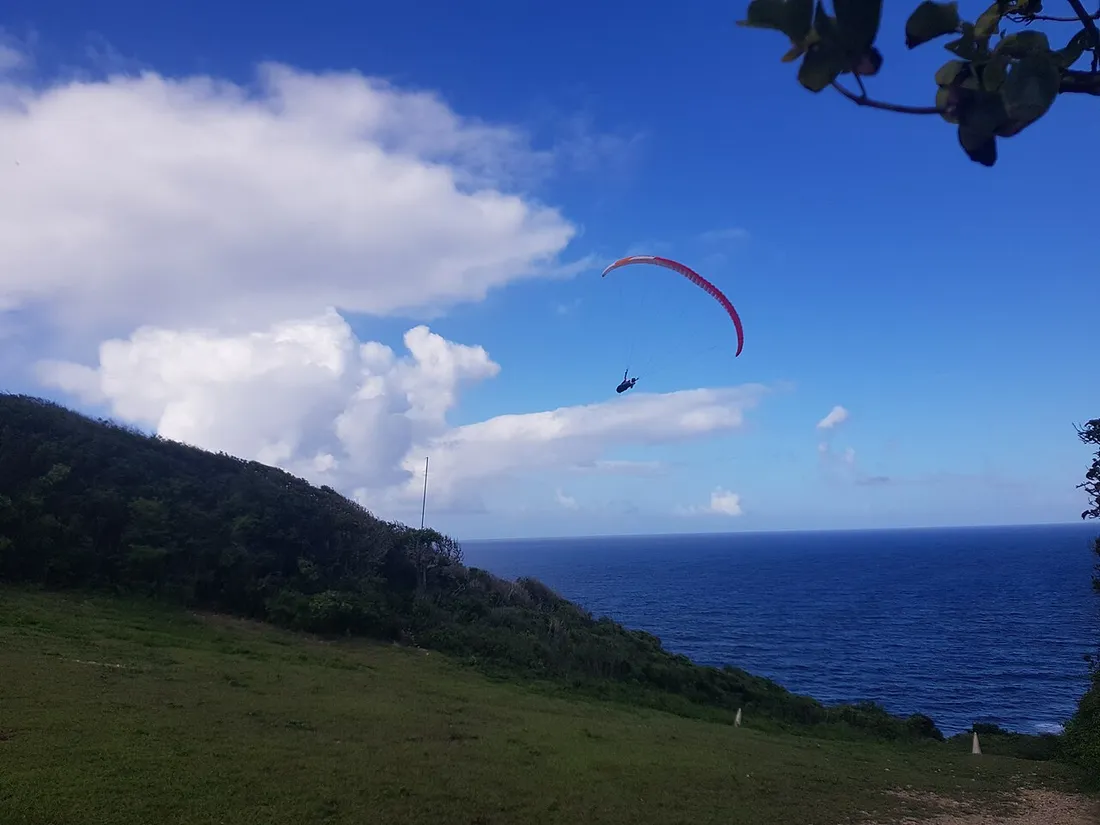
Paragliding, unpowered, depends on the terrain and thermals. In Guadeloupe, it’s practiced mainly tandem above the heights of Basse-Terre and certain headlands of Grande-Terre. The feeling of silence and gliding is incomparable, but the range stays local: you fly over one site, not the whole archipelago.
- Flight duration: 15 to 30 minutes depending on conditions.
- Take-off: from a hillside, after a short approach walk.
- Weather: very demanding — you need the right wind in the right window.
My first-hand advice: for a first flight that shows both wings of the butterfly, choose the microlight. Save paragliding for thrill-seekers willing to wait for the perfect weather window.
Comparison of microlight tour circuits
Here are the most requested itineraries, with realistic price and duration ranges observed in the field (per person, shared or private flight depending on the aircraft).
Grande-Terre seaside circuit (20-30 min)
Ideal for a first time. Take off on the east side, fly over Sainte-Anne and Caravelle beach, Saint-François, Pointe des Châteaux, then return via the cane plains of Le Moule.
- Indicative price: €90 to €130 / person.
- Highlight: turquoise waters and light-flooded beaches.
Basse-Terre & Soufrière circuit (45 min)
The most spectacular in scenic terms. You skirt the volcano, discover the Carbet waterfalls, the National Park canopy, then the leeward coast and the Réserve Cousteau above Bouillante and Malendure.
- Indicative price: €160 to €220 / person.
- Highlight: a forest-volcano-reef contrast unique in the West Indies.
Grand archipelago tour (1 hr - 1 hr 30)
The signature flight: both wings, plus a loop over Les Saintes and sometimes Marie-Galante (the Bielle, Bellevue and Père Labat rum distilleries seen from above) or La Désirade.
- Indicative price: €280 to €420 / person.
- Highlight: you literally see the entire butterfly archipelago in one flight.
Photo / sunset flight (30-45 min)
End-of-day window, golden raking light over Pointe des Châteaux and the islets. Hugely popular with couples and photographers.
- Indicative price: €150 to €200 / person.
Choosing an insured, recognized operator: the checklist
This is the heart of a BOFU decision. Guadeloupe’s skies feature serious providers and, unfortunately, a few opportunistic offers. Always check:
- Aviation civil liability insurance: ask for the policy number and passenger coverage. A serious operator shares it without hesitation.
- The declaration of activity (transport or pleasure flight) and the aircraft registration (verifiable).
- The pilot/instructor’s license and experience: number of hours, microlight instructor qualification.
- Aircraft maintenance: an up-to-date maintenance log, recent aircraft.
- Verified reviews and seniority: an operator established on the island for several seasons.
- The weather policy: clear rescheduling or refund in case of cancellation for conditions.
- The safety briefing: harness, helmet, instructions — it must be systematic.
Be wary of abnormally low rates and bookings without a written contract. A first flight involves your safety: price isn’t the only criterion.
Weather windows: when to book your flight
The weather makes or breaks a flight. The archipelago lives to the rhythm of the trade winds and two seasons.
- Dry season (December to April): this is THE period. Clear skies, regular but manageable trade winds, maximum visibility on the volcano and the islets. Book on this window for preference.
- Wet season (June to November): frequent tropical showers, cyclone risk from summer into autumn. Flights remain possible in the morning, but cancellations are more numerous.
A few rules I apply for my travelers:
- Fly in the morning (7 a.m. - 10 a.m.): more stable air, fewer thermal turbulences, clean light for photography. La Soufrière often clears early in the day before veiling over in the afternoon.
- Build in flexibility: book your flight early in your stay to keep a fallback date in case of rescheduling.
- For paragliding, accept that confirmation sometimes only comes the day before: it’s the sign of a serious operator who doesn’t take off in doubt.
Keep in mind the time difference (-5 hrs in winter, -6 hrs in summer relative to Paris) so you call operators at the right time; the local dialing code is +590.
Organizing your flight from your Hostel Toucan stay
The logistics of a first flight are far easier to manage when you’re well located. Staying on the Saint-François, Sainte-Anne or Le Gosier side brings you closer to the Grande-Terre airfields; accommodation in Deshaies or Bouillante makes flights toward Basse-Terre and the Réserve Cousteau easier.
At Hostel Toucan, we know the island’s aerial operators and help our travelers lock in the right weather window. Booking is done directly, with no platform fees, with free cancellation up to 7 days before arrival and 7/7 WhatsApp support to adjust your schedule if the weather shifts. Discover our accommodations in Guadeloupe ideally located, and prepare the rest of your stay with our complete guide to Guadeloupe.
Do you own a property and would like to showcase it to travelers seeking experiences like this one? Discover our property management offer.
The Guadeloupe sky is waiting for you: choose your circuit, check the insurance, aim for the dry season, and let the butterfly spread its wings beneath you.
FAQ
How much does a microlight flight in Guadeloupe cost?
Expect around €90 to €130 for a short circuit (20-30 min) over Grande-Terre, €160 to €220 for a flight over la Soufrière and Basse-Terre (45 min), and €280 to €420 for a grand archipelago tour of an hour or more. Prices vary by operator and whether the flight is shared or private.
What is the best time for a microlight or paragliding flight?
The dry season, from December to April, offers the clearest skies and the best visibility on the volcano and the islets. Favor morning flights (7-10 a.m.), when the air is more stable and la Soufrière often clears before veiling over in the afternoon.
Do you need any particular physical condition to fly?
No for the microlight, which is motorized: you’re simply a passenger alongside the pilot. Tandem paragliding requires a short approach walk to the take-off point and basic mobility for the launch run. Always ask the operator about weight limits and minimum age.
How do you check that an aerial operator is reliable and insured?
Ask for the aviation civil liability insurance policy number with passenger coverage, the aircraft registration, the pilot’s qualification, the company’s seniority and the weather cancellation policy. A serious provider supplies this information without reluctance and carries out a systematic safety briefing.