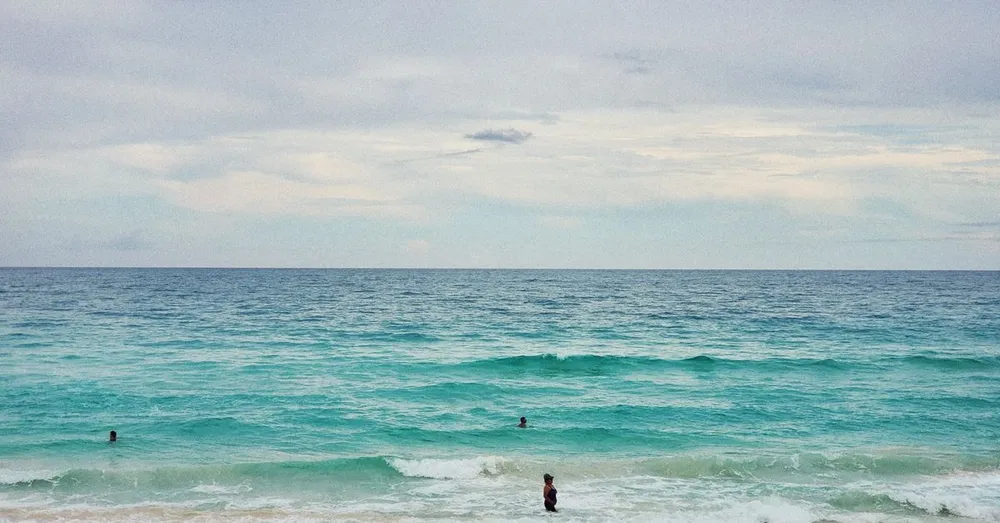
“Sorry, this is private.” You might hear that sentence one day in front of a gate, a jetty or a row of sun loungers, somewhere between Anse Mitan and Sainte-Anne. And yet, in nearly every case, it is legally false. In France, and therefore in Martinique, which is an overseas department and region (DROM), the sand and the sea belong to everyone. Access to a public beach in Martinique is protected by old and solid legal texts, from the shoreline to a strip of passage running along the coast. But the reality on the ground is more nuanced: a hotel may occupy a section of beach, a villa may complicate arriving on foot, and some coves remain hard to reach. As a concierge company based on the island, we sort out fact from fiction for our travellers every season. Here, jargon-free, is what the law actually says about access to the Martinique coastline.
The Beach Belongs to Everyone: The Principle of the Maritime Public Domain
Let’s start with the basics, the very thing that makes the answer to our title’s question, almost always, yes. Under French law, the seashore falls within the maritime public domain (DPM), in the overseas territories just as in mainland France. This domain is inalienable and imprescriptible: it can be neither sold nor acquired through use, even after decades. In concrete terms, no one can become the owner of the beach.
The natural maritime public domain includes in particular:
- The seabed and subsoil up to the limit of territorial waters.
- The shoreline, that is, the zone the sea covers at the highest tides in the absence of a storm.
- The lais and relais de la mer (land the sea has uncovered or covered over).
- Part of the salt ponds connected to the sea.
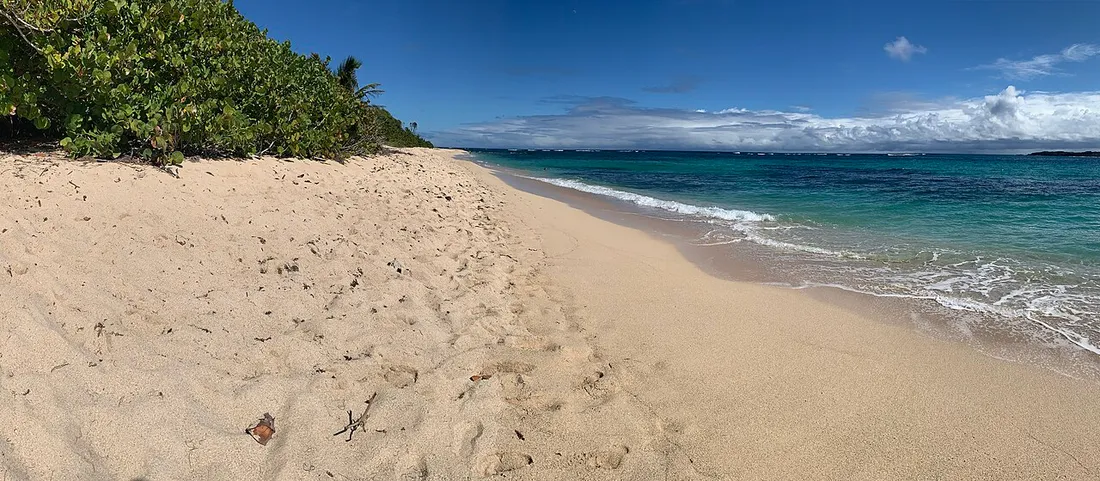
The consequence is crystal clear: the sandy beach itself, where you lay down your towel, is part of this maritime public domain of the overseas territories. It is open to everyone, free of charge, for walking, swimming and recreational fishing. No private individual, no hotel and no residence can legally privatise a beach in Martinique or deny you access once you are there.
Pedestrian Right of Way: The Right to Walk Along the Coast
Knowing that the beach is public is useless if you can’t reach it. This is where a second pillar comes in, often unknown to visitors: the pedestrian right of way along the coastline (the SPPL), established by the 1976 law and incorporated into the Urban Planning Code. It applies fully in Martinique.
This coastal right of way creates, across private properties bordering the sea, a strip 3 metres wide reserved for pedestrian passage. In other words, even where private land borders the coast, walkers have the right to pass on foot along the shore. The key points to remember:
- It is free and open to all pedestrians (not to vehicles, nor, in principle, to bicycles).
- The neighbouring owner cannot fence it off or obstruct it.
- Its route may be modified by the authorities to bypass an obstacle, a house too close to the shore or a dangerous area.
- In addition, in some municipalities, a transversal right of way allows you to reach the sea from the public road by crossing private land, where no direct access exists.
In short: if a villa has been built right between the road and the cove, the law provides, in theory, a means of reaching the beach on foot. In practice in Martinique, not all these paths are yet signposted or developed, but the right itself exists.
What a Hotel or Villa Can (and Cannot) Do
This is where most of the misunderstandings arise, along with those famous “private beach” signs. Let’s distinguish three situations we regularly come across on the ground.
Temporary Occupation of the Public Domain
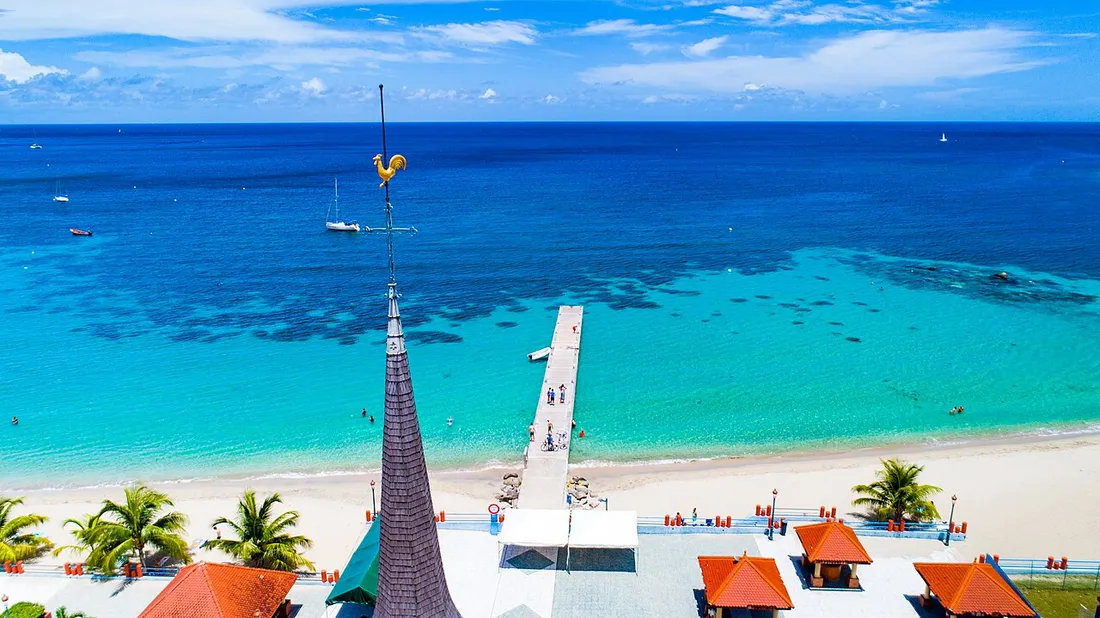
A hotel, a beach restaurant or a water-sports club can obtain a temporary occupation permit (AOT) for the maritime public domain, granted by the State in exchange for a fee. This allows it to set up sun loungers, parasols or a jetty on a defined section of the beach. But this occupation:
- Remains temporary, precarious and revocable: it is never ownership.
- Does not authorise fencing off the beach or preventing the public from moving around and swimming.
- Must leave free passage along the shore.
So you can perfectly well walk in front of a hotel, swim opposite it, and stroll along the sand. What you cannot do is sit free of charge on its rented lounger or use its paid facilities. That’s the nuance, and it is often deliberately blurred.
Private Land Sloping Down to the Sea
A private property can extend right up to the boundary of the maritime public domain. The owner is then on their own land, but not on the beach below, which remains public. They must also accommodate the pedestrian right of way on the 3 metres bordering the shore. So they cannot forbid you from passing along that strip, nor “privatise” the cove at the bottom of their garden.
The Special Case of Beach Concessions
Some municipalities sign a beach concession with the State to develop and maintain a site (toilets, lifeguard stations, subcontractors). Even in that case, a minimum portion of the beach (in both surface area and length) must remain free and open of access and of any equipment. The French logic is consistent: private use is the strictly regulated exception, free access is the rule.
The Coastal Conservatory: An Ally of Public Access in Martinique
Beyond the maritime public domain, one player provides lasting protection for Martinique’s coasts: the Coastal Conservatory (Conservatoire du littoral). This public body buys up coastal land threatened by development in order to permanently shield it from construction and open it to the public.
In Martinique, the Coastal Conservatory protects several thousand hectares among the island’s most beautiful and often wildest sites:
- The Caravelle Peninsula and its reserve, on the Atlantic side (Tartane, La Trinité).
- Vast areas around Sainte-Anne and the Pointe des Salines, in the Grand Sud.
- Stretches of the North Caribbean coast between Le Carbet, Saint-Pierre and Le Prêcheur.
- The islets and mangroves of the bays of Le Robert and Le François.
On this land, access is free and guaranteed, but managed to preserve the environment: you stay on the waymarked trails, you don’t drive in, you don’t camp, and you take nothing. It is precisely thanks to this protection that beaches like Grande Anse des Salines or trails like the Trace des Caps will stay sheltered from concrete and open to future generations. To place these sites within a wider discovery of the island, browse our complete guide to Martinique.
The Real Limits to Access: What Can Legally Block You
While the beach is public, certain restrictions are entirely legal, and you need to know them so as not to cry foul wrongly. The right of access to the Martinique coastline gives way to:
- Military or port zones (around Fort-de-France in particular), closed for security reasons.
- Nature reserves with strict rules, where passage may be channelled or seasonally closed (turtle nesting areas, for example).
- Municipal safety orders: temporary closure for cyclonic swell, mass sargassum strandings, shark risk or pollution.
- Swimming bans linked to chlordecone on the fishing side, which do not close the beach but regulate the consumption of seafood.
These limits do not contradict the principle of public access: they temper it now and then, for safety or the environment. On site, a red flag or an order posted at the town hall always takes priority over your urge for a swim.
Reaching the Coast in Practice: Our Local Tips
Legal theory is all well and good; getting your feet in the water without losing your temper is better. A few field-tested reflexes for the Martinique coastline:
- Spot the signposted public access points: most beaches have a municipal path, a car park or a marked trail. No need to cross a property when an official access exists 100 metres away.
- Park sensibly: at Les Salines as at Anse Dufour, arrive before 9 a.m. to find a spot and respect authorised parking (fines do happen).
- Don’t confuse private with paid: a car park or a service can be paid for without the beach itself being so.
- Stay courteous and discreet when using a right of way: you are within your rights, but you are skirting someone’s garden.
- Favour the car: on this island where it is strongly recommended, many secluded coves are earned only at the end of a small road or a trail.
To choose a base well connected to the beaches, see our rentals in Martinique, often just a few minutes’ walk or drive from a public access point to the sand.
Make the Most of Your Coastal Stay with Hostel Toucan
Understanding the maritime public domain of the overseas territories, the right of way and the Coastal Conservatory sites is the guarantee of enjoying the Martinique coast with peace of mind, without being intimidated by an abusive sign. But you still need a good local anchor. At Hostel Toucan, a concierge and holiday-rental service in Martinique, we help our travellers find the right access at the right time.
Booking directly with us means:
- No platform fees: you pay the fair price, with no added commission.
- Free cancellation up to 7 days before arrival, ideal when your plans depend on the weather and the sargassum.
- WhatsApp assistance 7 days a week to know which cove is open, which car park to aim for and which public access to use (dialling code +596; -5h in winter and -6h in summer compared with Paris).
The best time to explore the coast remains the dry season (the Carême), from December to April, with calmer seas and clearer skies. And if you own a seafront property, find out how we support owners in managing their rental, in keeping with these access rules. With the right legal bearings, Martinique opens up all of its sand to you: here, no beach ever truly closes.
FAQ
Are there any private beaches in Martinique?
No, not in the sense of a beach you could be barred from. The shore and the sand fall within the maritime public domain, which is inalienable: no beach can be bought or privatised. A hotel or restaurant can obtain a temporary permit to set up sun loungers and parasols on a defined section, but it can neither fence off the beach nor stop you from moving around, swimming or walking along the shore.
What is the pedestrian right of way along the coast?
It is a right established by the 1976 law that reserves, across private properties bordering the sea, a strip 3 metres wide for pedestrian passage along the shore. The neighbouring owner can neither fence it off nor obstruct it. A transversal right of way may also allow you to reach the sea by crossing private land where no direct access exists. In Martinique, this right applies, even if not all the trails are yet developed.
Can I be charged for access to a beach in Martinique?
Access to the sand and swimming are free everywhere. However, associated services may be paid for: a private car park, the rental of sun loungers, the use of a club’s or hotel’s facilities. Don’t confuse a paid beach (which doesn’t exist) with a paid service or parking nearby. You always keep the right to lay your towel on the free sand and swim without spending a thing.
Does the Coastal Conservatory close off access to beaches?
On the contrary: the Coastal Conservatory buys coastal land to protect it from development and open it lastingly to the public, as at the Caravelle Peninsula or around Sainte-Anne. Access there is free and guaranteed, but managed to preserve the environment: you stay on the waymarked trails, with no vehicle, no camping and taking nothing. Occasional closures remain possible for safety or to protect species, such as turtles during the nesting season.