What you actually see of a Kourou launch, depending on distance
Published on August 12, 2026 · by Ismael Samuel
It is the question we get asked most before a launch, and the one official sites answer least: what exactly am I going to see? A launch is not a firework display — it is a phenomenon that unfolds over several minutes, and distance changes everything: what you see, what you hear, and the gap between the two. Here, distance by distance, is what you should genuinely expect from an Ariane 6 or Vega-C launch from the Guiana Space Centre.
The principle: light arrives before sound
This is the part nobody anticipates and that catches everyone out. Light reaches you instantly; sound takes roughly 3 seconds per kilometre.
In practice:
At 5 km, you see the lift-off, then the roar arrives 15 seconds later.
At 15 km, you wait close to 45 seconds.
At 60 km, more than 3 minutes — and at that range there is often nothing left but a dull vibration, if anything at all.
That lag creates a strange, memorable effect: the rocket is already high in the sky when the noise catches up and hits you in the chest. Do not leave your spot at lift-off — that is usually the best moment of all.
These are the areas reserved for guests and registered visitors, the closest positions permitted to the launch pad.
What you see: the launcher on its pad before ignition, the ignition itself, the water deluge, the entire climb, and booster separation with the naked eye under a clear sky. It is the only place where you can genuinely make out the structure of the rocket before lift-off.
What you feel: the noise arrives at around 15 seconds and it is physical — a vibration in your sternum, in the ground, in the windows. That is the part nobody forgets.
The constraints: registration is compulsory and places are limited, you must arrive several hours ahead, and you cannot leave before operations are over. Our guide to attending an Ariane 6 launch at the Guiana Space Centre sets out the registration procedure in detail.
At 10-15 km: the town of Kourou, its beaches and centre
This is the distance of Kourou’s public vantage points, open to everyone without registration.
What you see: you do not see the pad itself, hidden by vegetation and terrain. But as soon as the rocket rises above the horizon line — a few seconds after ignition — it becomes perfectly visible, with an intense flame and a rising column of smoke. You then follow the ascent for several minutes.
What you feel: the sound arrives at around 40-45 seconds, very audible, less physical than at 5 km but thoroughly impressive.
The smart move: look for a clear horizon to the north-west, with no buildings or tall trees. The seafront and the open esplanades work well. Arrive at least an hour early: the unobstructed spots fill up.
At 60 km: Cayenne, Rémire-Montjoly, Matoury
This is the distance from the Cayenne conurbation, where many travellers stay.
What you see: under a clear sky, a very bright point of light rising above the western horizon and leaving a trail behind it. At night it is spectacular — a genuine comet climbing slowly, then tilting eastward. By day it is far more discreet: white smoke and a bright dot you have to hunt for.
What you feel: generally nothing. The sound is too attenuated, and with an unfavourable wind it does not reach you at all.
The smart move: face west-north-west, on a beach or a high point. Montjoly beach and the heights of Rémire give you the right line of sight. And above all: check the exact launch time and be outside 5 minutes beforehand, because there is no audible countdown to warn you.
Day or night: what really changes
This is the factor that weighs most, more than distance itself.
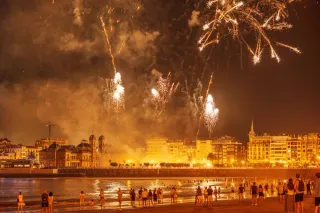
A night launch is far more spectacular at every distance. The flame lights up the sky, the trail stays visible for a long time, and from Cayenne the effect is striking. Near the equator, night falls around 6.30pm all year round: an evening launch is therefore a night launch.
A daytime launch, on the other hand, gives you a much clearer read on the rocket itself when you are close: you can see the structure, the boosters, the separation. At 60 km, in daylight, the effect is modest.
Cloud cover. A low ceiling can swallow the rocket within seconds. It is risk number one, particularly in the rainy season (December to July). The launch goes ahead anyway — you will hear it, but you will see almost nothing.
Your line of sight and obstacles. One building, a row of coconut palms or a hill is enough to hide the first 30 seconds, precisely the most impressive ones. Scout your spot the day before, at the same hour.
Street lighting. At night, a single lamp post in your field of view wrecks both the view and the photos. Move away from light sources.
Postponement. A launch window can slip by 24 hours or more. Never book your return flight for the day after a launch. See why a launch gets postponed.
Summary table
Distance
What you see
Sound
Verdict
~5 km (official sites)
Pad, ignition, full ascent, separation
~15 s, physical
The maximum experience, registration required
~10-15 km (Kourou)
Rocket as soon as it clears the horizon, long ascent
~45 s, very audible
The best accessibility-to-spectacle ratio
~60 km (Cayenne)
Point of light and trail, superb at night
Generally inaudible
Fine at night, disappointing by day
Where to stand, depending on your situation
You are staying in Kourou: stay in Kourou. Find a clear north-west horizon and arrive an hour early.
You are staying in Cayenne or Rémire-Montjoly: for a night launch, Montjoly beach is more than enough. For a daytime launch, make the drive to Kourou — allow 1 hour (60 km) and set off very early, as traffic builds up on launch days.
You have official registration: follow the arrival times to the letter, they are not indicative.
A launch is not booked like a show: the date moves, the window is narrow, and accommodation in Kourou saturates on launch nights. Two pieces of advice that head off 90 % of disappointments: plan several nights on site around the date, and do not leave the following morning.
At Hostel Toucan, our properties in Kourou, Cayenne, Rémire-Montjoly and Matoury let you choose your distance. Direct booking comes with no platform fees, cancellation is free up to 7 days before arrival — handy when a launch window shifts — and our WhatsApp support answers 7 days a week to confirm the exact time and the best spot on the day. Browse our accommodation in French Guiana, and check the 2026 Kourou launch calendar to lock in your dates.
Do you own a property in Kourou or in the Cayenne area? Launch nights are the most predictable demand peak of the year: our property management service knows how to capture it.
In summary
At 5 km, you experience the launch physically, sound included, but you need registration. At 10-15 km from Kourou, you see the rocket as soon as it clears the horizon and you hear it very well: the best compromise, with no formalities. At 60 km from Cayenne, expect a point of light and a trail — magnificent at night, disappointing by day, and without the sound. In every case, cloud cover and a clear horizon matter more than the kilometres, and the sound always arrives after the image, at 3 seconds per kilometre.
FAQ
Can you see a Kourou launch from Cayenne?
Yes, but it is a completely different experience. At around 60 km, you make out a very bright point of light rising above the western horizon and leaving a trail — spectacular at night and far more discreet by day. The sound generally does not reach you. You need a clear horizon towards the west-north-west — Montjoly beach works well — and you need to be outside a few minutes before the exact time, because nothing on site will warn you.
How long after lift-off do you hear the rocket?
About 3 seconds per kilometre of distance. At 5 km from an official viewing site, the roar arrives after some fifteen seconds and it is physical: you feel it in your chest and in the ground. At 15 km from Kourou, allow 45 seconds. Beyond 50 km, the sound is most often inaudible. That is why the rocket already looks high when the noise catches up with you.
Is it better to watch a launch by day or by night?
At night, without hesitation, if spectacle is your priority: the flame lights up the sky, the trail stays visible for a long time and the effect carries as far as Cayenne. By day, on the other hand, you can make out the rocket itself far better when you are close — structure, boosters, separation — but the impression is modest at long range. Near the equator, night falls around 6.30pm all year round, so any evening launch is a night launch.
What can stop you seeing a launch?
Cloud cover above all: a low ceiling can hide the rocket within seconds, and the risk is markedly higher in the rainy season, from December to July. Next come obstacles in your line of sight — a building, coconut palms, terrain — which hide precisely the first thirty seconds, the most impressive ones, which is why it pays to scout your spot the day before at the same hour. Finally, a launch window can always slip by 24 hours or more.
Nous utilisons des cookies de mesure d'audience et de publicité pour améliorer votre expérience
et nos campagnes. Vous pouvez accepter ou refuser. Voir notre
politique de confidentialité.