Watching a rocket launch with children: what to plan for
Published on August 12, 2026 · by Ismael Samuel
Seeing a rocket lift off is one of the most powerful memories you can give a child. But between the idea and the reality there are three to five hours of waiting, 30 °C heat, mosquitoes at dusk, and a lift-off that lasts two minutes. Plenty of families come away frustrated because they prepared for the launch and not for the wait. Here is how to flip that around.
From what age?
There is no hard rule, but there is a useful benchmark.
Under 4-5: the wait is too long and the noise can frighten them. If you go anyway, favour a public viewing spot in town that you can leave at any moment, rather than an official site where you are stuck until operations are over.
From 5 to 9: the ideal age, provided the wait is prepared for. The lift-off makes a lasting impression, as long as they have something to keep them going beforehand.
At an official viewing site, always check the access conditions sent with your confirmation: the safety rules and the fact that you cannot leave before the end of operations weigh heavily with young children.
This is the most important trade-off, and it does not play out the same way as it does for an adult.
A daytime launch is far easier to handle as a family: no disrupted bedtime, easy navigation, a journey home in daylight. The flip side is that the wait happens in full sun — cap, sunscreen and shade become essential — and the show is less impressive from a distance.
A night launch is considerably more spectacular and works even from Cayenne. But night falls around 6.30pm all year round: an evening launch means a late bedtime, driving home in the dark on unlit roads, and mosquitoes at their peak.
Our recommendation: daytime for under-7s, night-time beyond that, if your child copes with a late bedtime. The full comparison is in night launch or day launch.
The noise: the point not to overlook
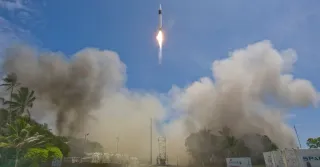
From around ten kilometres away in Kourou, the rumble arrives some thirty seconds after the image and it is genuinely loud. From an official viewing site around 5 km away, it arrives after fifteen seconds and it is physical: you feel it in your chest and through the ground.
For a child, that sensation can be wonderful or terrifying — and it mostly comes down to preparation.
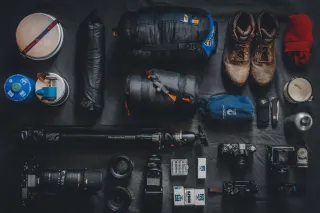
Bring ear defenders if you are at a close site. It is the one piece of kit that is genuinely specific to this outing.
Explain the delay beforehand: “we’ll see it first, hear it afterwards, and it’s going to be loud”. A forewarned child reacts completely differently.
Two scenarios are likely, and it is better to anticipate them.
The child gives up before the launch. If you are at a public spot, you can take a break, walk around, come back. That is a strong argument in favour of public spots with young children — see watching a launch for free in Kourou.
The launch is postponed. It happens often, and it is the hardest disappointment to manage with children. Prepare them for the possibility before you set off: “maybe the rocket won’t go up tonight, and we’ll come back”. And have a fallback activity ready — see your launch has been postponed: what to do with your stay.
From Cayenne, a gentler option
If you are staying in the Cayenne area and the launch is at night, staying put is a very reasonable family choice: you avoid two hours of driving and the crowds, your child can have dinner and get ready calmly at home, and you head out ten minutes beforehand onto Montjoly beach. The show is real, just without the sound. See can you see a launch from Cayenne.
Organising the family trip
Two rules that count double with children: arrive at least two days ahead — after an 8.5-hour flight and 5 to 6 hours of time difference, they are even more out of sync than you are — and do not book the return flight for the day after the launch.
At Hostel Toucan, our properties in Kourou, Cayenne, Rémire-Montjoly and Matoury are designed for families: a whole apartment rather than a hotel room, a fitted kitchen so you can eat on the children’s schedule, well-maintained air conditioning for sleeping, and space for everyone to breathe. Direct booking with no platform fees, free cancellation up to 7 days before arrival, tapering rates if you extend after a postponement, and WhatsApp support 7 days a week.
Do you own a property in Kourou? Our property management service captures the demand generated by launch nights.
In summary
A launch is prepared through the wait, not through the lift-off. Count on three to five hours on site: bring something to occupy them, a snack before the peak, a chair, repellent and water. Lean towards a daytime launch for under-7s and a night launch beyond that, and favour a public spot you can leave at any moment over an official site where you are stuck. Warn them about the noise that arrives after the image — ear defenders if you are close — and above all, prepare them for a possible postponement.
FAQ
From what age should you take a child to see a launch?
From around 5, provided the wait is prepared for: that is the age at which the lift-off leaves a lasting mark. Under 4-5, the three to five hours of waiting and the noise make it hard going; if you go anyway, choose a public spot you can leave at any moment. From 10 upwards, the technical interest starts to kick in and a prior visit to the Space Centre or the Space Museum changes everything.
Is the noise of a lift-off dangerous for a child?
From around ten kilometres away in Kourou, the rumble is loud but harmless. From an official viewing site around 5 km away, it is physically felt: ear defenders are recommended for young children. In every case, warn them beforehand that the sound will arrive after the image — some thirty seconds in Kourou, around fifteen at a close site: a forewarned child reacts entirely differently.
Is a day or a night launch better with children?
Daytime for under-7s: no disrupted bedtime, easy navigation, a journey home in daylight, even if the wait happens in the sun and calls for a cap, sunscreen and shade. Night-time beyond that, if your child copes with a late bedtime: the show is considerably more impressive and works even from Cayenne. Remember that night falls around 6.30pm all year round in French Guiana.
How do you handle the disappointment if the launch is postponed?
By preparing them before you set off: say clearly that the rocket may not go up that day, and that it is not a problem. Postponements are frequent and usually come down to the weather or high-altitude winds. Have a fallback activity ready — Îles du Salut, Montagne des Singes, the Space Museum — and favour a week-long stay, which lets you try again a few days later.
Nous utilisons des cookies de mesure d'audience et de publicité pour améliorer votre expérience
et nos campagnes. Vous pouvez accepter ou refuser. Voir notre
politique de confidentialité.